Pulses a useful crop for 2017 despite poor yields in 2016
Peas and beans have an important place as a break crop in the arable rotation and as a contributor to gross margins, despite mixed grower experiences over the past two years.
Pulse yields and quality were significantly down in 2016, but traders point to the big opportunities for beans and large blue peas for human consumption for this year.
According to Franek Smith of Dunns and vice-president of the British Edible Pulses Association (BEPA), the pea area has increased by 55% over the past two years, but three-quarters of that additional area was taken up by marrowfats.
“As a result, there is now a need for more large blues to go into Europe and there are some lucrative contracts out there, with £40-50/t premiums,” he reports.
See also: Peas dominate new additions to pulse variety list
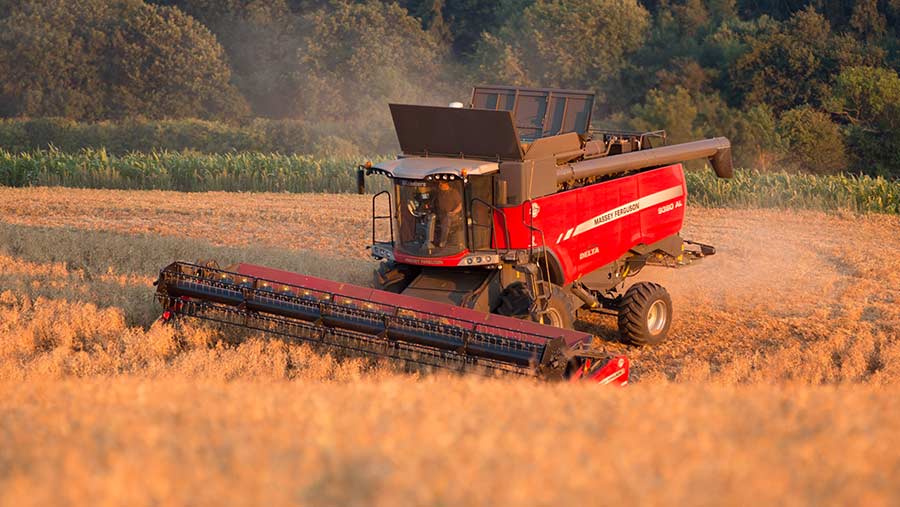
© Tim Scrivener
In contrast, the production of marrowfats exceeded demand, despite only three countries growing them – the UK, Canada and New Zealand.
Mr Smith’s advice to growers intending to plant marrowfat peas in 2017 is to secure a contract as soon as possible.
Spring beans
The total UK bean area was 179,000ha in 2016, up 5% on the previous year, producing some 250,000t of winter beans and 350,000t of spring beans.
Poor yields and quality have put pressure on supplies, as some 70% of spring beans and 80% of winter beans were unsuitable for human consumption, while yields were 0.5t/ha down.
Stem nematode and bruchid beetle damage were responsible for the very high level of quality rejection, which was twice that of previous years.
“Our exports to Egypt are down, being half of what they usually are at this stage of the year. There is more competition from the Baltics this year, but the pound is cheaper,” says Mr Smith.
Fortunately, UK animal feed compounders are in the market, as domestic beans are cheaper than soya and are GM-free.
Improving yields
There is plenty of scope to improve the yields of spring pulse crops, with experts at a recent Agri-Tech East conference suggesting that a rethink on how peas and beans are managed is required if their potential is to be achieved.
As Ian Smillie of crop consultancy Adas says, the gap between farm and research yields is narrowing, with the best farms now seeing yield improvements.
“Peas have a potential yield of 12t/ha. If we can get crops to capture as much light and water as possible, and keep them protected, we will be well on our way,” he adds.
For this to happen, canopy duration needs to be maximised, so early canopy closure and late canopy senescence are desirable characteristics, while better root development and increased nodulation may be required.
“We need to look at factors such as whether we’ve got the varieties suitable for early drilling and if fleecing has a role. Perhaps winter peas would suit this model better,” says Dr Smillie.
Getting roots down to 1.5m to extract water brings soil management into play, while pest and disease resistance will also be important as the use of some pesticides is being restricted.
Case study: Beans in Oxfordshire

Julian Gold © AHDB
Spring beans are making a comeback at the Hendred Farm Partnership, the AHDB’s Wantage Monitor Farm, with some 100ha planned for 2017.
Farm manager Julian Gold explains that harvest logistics played a big part in his reluctant decision to switch from the winter to the spring crop, even though he had previously vowed not to grow spring beans again.
“Like many other growers, we have suffered with yield variability with spring beans in the past. On this farm, they can’t be relied upon to yield well every year,” he says.
His five-year spring bean yield average is 3.41t/ha, so the 2016 result of 4.5t/ha was very pleasing and was higher than the 3.8t/ha he achieved with winter beans.
“But there have been other years where they haven’t performed at all. In 2014, for example, we managed only 1.85t/ha,” he says.
Despite this mixed bag of results, bringing more spring barley into the rotation in order to defeat blackgrass has forced Mr Gold to rethink his harvesting operation.
“I need a bean crop that I can harvest easily and won’t hold us up at a busy time. Spring beans offer that and are much easier to direct-drill into afterwards,” he says.
However, the very kind 2016 autumn tempted him to drill some winter beans after all.
“I also drilled a trial area of spring beans at 35 seeds/sq m in the autumn, to see how they cope with the conditions,” he adds.
In most years, these autumn-drilled spring beans will out-yield winter beans when drilled at the same time, with the only problem being if there is a very hard winter.
Case study: Peas in Yorkshire

Guy Shelby © Jim Varney
Blue peas have provided a useful alternative to vining peas as part of East Yorkshire grower Guy Shelby’s battle against blackgrass, and have fitted well into his one-in-six-year rotation.
He grew 16ha of the variety Daytona for the first time in 2016 on a buy-back contract with Glencore to complement his existing vining peas. The crop is followed by wheat in his rotation, which also includes spring barley, oilseed rape, and beans.
Peas are the only crop established after the plough at Benningholme Grange, Skirlaugh, north of Hull, giving Mr Shelby the opportunity to bury blackgrass seed and establish a loose, friable seed-bed which suits the fussy crop.
With a late-drilling date ranging from April to early May, there is plenty of time to use glyphosate to kill off a spring flush of blackgrass, he adds.
The seed-bed may need a pass with a spring tine cultivator, but often it will be possible to get straight on with the drill. Sowing requires the soil to be warm with a rising temperature, with the crop established this year on 9 May.
Herbicides Lingo (clomazone+linuron) and Stomp Aqua (pendimethalin) were applied at pre-emergence for further grassweed and broad-leaved weed control.
He always rolls after the drill to bury stones as this will be a great benefit to the combine driver if the crop goes down.
Variable costs came to about £345/ha, including seed, phosphate, potash, micronutrients, herbicides and desiccation.
Mr Shelby says the short growing season with peas gives an additional benefit for weed control as it will sometimes be possible to go through with glyphosate for desiccation before all the blackgrass seeds have matured.
This year’s crop was particularly large, growing to over four feet in some places, and although it went down, it wasn’t “nailed to the floor,” and was easily harvested and yielded an impressive 5t/ha.
The crop made the top specification for quality, and Mr Shelby says that blackgrass seed return was greatly reduced. With harvesting starting at the end of August, there is time to spray off any blackgrass flushes ahead of a following winter wheat crop.

Staying sharp shouldn't be a chore