

Advertiser content
Top tips for building a late blight programme in 2026
With the emergence of new resistant late blight strains and the loss of mancozeb, it was inevitable that fungicide programmes in 2026 would be different from previous years.
The mild winter has enabled volunteer potato plants to survive, and a weak market has pushed more crops into dumps, creating ideal conditions for inoculum survival and growth. Weather conditions have continued to favour disease development into spring, exacerbating the challenge ahead.
With the pressure growing, we catch up with Graham Tomalin from VCS Potatoes to get his top tips for the 2026 season.
VCS Potatoes is leading independent agronomy consultancy which specialises in potato production and trials. Based in East Suffolk, Graham works across the East Anglia region and is responsible for tens of thousands of acres.
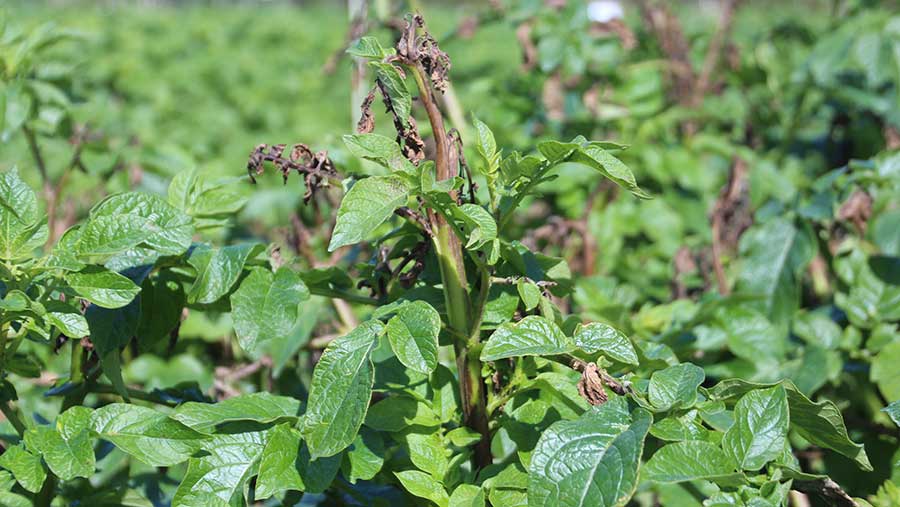
© BASF
New blight strains present a new challenge
“The challenge for the season ahead is quantifying the risk of the new late blight strains,” he says.
“Although we will design programmes to take into account their likely presence, knowing when and where the new strains are likely to occur will be vital. We’ll be using the information from the James Hutton Institutes’ Fight Against Blight (FAB) project to inform our decision making.”
Both EU43 and EU46 have specific resistances to commonly used fungicides. EU46 was found in the West Midlands and Wales throughout last season, and while there was only one outbreak of EU43 late last year in East Anglia, concern is growing.
“Given that there are strains within strains, the resistance picture is rather complex but generally speaking, the EU43 found in the UK and Ireland is predominantly resistant to CAAs, and the EU46 within the UK is resistant to OSBPIs.”
“It’s no longer possible to build a programme without including products with known resistance,” says BASF Business Development Manager, Paul Goddard.
“To do that you need to place them carefully, using them at times when their control will be optimised and protected by the chemistry around them.
“Judicious use of Privest will be essential. It offers a true ‘firebreak’ within programmes, something that is becoming increasingly important as new resistant strains develop.”
Mancozeb will be missed
The final use-up period for mancozeb ended on the 30th November 2025, meaning that growers are approaching the 2026 season with a reduced toolkit.
“The loss of mancozeb will be felt this year,” acknowledges Graham.
“Its value was in its multisite activity, its broad-spectrum control and the lack of resistance. The difficulty in the future will come if we get active blight early in a crop’s development, and conditions remain conductive to the disease’s development throughout the season.
Complying with the FRAC guidelines while effectively controlling the blight will be very difficult in this situation.”
Paul agrees adding: “It was also a good product for protecting crops against Alternaria and protecting other chemistry. As a result, there will be more pressure on the other actives in the programmes.”
“Whilst there is no direct replacement for mancozeb currently, thanks to a strong pipeline from BASF, growers do have some options.”
Right product, right place
One well established aspect of Graham’s programmes is the positioning of products based on their mode of action.
“From application two through to four, it is very important to use a systemic product that moves with the plant and protects the new growth.
“Protectant products are well suited to the stable canopy phase but if you’re finding outbreaks within a crop, or there are some in the local area, you should include a curative as well.”
“Privest is the best product to protect new growth during rapid canopy development because it is truly systemic,” adds Paul.
“It is the only product to have activity against all genotypes of phytophthora. Its activity can extend into the start of stable canopy – while the plant is still growing, Privest’s mode of action will help keep it resilient to disease.
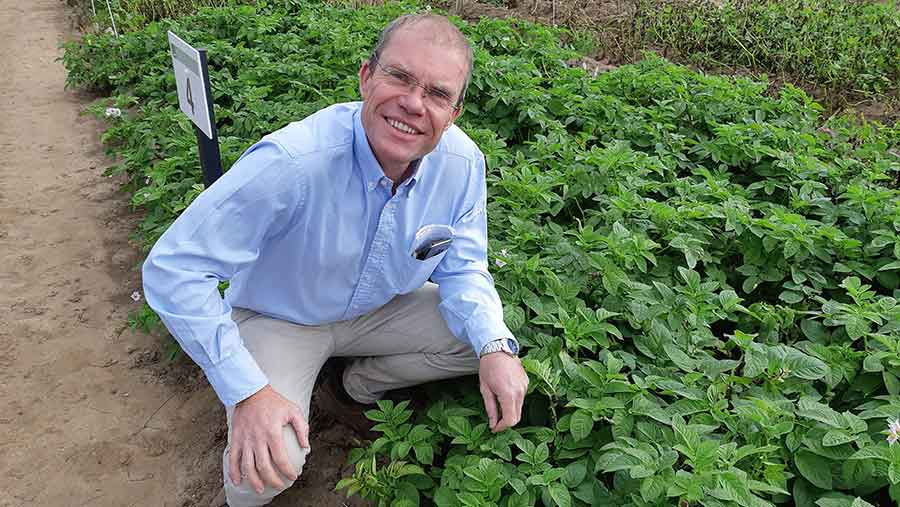
Paul Goddard © BASF
“The advantage is that it moves completely within the plant, ensuring all green area is protected. Locally systemic products, like Infinito, have some mobility but it is not as good as that from a truly systemic product.”
With its tuber blight protection, Paul sees Infinito as a product that suits a later slot in the programme.
“Here, it is a useful alternative to the QiIs,” he says.
Graham final advice is to pay attention to the details.
“When applying fungicides ensure you cover the whole field, paying particular attention around poles and at the headlands.
Use the right nozzles for the product and the conditions as coverage is important, particularly for less systemic actives.
Avoid situations where runoff from the leaf is likely such as when the leaf is damp before applications.”
Provided by
BASF offers renowned and innovative fungicides, herbicides, insecticides and growth regulators for agriculture. Our products and services help farmers increase their yields and optimize the quality of their products.