

Advertiser content
Helping farmers diversify with BNG – an adviser’s view
Having worked in rural surveying and estate management, Principal Land Manager Will Witchell brought a great deal of knowledge and experience with him when he joined Environment Bank in early 2025.
Since then, Will has been instrumental in developing Environment Bank’s landowner relationships, helping farmers diversify through Biodiversity Net Gain (BNG) and pushing the envelope of what can be achieved through BNG Habitat Banks.
Here, Will provides his insight on the evolution of land ownership and agriculture in England and reflects on how growing up on a family farm gave him a passion for habitat protection and inspired his career journey.
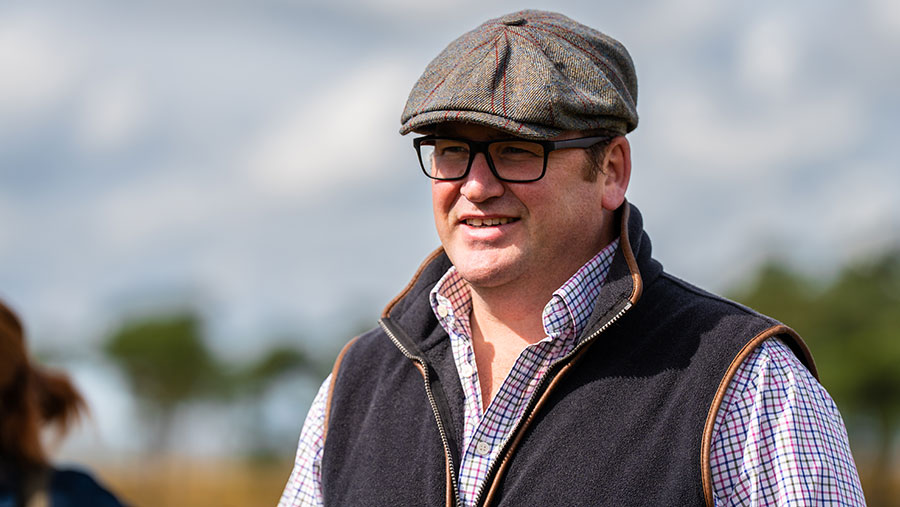
Principal Land Manager, Will Witchell © Environment Bank
What big challenges do you see currently facing farmers in England?
Currently, I’d say it’s the uncertainty. The fact that the government can end existing schemes at such short notice is raising questions about what’s around the corner.
The other big one is Inheritance Tax (IHT) which has been so prominent in the headlines.
Family-owned farms are feeling less secure about land passing between generations and there’s the possibility that they might have to sell part of their land – the bedrock of their business – to cover the bills if one of the owners passes away.
Thankfully, the Government raised the threshold due to the pressure the changes created but it is still a big issue when considering the future of a farming enterprise.
There’s also the rising cost of resources. After the invasion of Ukraine in 2022, fertiliser costs tripled overnight and similar dramatic rises are still having a big impact.
Fuel costs are going up, and the margins aren’t significant enough to guarantee a profit, especially with the loss of subsidies.
All this adds up to a landscape where sustainable farming seems far less viable which is why a growing number of landowners are looking to diversify and find other sources of income, and that’s hopefully where we come in.
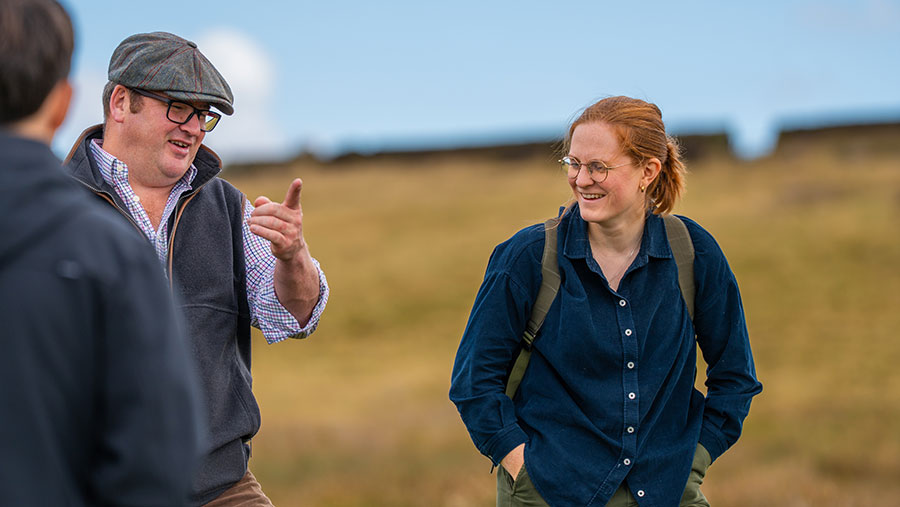
© Environment Bank
Why is BNG becoming such a popular option for farmers and landowners?
Diversifying through something like BNG ensures all your eggs aren’t in one basket.
Farmers can lock up a significant portion of land for 30 years and receive a guaranteed income… and it’s regenerative, so the net quality of the land on which they’re farming will improve in that time.
People are beginning to recognise the importance of soil quality in ensuring good crop yields, so if you can invest in something which enhances that while also providing a long-term income, that’s a huge win.
Farmers are essentially custodians of the landscape, so they have to look far into the future when they’re planning.
When they plant something, they’re thinking about how this will impact the generations ahead of them.
So, if you say to a farmer that a parcel of their land can continue to generate revenue for 30 years while also creating something meaningful to pass on to the next generation, that’s very appealing.
What kind of feedback do you get from farmers and landowner partners?
Our partners really appreciate the certainty we can give them. Being able to de-risk their business and see where their money is coming from is vital.
For some, the opportunity to try different types of farming and re-evaluate their stock output also holds some appeal.
If you have money coming in from BNG, you can potentially scale back the amount of produce you need to sell, so it gives you the chance to make some changes.
Livestock can also play a role in nature restoration and landowners like this because it means they can introduce animals which they perhaps haven’t been able to accommodate previously and do so with the confidence that it will help the land rather than damage it.
All of this means that they can create something more mixed, akin to the kind of farms that existed in the early 20th century.
Working with us, they get to achieve a two-level effect – a hard and fast de-risking of their business and an opportunity to return to traditional farming practices.
What do you find most rewarding about your role?
I love seeing the actual change happening to the land in real time. That was a big part of why I got into land management.
You plant a tree today and then get to see it grow and support wildlife for the next 30 years. No matter where I might be by then, I can still drive that route or walk that field and see how things have changed for the better.
I also enjoy the duality of it – making the land work for the landowners while also supporting our biodiversity mission at Environment Bank, really marrying up the benefits for farmers and for nature.
It’s great to travel around and see parts of the country I’m less familiar with and Environment Bank’s team is so diverse and special, that getting to know everyone as we continue to grow has been such a good experience.
How did you first become interested in farming and land management?
I was raised on a family farm in the Cotswolds. My father, uncle, and brother are all land agents, and we all grew up spending most of our time outside, either working the farm or exploring the landscape.
Our farm was originally a dairy farm until we switched to red deer in 1989, which was very formative for me.
I spent 30 years in the Cotswolds looking after the deer and organic farming, while also working on conventional arable farms alongside.
Having seen and developed an interest in the environmentally friendly aspects of the work, I transitioned into estate management, working in Northern Ireland, then County Durham and Northumberland before joining the incredible team at Environment Bank.
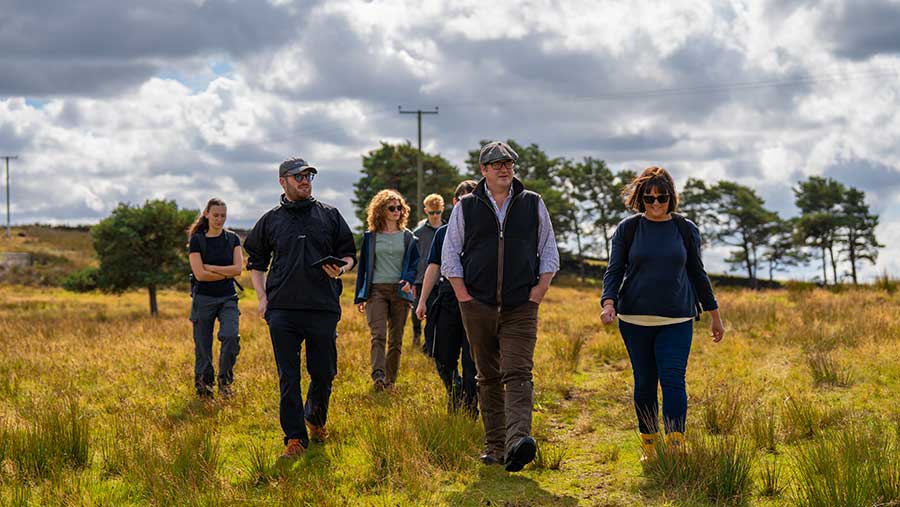
© Environment Bank
What would you say to anyone considering BNG for their land?
It’s really important for us that, from the earliest conversations we have with landowners, it’s not just a business discussion, it’s a personal and emotive one recognising any deep connection their family may have to the land.
BNG is not for the faint of heart because nobody can really be sure where they’ll be in 30 years and, with such long a timeframe, you have to guarantee that everyone is all-in.
We also always make sure to emphasise that the security is important, but it can’t offer the same quick windfall that a land sale might.
But once we’ve navigated those two key points, the fundamental thing we can emphasise is that, by choosing to work with us, they still get to own the land and have a say in exactly how it develops and changes.
The real reward comes from creating that partnership and seeing the land change from below ground upwards.
So, if they have the chance to take a step back and really consider how BNG is going to work for them in the long term, coupled with the lack of risk, it can start to make a lot of sense as a diversification option.
What types of landowners can get involved with BNG?
There’s an interesting cross-section of people who could benefit from diversifying through BNG, covering pretty much anyone who owns land.
You have traditional farmers, who account for most of our Habitat Banks, as well as large scale farming operations and rural estates.
Younger people who want to approach farming in new ways, and people who own the land but live elsewhere and want to keep it as an investment that they can reliably draw from over time, can also benefit.
One of our strengths is that we can approach any of those people and offer something that suits their unique needs. BNG is becoming more attractive to investors as time goes by, once again because it can offer that guaranteed annual income.
Developers can also get involved in BNG as well. For instance, if they own land that has high flood risk, which makes it unsuitable for housebuilding, this offers a perfect opportunity for BNG, giving them another way to generate value from the land.
Similarly, councils in England own a lot of land that they might not necessarily have the resources to do anything with by themselves, so we can provide the expertise and support they need to enhance their local habitats, generate a long term income, and create Biodiversity Units to support local development.
Ultimately, we encourage anyone who owns land to come and talk to us!
The list of reasons why we might not be able to help is very short, and there’s nothing to lose (and everything to gain) from having that introductory conversation.
© Environment Bank
How does BNG compare to other diversification options?
It’s far more flexible than a lot of other environmental schemes.
Our habitat management plan is a living document so we can tweak and adapt it together depending on the needs and interests of the landowners so long as the habitats are meeting the required condition for BNG.
They might want to use more machinery, introduce (or reduce) livestock, or even get their family more involved.
We can work to a wide range of different wants and needs. In so doing, we can build a relationship with the landowner and really create something that speaks to their goals and values.
I’d hesitate to liken BNG to a marriage, but there are definitely parallels! You get out what you put in, and it matures over time.
Ultimately, you’re leaving the land better than you found it and learning a great deal along the way.
What sets apart Environment Bank’s model from others?
The funding is the big one. We fund everything required to set up the BNG Habitat Bank so that the landowner doesn’t need to dip into their own pockets.
The capital cost for setting up these habitats is big, so being able to circumvent that is a significant differentiator.
We also remove all of the pressure relating to the process of legally registering the land for BNG, marketing the Biodiversity Units, and managing sales with developer clients.
We can ensure that they have the appropriate types and number of Biodiversity Units on the national gain sites register to meet sales quotas, we assume all of that responsibility.
Moreover, if the local market booms and our sales team are able to increase the sales margins, our landowners get to see an even greater return on investment through our revenue share offering, so their success mirrors ours.
With us looking after the volume and variety of Biodiversity Units, and the landowner directly benefiting from further growth in the market, we can offer something that is secure and has a wealth of upside.
The other element is expertise. We have an amazing in-house team of ecologists, and our surveying is first-class.
We have the science to back everything up, and we won’t do anything that we haven’t properly assessed against our reputation and the way we’re using our capital.
That kind of fastidiousness goes a long way; it’s not a finger in the air. It all comes down to using that expertise to build trust, and that’s why landowners feel safe with us.
Find out what your BNG Habitat Bank options are.
Provided by
Environment Bank is leasing parcels of land to create biodiverse habitats that will play a key role in restoring ecosystems while also providing a secure, long-term income for farmers and landowners though Biodiversity Net Gain (BNG).