

Transition Farmer: 51ha council holding offers route into ag
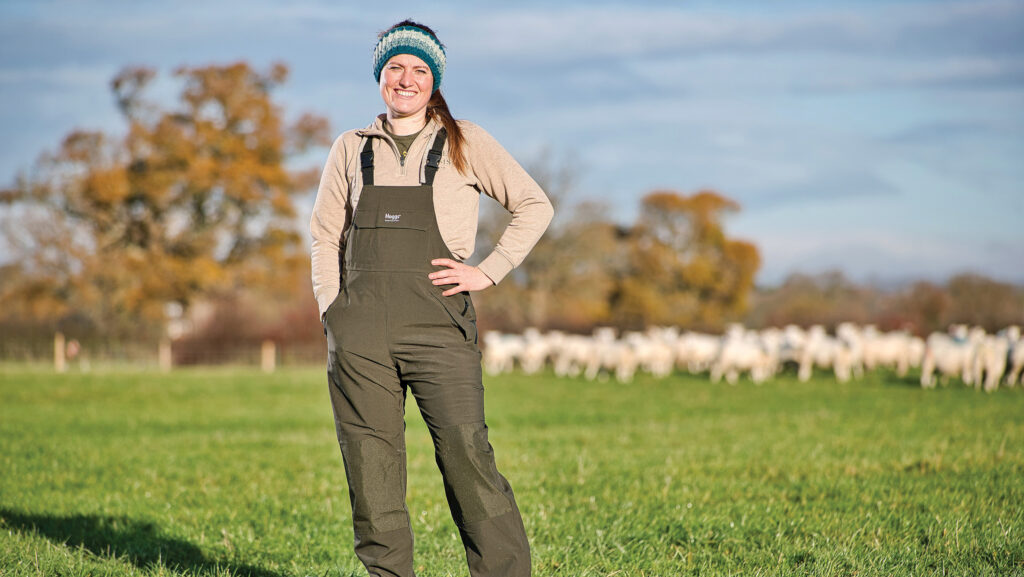 Lucy Eyre © Richard Stanton
 After a hard-fought route into agriculture and now farming a 51ha council-owned holding on the Welsh border, new entrant Lucy Eyre, who joins our roster of Transition Farmers this month, sees only opportunity in the system she is developing.
Some of this she attributes to farming according to regenerative principles, avoiding pushing land and stock to the limit of their possibilities.
“When I first started farming I was driven by the ethos that to be profitable you need the stock numbers, which does work well for a lot of farmers.
“But to facilitate that you are reliant on a lot of external inputs like fertiliser and wormers.”
See also: Managing regenerative farming: Options for support and advice
Lucy Eyre
Farm facts
Wern Holding, Welshpool
- Farm size: 51ha
- Livestock: Lleyn sheep, British White cross Hereford cattle, pigs
- Soil: Clay/clay loam
- Rainfall: 1,600mm
“Pushing the boundaries of how the land can perform often doesn’t help profitability – I am learning that it is better to pull back on stocking density and let the ground do more of the work for me,” she says.
As is frequently the case for new entrants, Lucy’s path into farming didn’t follow a straight line; as she puts it, it resulted from “happy accidents and a series of unfortunate events”.
Despite having no family connection to agriculture, as a child she was fixated on becoming a farmer.
Veterinary medicine offered an alternative means of working with livestock so that’s what she did, getting a job at a “James Herriott-style” practice in rural Yorkshire after graduating before relocating to Scotland.
The farmhouse Lucy rented had a small parcel of land so she acquired a handful of pet lambs to bottle rear, growing her flock of pedigree Lleyns each time more land became available, adding dairy bull calves to her burgeoning enterprise and buying 13 acres with an agricultural shed in situ.
“At one point I had nearly 20 landlords, some with an acre or two here and there,” she says.
Over four years, Lucy built up ewe numbers to 500 while continuing to work full-time as a vet, to generate cashflow to grow her fledgling business.
When she unexpectedly and abruptly lost a big chunk of that land it was time to put into action her plan to apply for a farm tenancy.
Wales presented that opportunity, specifically Wern Holding, a 51ha Powys County Council-owned former dairy farm at Wern, near Welshpool.
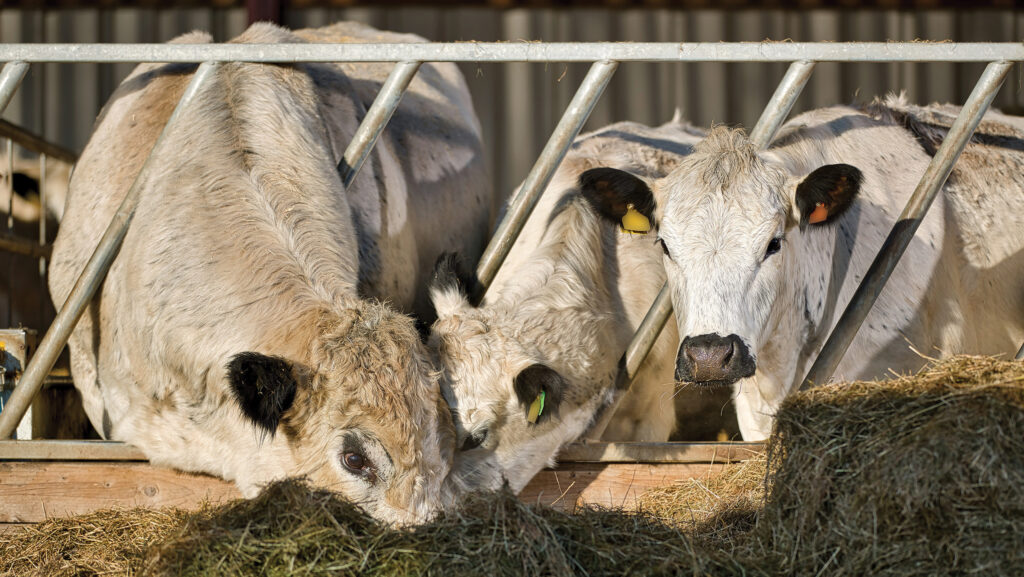
Lucy Eyre’s British White cross Hereford cattle © Richard Stanton
That was 2020, and Lucy has since upped beef numbers and downsized the flock, running 33 British White and Hereford-cross cattle and 90 ewes, while shaping a system that puts the soil and other natural assets front, and centre.
“Essentially I am trying to manage the soil and allowing that to manage everything else,” she explains.
Mob-grazing benefits
Cattle are mob-grazed with daily moves and, after recently taking delivery of a new set of electric fencing, it’s an approach that will be rolled out for sheep in 2026.
“The difference it has made to the soil is unreal,” Lucy reports.
This was particularly apparent during 2025’s prolonged dry period.
“When we were all staring down the barrel of pretty dry weather, I made the decision to let the grass in a couple of fields grow as long as I could before grazing.
“And just by testing it with my hands I could see how moist the soil was in those, there were no cracks.
“On that very basic metric, the difference was huge in the areas I let grow long.”
Hedgerows are similarly managed with a shift away from annual flailing.
“I am letting them grow a bit, laying some and replanting where ancient hedges once grew.
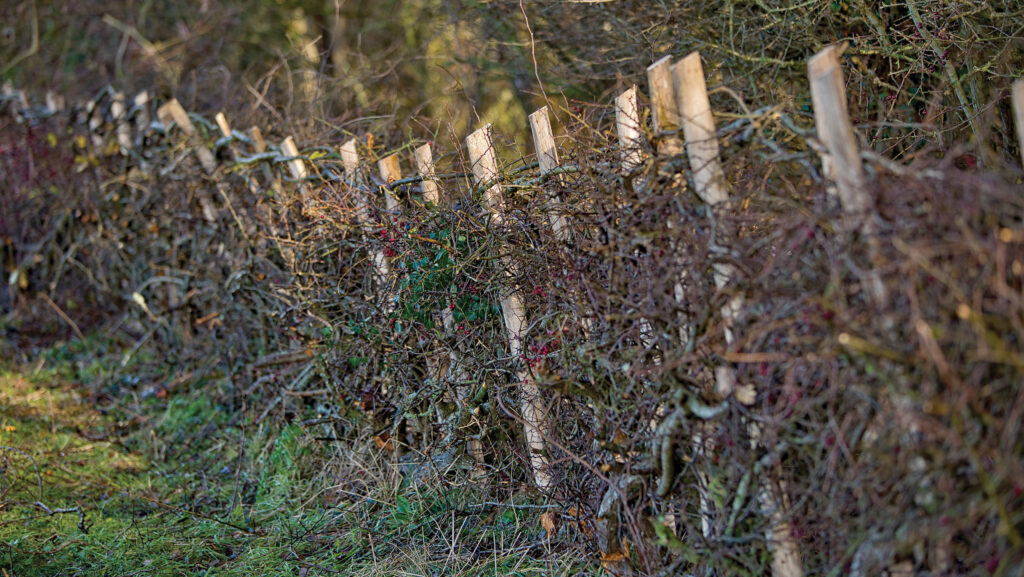
A move away from annual hedgerow flailing is benefiting wildlife, and soil health © Richard Stanton
“It is about changing the narrative and the perspective, looking at the farm as a landscape and then working out how I can farm it to its most beneficial and how it can benefit the livestock as well.
“All the natural capital is there, I just have to work out how best to use it.”
Lucy, who is a member of the Nature Friendly Farming Network, firmly believes that farming this way also has a mental health advantage, as it allows her to focus on things that are within her control, and on which she can have an effect.
“Farmers can spend a lot of their time feeling that they are controlled by external pressures like fertiliser prices, market prices, what the government are doing next.
“But when you are farming regeneratively and sustainably managing your business, you are instead concentrating on how you can make your soil and farm better, how you can improve your hedgerows.
“You can then set goals and that helps with the feeling of achievement and not having that sense of helplessness while at the mercy of external pressures.”
Taking a harsh approach to culling in the 10 years since she acquired her first Lleyns has resulted in a high-performing flock.
“It’s a pretty robust flock. They are good mothers, nice and milky with a decent frame, but not huge.
“I want sheep that work for me. I only pulled one lamb last year – as soon as I need to do that, the ewe gets a red mark on her back.
“That has paid serious dividends because I now have great granddaughters and onwards – sheep that work really well in my system.”
Performance recording generates data to inform decisions on the best animals to retain.
Direct selling
During those early years of farming in Scotland, Lucy sold directly to customers, using local abattoirs and establishing a boxed meat business, but the move to Wales brought this to an abrupt end.
What had been a relatively simple system in Scotland with supportive environmental health officers and a network of local abattoirs has not been replicated for her in Wales.
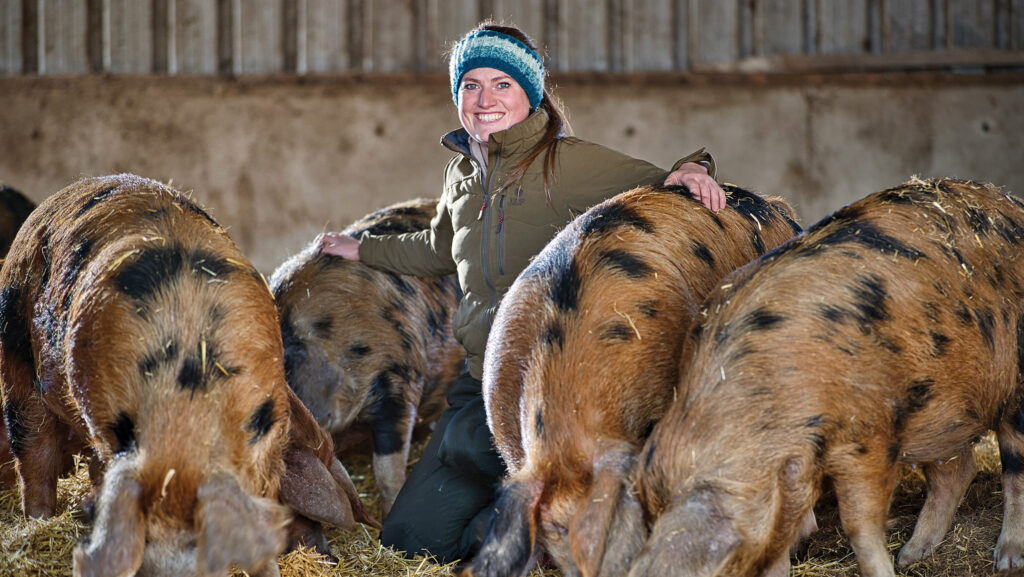
Lucy with her pigs © Richard Stanton
“The abattoirs are really over-stretched. I’ve spent four or five hours waiting to offload.
“And when that abattoir is already an hour and 20-minute drive away from the farm, you are spending the best part of a day dropping off animals.
“And you then have to return to pick up the meat in a week’s time and distribute to customers.
Direct selling isn’t an option she has completely shelved though.
“It’s something I really want to get back into doing, I’m re-evaluating it and have a couple of ideas in the background.”
As Lucy reflects on her decade in farming, she admits she is her own worst critic.
“It’s a constant learning curve. If I was to go back five years there are so many things, on reflection, that I would change.
“For me, it can be a job to get away from that feeling that I need to be doing the right thing all of the time.
“I have had to learn to be kinder to myself, to not expect everything to be in place.
“Mentally, it is a really good way of getting around all those rabbit holes I find myself getting stuck in.”
Transition goals
- Strike the right balance of livestock numbers for the farm
- Reduce inputs and maximise the use of grass to farm in harmony with nature
- Re-establish direct meat sales to customers
Explore more / Transition
During the series we follow our group of 16 Transition Farmers through the challenges and opportunities as they seek to improve their farm businesses.
Transition is an independent editorial initiative supported by our UK-wide network of partners, who have made it possible to bring you this series.
Visit the Transition content hub to find out more.
