

How low-input farming can protect profits as costs rise
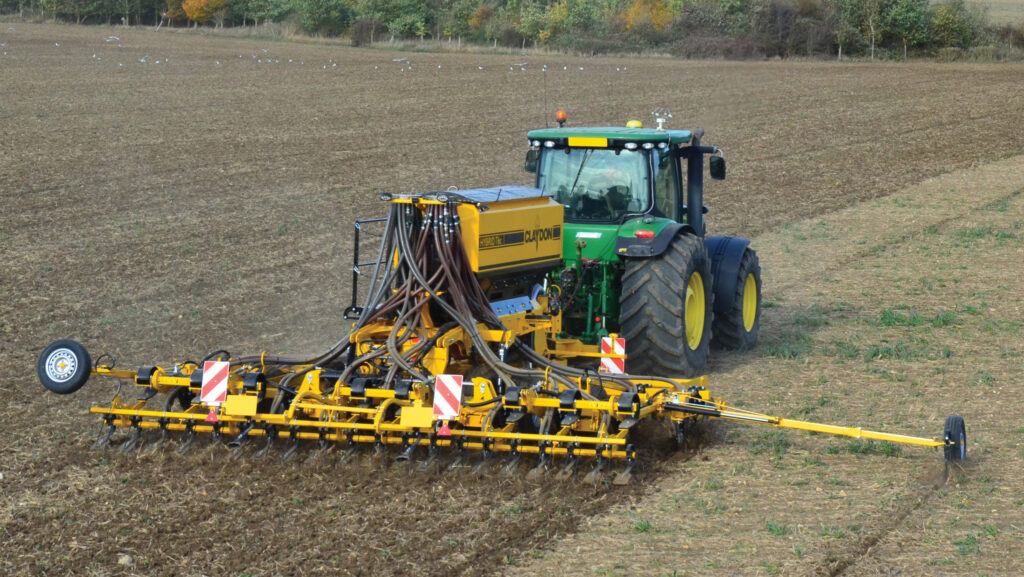 Claydon Hybrid T6c drilling into stubble © Claydon
 Events in the Middle East have seen fertiliser and fuel prices skyrocket, renewing interest in farming systems that are less dependent on artificial inputs and not so exposed when global turmoil cause market prices to shift.
Moving away from high-input production methods towards a model that prioritises soil health, biodiversity and long-term business sustainability, with its associated cost structure changes, is working well on many farms.
The aim is for nature and farming to work together, for the benefit of wider society, while also ensuring a profitable future for the farm – even without government support.
“Farmers have a responsibility to manage the landscape without abusing nature,” believes Chris Clark of Nethergill Associates.
He says there is a sweet spot for every farm where profitability is at its highest and nature is at its optimum. “We call it farming at maximum sustainable output [MSO],” he explains.
“Beyond that point, artificial substitutes or inputs have to be used to drive output.
“And that increases the farm’s reliance on industrial energy, which is proving to be a problem at the moment.”
Hitting the sweet spot
To get to this sweet spot, farmers need to sub-divide their variable costs into productive variable costs and corrective variable costs, he believes.
Productive variable costs are those that work with nature, such as home-grown feeds, bedding and manures, while corrective variable costs are those based on industrial energy, such as artificial fertiliser.
“The aim is to mobilise the free-issue resources, such as sunlight, as much as possible, so that you aren’t having to push yield beyond what the land is capable of.”
Using large quantities of fossil fuels, artificial fertilisers and bagged animal feed will only add pressure to profit margins that are already very tight at a volatile and uncertain time on the world political stage, he warns.
“We’re currently seeing rising energy and fuel costs caused by the Gulf conflict, as well as disruption to supplies.
“That really emphasises how unsustainable it is going to be to maximise production in this way.”
A report called Farming at the Sweet Spot, published by the Nature Friendly Farming Network (NFFN) and The Wildlife Trusts, shows up to a 45% increase in commercial return where nature-friendly farming methods are being used.
Taken from 165 farm business accounts, the highest return was achieved by lowland livestock farms (45.3%) and the lowest by lowland arable units (9.5%).
Making the numbers work
At Neidpath Farms, Peebles, in the Scottish Borders, the focus for farm manager Matt Griffin has been on building a farming system that works with nature while being financially resilient.
Matt is an NFFN member and he has moved away from high-input methods to create more opportunities and reduce the farm’s reliance on subsidies.
Changes introduced across the four farms covering 1,012ha since April 2021 include replacing Salers cattle with Angus and reducing six sheep breeds to Romneys and Romney crosses, while moving to an adaptive multi-paddock grazing system with long rest periods.
Fertiliser use has been halved each year, with fuel bills also coming down as the new bale grazing system made setting bales out pre-winter more efficient.
Vet bills have remained steady but more emphasis has been put on prevention.
Numbers are as follows:
- Concentrate animal feed – down 75%
- Fertiliser – down 100% (£40,000 to £0)
- Fuel – down 40%
- Stocking level – up 40%
- Cattle value – up 500% (£120,000 to £600,000).
Matt’s tips for those considering a similar transition are to be prepared for three years of disrupted cashflow, to monitor livestock condition carefully and to reduce stock numbers by 10-20% for the first two years.
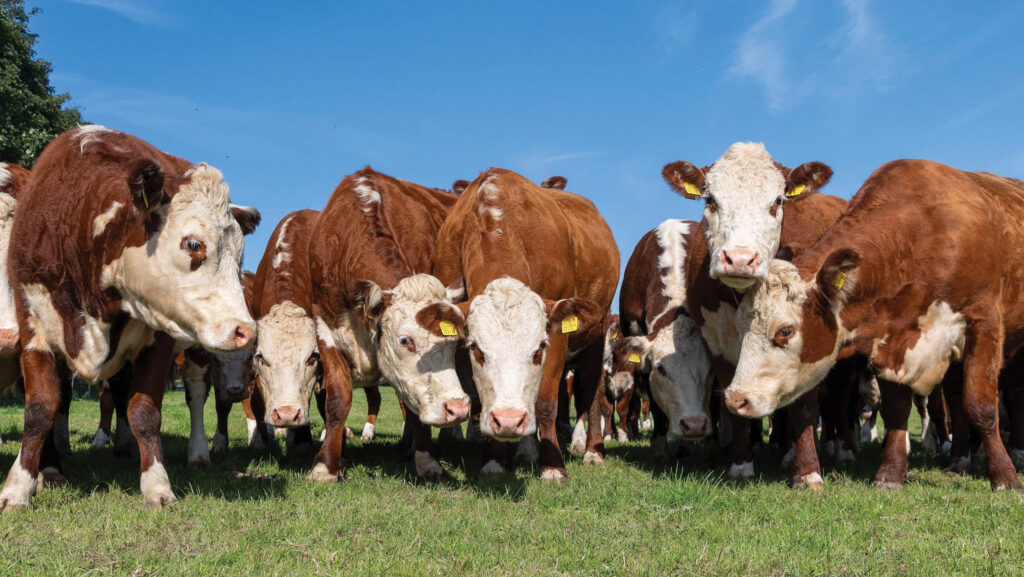
Mob-grazing cattle © Wayne Hutchinson/Alamy Stock Photo
The reduction is needed while set stocking is replaced with mob- or rotational grazing.
His final point is to use the best water and fencing infrastructure you can afford, even if it means doing the work in stages.
That is because the cost of replacing it is more than the savings made on the original purchase.
Case study: Homer Farming, Wiltshire
There was no “light-bulb moment” for Wiltshire farmer Geoff Homer when he decided to change the direction of the family farming business and concentrate on reducing inputs as much as possible.
As costs of production rose in both dairy and arable enterprises, Geoff realised that lining other people’s pockets was not going to secure the future of the business or create the sustainable farming model essential for taking it forward.
Instead of pushing for higher milk and grain yields, he put the focus on profit and margin.
That called for a different mindset and some step changes – getting more milk from grass, learning a lot about nitrogen, reducing overall reliance on artificial inputs and making soil health a priority.
Given recent headwinds and the financial pressures being felt by the farming sector, his timing couldn’t have been better.
With two tenanted farms and one contract farm agreement covering 1,100ha near Marlborough, Homer Farming does not own any land but does have machinery and cows, along with 13 full-time members of staff.
As such, the business structure means any profits have to be shared among two parties. “That concentrates the mind,” says Geoff.
“I enjoy farming in this way as it drives the thought processes and means we have to farm well. It also ties in with the signals that we are getting from the government.”
In the past four years, Homer Farming has slashed purchased inputs as far as it can.
With the help of an agronomist and a vet, both of whom are on board with his vision, profits are up, even at current commodity prices.
With three dairy herds plus youngstock across the three sites, the system has been changed by introducing different genetics and breeding, so that they can push grazing and the use of home-grown forage as much as possible.
“On the contract farm, we have also integrated the dairy with the arable side of the business, milling the crops on site so they can be fed to the cows,” says Geoff.
“Our bagged feeds bill is right down.”
In 2025, grazing took place for 11 months of the year.
The herds have moved to block calving, to help reduce workloads, bring costs down and get more production from grass.
Fertiliser has been a particular focus. As well as making better use of slurry and clovers, Geoff made the move to liquid fertiliser eight years ago for the greater precision and efficiency it offered.
He has taken that a stage further and now melts urea on-site, applying it as a foliar treatment through a Tow and Fert machine.
“With bagged nitrogen, you get 50-60% nitrogen use efficiency, and with liquid nitrogen it goes up to 70%,” he says.
“Foliar nitrogen takes that up to 90%, so applying just 9kg of N/ha is equivalent to 40kg of bagged nitrogen per hectare,” Geoff explains.
The Tow and Fert machine is also used across the arable area.
Based on last year’s figures, polymer urea was £2.20/litre and his home-made urea worked out at 70p/litre.
“It allows me to add a carbon source and other things to it too, so we can put in what is needed by the crops as we are going through them.”
While insecticide is not used across the arable area, Geoff continues to bring down fly repellent and wormer use in the cattle herd.
“We have positioned fly buckets around the dairies and observe the cattle closely. Just like people, some cattle attract more flies than others.”
Vet and medicine costs have fallen and he makes a habit of questioning every input that goes into the dairies.
Direct-drilling of arable crops started when Geoff had the opportunity to hire a John Deere 750a drill and give it a go.
He then realised the importance of keeping the soil covered and having diversity in the rotation, before taking the plunge and integrating livestock.
Reflecting the dairy success, input use has plummeted.
As nitrogen rates have come back, so has the need for fungicides, while using sheep to graze crops in winter and early spring has also contributed to fewer interventions.
“Last year, after grazing the wheat, there was no need for any plant growth regulators and we used just one fungicide for yellow rust at a cost of £9/ha. The dry weather helped, of course.”
Four years ago, Geoff started grazing winter barley with sheep, as it had an early net blotch outbreak.
“I knew that fungicides would not work so I had nothing to lose. It was successful, so we now graze wheat, barley and oilseed rape.”
Putting the sheep across crops removes the diseased leaves and takes away some biomass, he explains.
“It shocks the plant, which then reacts by putting its roots down and then regrowing.”
Grazing oilseed rape requires more caution, as it is important the sheep do not remove the growing point, he adds.
“We have not used any autumn or spring fungicide on the rapeseed crop for the past two years, except for a sclerotinia treatment, and flea beetle has not been an issue.”
An interest in soil biology has seen Geoff working with his agronomist Ben Arthur to brew microbial inoculants, which are then applied at drilling.
The idea is that they kick-start the soil biology and support healthy plant and root growth, eliminating the need for seed treatments and starter fertiliser.
His next step is to do more to exploit biology.
He has a compost turner on order and will be using manures to produce compost for use across the farm.
“We are also going to start growing four-way variety blends,” reveals Geoff.
“They should help with our mission to keep cutting inputs and reducing risk but maintaining yields.”
Homer Farming at a glance
Chisbury Lane Farm
- Home farm
- 140ha of medium to heavy clay loam
- Converted to autumn calving in 2013
- Moved from pedigree Holsteins pushing 11,000 litres to a 570kg cow producing 7,000 litres, 4.5% butterfat, 3.6% protein
- New heifer shed, parlour and farm entrance in 2019, plus lined lagoon expansion and extra cubicles
Warren Farm
- 220ha medium to heavy clay loam, originally contract farmed and became a farm business tenancy in 2016
- Milking 340 spring calvers, 6,000 litres, 4.8% butterfat, 3.7% protein
- New parlour, 5,000 railway sleepers, new water system and 113ha split into paddocks
- 80ha recently sold off – now two landlords
Waglands Farm
- Contract farming agreement started in 2022
- 600ha of medium clay loam with half the farm very flinty, 100ha for the dairy
- 300 autumn-calving cows producing 7,000 litres, 4.5% butterfat, 3.6% protein
- Crops include grass, maize, wheat, rye, spring barley, peas, oilseed rape and cover crops
The Milkyard
- Started January 2021 with on-site vending machine for pasteurised milk
- Moved on to making ice cream
- Currently selling 60 litres/day of milk, plus other local produce
- Plans to push ice cream production and produce yoghurt and butter
High-output systems: Are they all bad?
Common opinion on high-output farming systems suggests they are bad for the environment, incur extra input costs, increase risk and have higher carbon footprints.
That is not always the case, says Dr Christina Baxter of Adas, who questions whether minimising input costs is always the better way, especially in arable systems.
Her analysis of Yield Enhancement Network (YEN) data shows that higher yielding crops reduced greenhouse gas intensities by one-third on a per tonne of output basis.
In addition, these crops were more effective at capturing nitrogen from non-synthetic sources and had higher gross margins.
“High yields don’t necessarily mean high inputs,” she points out.
“Remember that yield dilutes variable costs and that there is a huge range of variable costs used on cereal crops, with the average being £450/ha.
“That means less than 3t/ha is needed to pay them.”
The more pertinent question for most arable farmers is how to make input reductions without compromising productivity, she adds.
This year, in particular, the current economic situation indicates that yield will be essential.
“It is about management rather than inputs.
“The other issue is land use – if output declines, we will need more land for food production, so we need to focus our efforts in the right places.”
Explore more / Transition
During the series we follow our group of 16 Transition Farmers through the challenges and opportunities as they seek to improve their farm businesses.
Transition is an independent editorial initiative supported by our UK-wide network of partners, who have made it possible to bring you this series.
Visit the Transition content hub to find out more.
