

How to manage farm data to improve profitability
 © Tim Scrivener
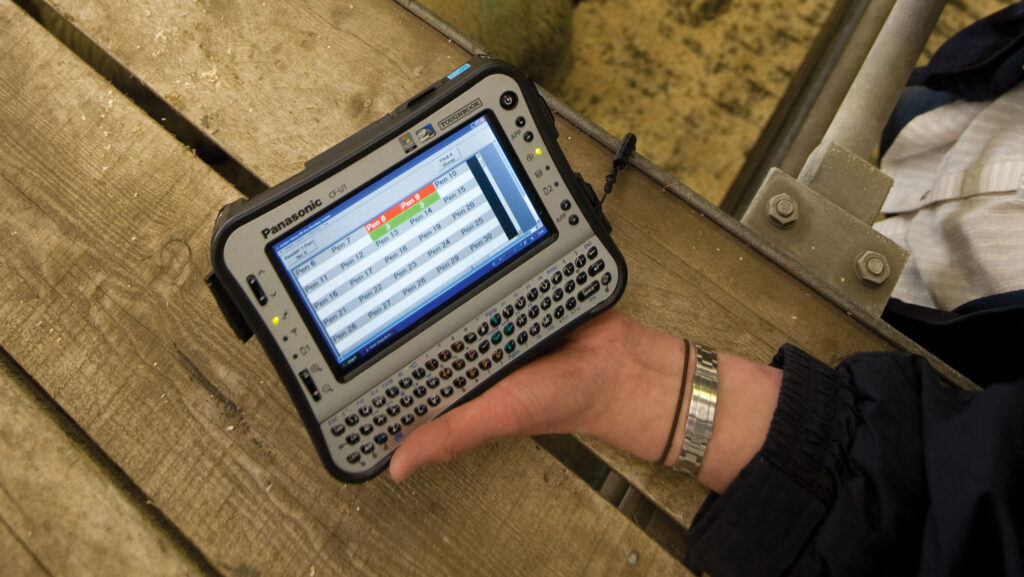
 Farmers can now access data on an unprecedented scale, enabled by robotic milkers, soil sensors, GPS-guided tractors, precision sprayers, drones and automated irrigation systems to name but some of the technologies they are investing in.
These generate vast streams of data, often swamping farmers with information overload which leads to them diverting too much time in their busy working days to managing unnecessary detail.
Conversely, the data produced can be underutilised, stored on USB sticks and hard disks that are stashed away in an office drawer, never to be used.
See also: 4 new nitrogen management technologies and how they work
There is therefore work to be done to ensure farmers manage data at an appropriate level.
As the UK Agri-Tech Centre’s head of farms points out, data only makes a difference if a farmer turns it into practical, real-world decisions, and uses it to make a positive change to what they do.
Robert Morrison likens data to conserving forage. “Data is like silage, it’s only useful if you store it properly and feed it out at the right time.”
One of the biggest criticisms Chris Hoskins of crop protection and supply company, Hutchinsons, hears of farm data is that it can be very difficult to look for and interpret, a view shared by the AHDB’s data programmes associate director Adam Short.
“There are some people, perhaps operating in the most commercial software spaces and in the supply chain, who will say fairly confidently that the data exists but farmers just aren’t using it,” says Adam.
Data sources
Modern farms produce data from multiple sources.
- Robotic milkers record individual yields, milking frequency and health problems
- Electronic tags and weigh crates track growth and health.
- Tractors, sprayers and combines produce operational data and harvest GPS information
- Drones, satellites and Light Detection and Ranging (Lidar) produce crop, soil and land data
- Automated irrigation systems and soil sensors monitor water use and soil conditions
Even a simple weather station generates rainfall and temperature data, says Robert.
Data supports compliance, fine-tunes management, and improves profitability across all systems, he adds, for instance simplifying audits for schemes like Red Tractor or crop assurance programmes through accurate recording.
Data helps to detect problems early and enables interventions, such as adjusting inputs when drone imagery shows deficiencies or irrigation according to soil moisture readings, or a cow being treating before a case of mastitis escalates.
It also reduces unnecessary machinery passes, inputs, or feed with benefits to cost of production and the environment.
Managing data
Robert sees no difference between data and fuel, feed or any other core farm input.
He advises farmers to focus on the decisions data helps them to facilitate rather than on technology dashboards.
“Think of data like your tractor dashboard: you don’t need every number, just the ones that prevent breakdowns and save fuel.”
Start small and keep it tidy, he says, and invest where the insight data clearly changes actions and margins. “Trying to use everything at once is like learning to drive a car and fly a plane on the same day,” he warns.
“Pick one area that costs you the most money or time, such as crop nutrition, irrigation efficiency, or livestock health, and use one tool well before adding another,” says Robert.
“Begin with what you already have, such as spray logs, yield maps, milk records, or weighbridge tickets.”
Capturing data can be as simple as doing so with a pencil and paper before graduating to spreadsheets or apps.
Add sensors gradually, starting with soil probes or livestock tags, and maybe then expand to drones or automated systems.
Data itself costs money to produce, but its value is only unlocked when it changes actions on the farm.
With data to hand, Robert’s recommendation to farmers is to set themselves one clear goal a year, such as reducing fertiliser waste in year one, and improving herd health in year two.
Don’t drown in numbers – look for trends rather than single figures. “Artificial intelligence [AI] tools can summarise raw data into alerts such as ‘field 7 needs nitrogen,’ ‘irrigation required in Zone C,’ or ‘cow 123 likely in heat,’” Robert explains.
“A simple rule is to ask: ‘What decision does this data help me make today?’ If it doesn’t answer that, ignore it.”
The UK Agri-Tech Centre’s five-step guide to managing farm data
- Start with one question
- Collect relevant data
- Use the right tools
- Act on the results
- Review and repeat
Data integration and sharing
Robert thinks it is best to choose a technology that integrates well as this will avoid “data silos”, isolated collections of data that prevent sharing between different systems.
This sharing is enabled by software management programs that act as a farmer’s central point for making use of data.
Data captured on spreadsheets or in a database is effectively useless if it isn’t channeled through a software program, Adam reasons.
“Farm management software is the farmer’s portal for utilising some of their data,” he says. But interoperability and portability are often lacking.
“If farmers could get hold of data and use it elsewhere I think it would drive a bit more innovation in that space,” says Adam.
“It all comes down to allowing all these bits of software to communicate with each other to enable the farmer to share data between platforms, that is what is lacking and holding agriculture back at this point in time.”
In some countries, governments are key enablers in this space, offering incentives in all sectors for the adoption of farm management software.
Poland is a case in point and this government intervention has had the desired outcome of driving uptake.
Good examples do exist where interoperability is a key feature of a system though. AgriRouter, a free-to-use system run by the German not-for-profit joint industry venture DKE-Data, has users in the UK including Dyson Farming.
The system enables farmers to exchange telemetric data between farm equipment, farm management software, and third parties, and to have control over data sharing between any of these elements.
Trust, transparency and control are regarded as the “north stars” in terms of data-sharing initiatives and AgriRouter has been built with those in mind.
Case study: Duncan Blyth, Albanwise Farming, Norfolk
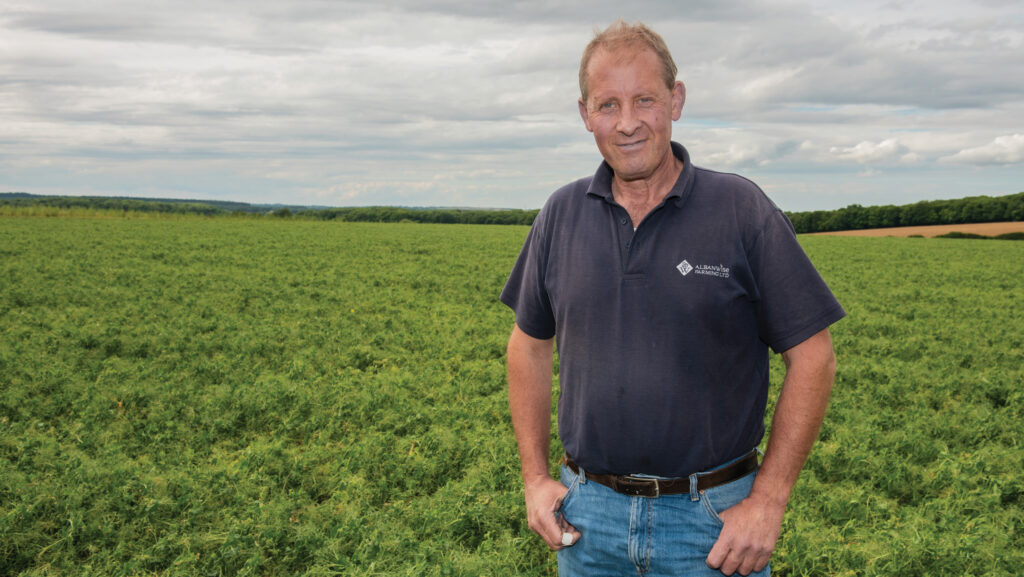
Duncan Blyth © Phil Weedon
Albanwise Farming, which farms the Barton Bendish estate in Norfolk, switched to a new software management programme five months ago and that small change has transformed the way it now farms.
Farm manager Duncan Blyth, a Transition Farmer, says it enables fields and areas within fields to be farmed much more accurately.
“That level of accuracy and detail makes a huge difference, especially as we have SFI (Sustainable Farming Incentive) and Countryside Stewardship schemes to consider.”
Managing data accounts for an increasingly greater proportion of Duncan’s time, and he acknowledges that is only a useful exercise if it delivers a financial benefit.
“We have to be careful that we are not just managing data for data’s sake, it has to lead to some concrete improvements.”
Adam has been leading a project at the AHDB, Farm Data Exchange, which aims to prove some of the principles around a trusted portal for farmers to control how, where and when their data is shared.
“This system could enable the sort of data sharing from one system to another, which will really add value to farmers,” he says.
He doesn’t believe it is realistic to expect all farmers to use an AI tool to analyse a lot of different datasets across various databases and software programs.
“There might be a handful that do but I don’t think it is realistic given all the other pressures farmers are under.
“It therefore comes down to that central hub of information, that piece of farm management software.”
For many farmers, sharing data with a trusted third party that is part of a farming operation is also useful.
Where the functionality is available, there is no reason why a farmer can’t set their software to send their vet a monthly summary of data gathered on digital tools, says Adam.
That might be incidence of lameness over that course of the previous month. The vet can then compare it with the herd health plan and establish whether or not the lameness rate is on target.
“There is also a compliance element to this, reporting on responsible antibiotic usage for example, and this can be made easier with the right choice of software,” says Adam.
Using AI
AI is useful when datasets become complex, but Robert reckons it only helps if farmers choose meaningful metrics and act on deviations.
Many big tech companies such as Google and Microsoft offer free online tools for storing data and analysing it with AI outside the sphere of commercial farm packages.
Google Sheets integrates AI through Gemini, and Microsoft Excel includes Copilot for trend analysis and charting.
These tools can help farmers visualise data and spot patterns without the need for paying expensive subscriptions.
But Robert warns farmers to be aware that data entered into public cloud services may be used to train AI models.
His advice is to avoid uploading highly sensitive information and to keep critical records in trusted, private systems.
Valuing data
Farmers often question the perceived value of the data they are harvesting, and its monetary value.
But Adam thinks the value of data to farmers is not in receiving sums of hard cash in return for sharing it in a commercial space but in the value they can extract from the supply chain, unlocking more from contracts, and the value data has to their own farming operations.
Carbon is a case in point. All supply chain contracts now have a key focus on sustainability therefore anything that farm businesses can do to improve efficiency will reduce their carbon footprint, while also saving them money.
“All this insight is going to come from data, it’s the only place it can come from really as all the gains from farmer’s instincts have mostly been exhausted,” says Adam.
“The conversation needs to move away from the payment of cash for data, value is the evidence it gives farmers to enable them to supply their product, I don’t think many have realised that it is a powerful bargaining tool.”
This is evident in the conversations know to be taking place within major retailers, with businesses questioning why they shouldn’t buy lamb from New Zealand if it comes with sustainability evidence when UK lamb might not.
“As soon as a farmer clocks that and uses it effectively, that is a big bargaining chip they can use,” says Adam.
High street banks also offer preferential loan rates and incentives to business customers who can evidence their environmental sustainability and impact.
This is because the PCAF (Partnership for Carbon Accounting Financials) methodology classification score put banks under pressure to reduce the carbon liability on their loan book.
In this instance, data is a key bargaining chip that could have a big financial impact for farm businesses.
Case study: Ryan McCormack, Dennington Hall Farms, Suffolk

Ryan McCormack © Jason Bye
Utilising data harvested from the farming operation is helping a family-run arable and beef farm to improve management and optimise production.
Dennington Hall Farms near Framlingham, Suffolk, grows combinable crops across 1,600ha and recently transitioned to a regenerative system on the majority of that land.
A digital farming platform allows farm manager Ryan McCormack and the farm team to record everything.
All 310 fields and 160km of hedgerows are mapped and stored in Omnia, together with cropping information for the diverse 12-year rotation, yield maps, and financial data.
As the system is cloud-based, it can be easily accessed from anywhere via a mobile, tablet, or computer.
Ryan, winner of the 2025 Farmers Weekly Farm Manager of the Year Award, says a key benefit of having digital records and mapping is for compliance with farm assurance, environmental, and other schemes.
Dennington Hall Farms has a Mid Tier Countryside Stewardship scheme and four Sustainable Farming Incentive (SFI) schemes which can be complex to manage but the software simplifies record keeping, including the evidence needed for compliance.
The same applies to visual crop assessments and input recommendations that the farm’s agronomists can upload from the field. Variable rate prescription functionality is used for variable seed, and nitrogen plans. Nitrogen rates are varied according to previous yield maps, soil testing, and NDVI imagery.
“Early in the season, we generally look to increase nitrogen rates on poorer areas to try and boost yield potential, whereas later in the season, once that potential is set, we will typically cut back on poorer areas and feed the better parts so they can fulfil their yield potential,” Ryan explains.
“At the moment, we’re only doing variable rate solid and liquid nitrogen, but we could expand this to include other nutrients in the future.”
Another important time-saving feature of the software is stock level management, which automatically updates the amount of fertiliser, seed, and other crop inputs held in stores, according to when and where deliveries are made, and when stocks are taken out to be applied.
Once invoices are entered into the system, they automatically feed into the cost of production analysis.
“The inventory system is all linked together so, if for example we create a crop recommendation to apply a certain amount of a product but there isn’t enough in stock, it will alert us at the time,” Ryan notes.
Likewise, the system also recognises all chemical Mapp (ministerially approved pesticide product) numbers, so when crop recommendations are being put together, it can automatically flag up any potential warnings of what can or cannot be applied and when.
Additional map layers show drainage systems and features such as water pipes.
Given the farm’s strong focus on protecting and improving soil health, Ryan has also set up a map layer for use at harvest showing trailer drivers where to park for certain blocks of land, limiting traffic to certain areas.
Another layer has been set up for winter pest control, showing the location of gas bangers in fields which means they can be easily and quickly located and recovered when no longer required.
Farm facts
- 1,600ha of which 1,200ha is regenerative arable. Mainly owned, 100ha arable on farm business tenancy, 200ha contract farming agreement on additional land
- 12-year rotation, 12 crop blocks
- Red Poll sucklers
- Staff: Ryan, assistant manager, two full-time operators, two part-time work experience students
- Countryside Stewardship Mid Tier agreement, four SFI agreements
- Carbon sequestration and biodiversity net gain projects
- Turtle dove conservation and restoration project
Explore more / Transition
During the series we follow our group of 16 Transition Farmers through the challenges and opportunities as they seek to improve their farm businesses.
Transition is an independent editorial initiative supported by our UK-wide network of partners, who have made it possible to bring you this series.
Visit the Transition content hub to find out more.
