

North West pipeline project: Why farmers need to engage early
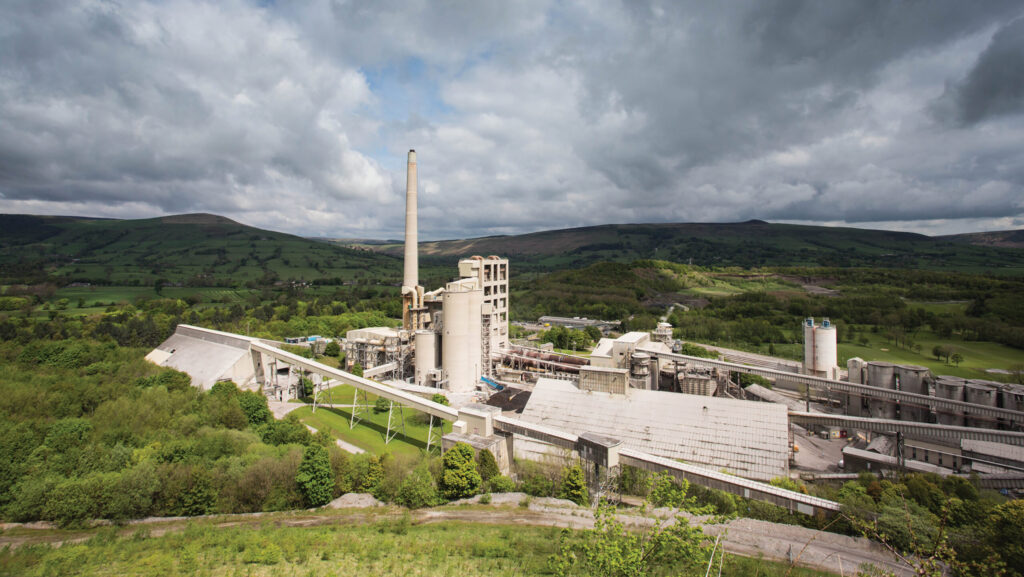 Breedon's Hope cement works, Derbyshire © Peak Cluster
 The Peak Cluster project is an underground pipeline running for almost 200km onshore, taking captured carbon dioxide from four cement and lime works to storage in former gas fields under the seabed off Morecambe Bay.
Originating in Derbyshire’s Peak District, it runs through parts of Cheshire, Staffordshire and the Wirral and is being developed by Progressive Energy on behalf of Tarmac, Holcim, Breedon and Buxton Lime.
See also: Down the drain: how infrastructure projects can harm farmland
“This is a massive project which will affect all sorts of businesses, from 100-horse liveries to 2,000-cow dairies and 100-cow dairies,” says Tony Rimmer, director of land agent Rostons, which acts only for landowners and occupiers.
He urges any potentially affected farmer or landowner to get in touch with their land agent or agricultural valuer now to begin engaging with the developer on the potential impact of the project.
What is Peak Cluster?
- A carbon dioxide pipeline of almost 200km, running from Derbyshire through Staffordshire, Cheshire and the Wirral.
- Developed on behalf of four cement and lime producers, the pipeline will take carbon dioxide emissions captured in manufacturing to storage in depleted gas fields beneath the Irish Sea off the coast of Morecambe Bay.
- HM Treasury’s National Wealth Fund has invested £28.6m in the project to support local economic growth and the transition towards net zero.
- As a nationally significant infrastructure project, the scheme will be progressed through a development consent order, which gives the project promoter enhanced powers relating to land access and acquisition.
- The manufacturers for which the scheme is being developed produce about 40% of the UK’s cement and lime.
- An interactive map of the proposed route, showing the 300m corridor and some wider areas where there are more options, is available to view.
Pipeline route
Currently the pipeline route is designated across a 300m wide corridor, with a plan to refine and reduce this to 100m through 2026.
Once installed, the pipeline is expected to have a protected 24m width above which no tree planting, deep cultivations, drainage or development will be permitted.
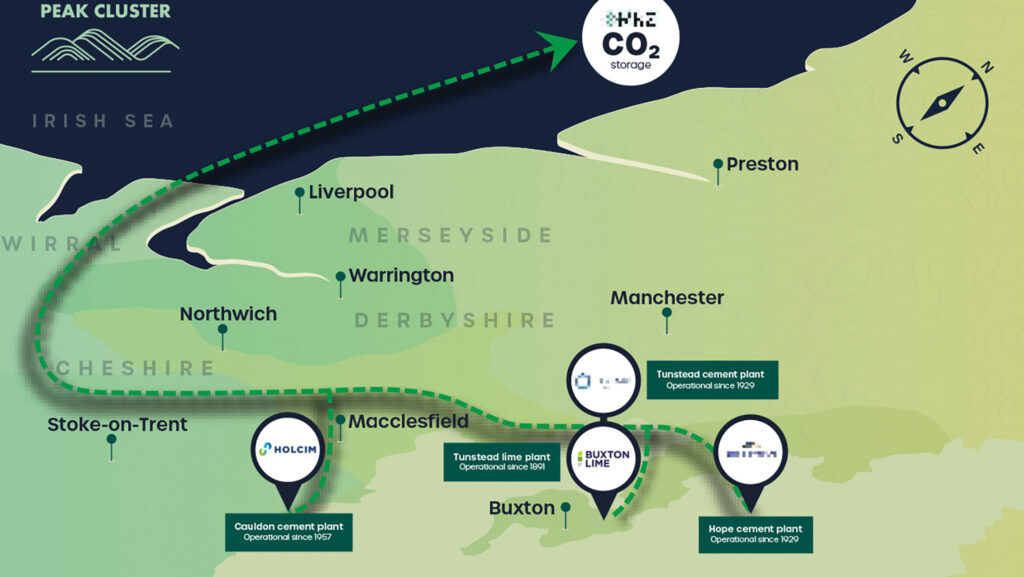
The Peak Cluster route map © Progressive Energy
Public consultation
A public consultation on the project opened this week.
Billed as the world’s largest cement decarbonisation project, it is classed as a nationally significant infrastructure project (NSIP), which means consent for the project will be granted through a development consent order (DCO), combining planning permission with compulsory acquisition powers.
Independent planning inspectors consider the DCO application, which will be developed over the next year as the route is refined and which must be signed off by Ed Miliband, secretary of state for energy security and net zero.
The DCO application is expected to be submitted late in 2027 and decided in mid-2028.
Peak Cluster consultation
- The initial consultation period runs from 12 January to 27 February 2025.
- Consultation details are available on www.peakcluster-consultation.co.uk.
- Paper copy project guides and feedback forms can be requested by calling 0800 0129 167.
- Eight public events are scheduled in the areas covered by the pipeline, starting on 24 January at Hoylake on the Wirral and ending on 12 February at Bradwell in Derbyshire’s Hope Valley. Online consultation sessions are also being held.
Land questionnaires and licences
For landowners and occupiers the first stage of what will be a five-year journey is under way, says Tony, with land information questionnaires having been received by farms where the land is registered.
Representatives of Peak Cluster have also been contacting and visiting farms.
The next stage is for the developer to seek survey licences, likely to be for 18 months, to initially give access for environmental and ecological surveys.
More intrusive ground investigation surveys such as boreholes and trenches will also be needed on some farms in summer 2026.
Many farmers have already been sent licences, for which a fee of about £1,200 is being offered.
These are unusual in that they encompass both foot and more intrusive types of access, says Jack Jones, a senior chartered surveyor with Rostons.
This 18-month licence can be renewed at the end of the term for a further 18 months.
Compensation for soil damage, lost production and other matters is payable on top of the licence fee.
The developer is asking for single licences for landlords and tenants, leaving some tenants with uncertainty over their rights and position, says Jack.
Early engagement
Land agent and surveyors advise early engagement with the developer, in order to influence the exact location of the pipeline within the 300m corridor and to enable a proper discussion of any voluntary agreement for payment of the long lease which the developer will ultimately take on the pipeline land.
This will enable it to lay the pipeline and maintain it in future. Lease payments are generally a one-off sum based on a percentage of the capital value of the land.
“Once the DCO is granted for the scheme, it will have compulsory powers, making early engagement vital,” says Jack.
Compensation is negotiated separately for disturbance to the farm business, for example the impact on soil structure and productive capacity, loss of productive land during construction and payment for accommodation works such as new gates, crossings for livestock and machinery.
Loss of business can also be claimed for. Farm drainage works necessary as a result of the disruption caused by the pipeline construction must also be accounted for.
“Drainage is heavily undervalued in infrastructure work and needs close attention,” says Jack.
“Accommodation works are important and include anything that can be done to mitigate and minimise the disruption and losses caused by the construction project.”
Communication between landowners and the developer can lead to proactive decisions and reduce the impact of the scheme, says Jack.
“While there is no guarantee, it may also be possible to divert the route, for example in the case of land where there is an option for housing or other development,” says Tony.
John Egan, Peak Cluster’s chief executive officer, says the project has attempted to identify and contact all potentially affected landowners within the 300m wide corridor of the proposed pipeline route and that the final construction working width is expected to be 30-40m.
“We will attempt to reach voluntary agreement with all landowners and will only seek to use compulsory acquisition powers where this is unsuccessful,” he says.
Professional fees
Landowners’ and farmers’ professional fees must be met by the developer and farmers’ own time spent on the project can be charged too.
Keeping a separate notebook for all Peak Cluster issues, recording time spent and any conversations, is a good idea, says Jack.
About 8ha of his own family’s 48ha dairy farm at Mollington near Chester is affected by a similar but smaller scale project, the HyNet Carbon Dioxide Pipeline, which is already under construction.
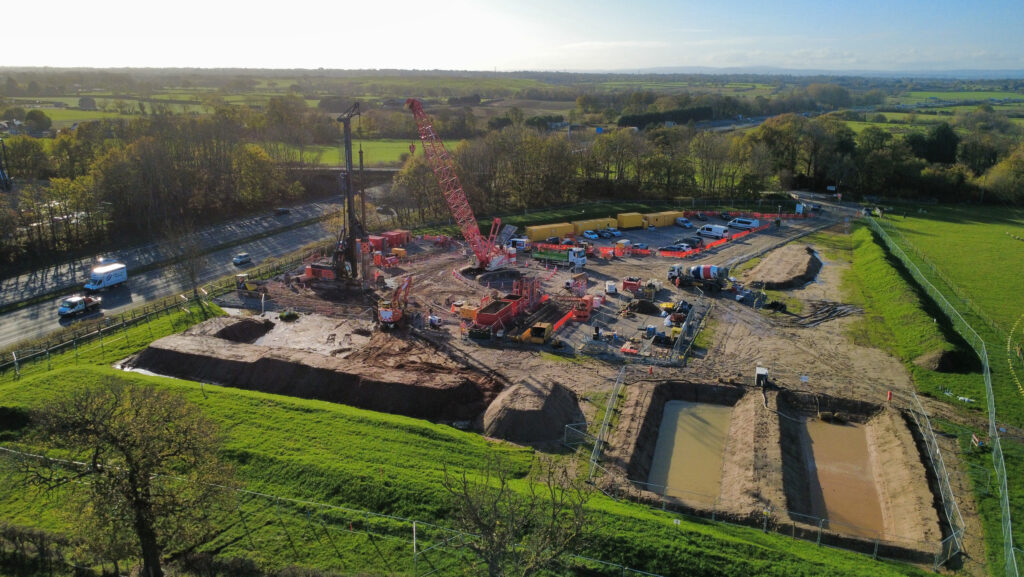
HyNet Carbon Dioxide Pipeline works on farmland adjacent to M56 motorway, for road crossing © Rostons Group
The tracks created during construction are wide fenced and the developer has also taken additional land for access off the road, as well as a compound for parking.
Richard Fearnall, managing director of surveyor Wilson Fearnall, is also advising landowners on the route and says claims must be properly assessed, evidenced and negotiated.
The works could take several years on a farm, reinforcing the need to understand the likely economic and practical impacts in order to make the case for compensation.
“That could cut a dairy farm in half and that’s a big impact, then there is the loss of production afterwards – reinstated soil won’t produce well in its first year at least,” says Richard.
DCO promoters are encouraged to secure access and leases under the voluntary route but Richard warns landowners and occupiers to look carefully at the terms of licences accepted on a voluntary basis.
These may contract the developer out of some of the safeguards and assurances offered by the statutory route, such as indemnities where contaminated land is disturbed by the works.
Advice for landowners and occupiers
- Engage early with the developer – a voluntary agreement may be quicker than the compulsory route and give more scope for negotiation to minimise the impact on the farm and business.
- Carefully consider the potential effects on the farm – detail these to help form the compensation claim and shape negotiations over lease terms for the land.
- Keep notes of the time spent on this by those in the business, and of any discussions or exchanges with the developer or their representatives.
- Professional advice is paid for by the developer but the landowner or occupier chooses the adviser.