

Demand and prices up in woodland market
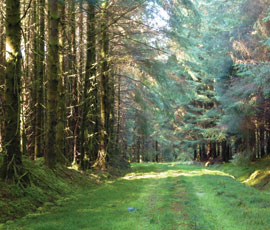
Higher timber prices and increased demand for woodland have pushed values up by 5%-20% over the past 18 months, in a market that is seeing a wide range of prices.
Woodland sales are split on the whole between smaller-scale amenity sales, mainly in England, and large-scale commercial conifer plantations, mainly in Scotland and Wales.
Smaller parcels of broadleaved woodland were making anywhere between £4,000 and £10,000/acre, depending on size, location, access, privacy and sporting value, said Mike Tustin, of agent John Clegg & Co.
“Demand for very small woodlands has increased in the past two or three years and that is having a big effect,” he said. “A 30-acre broadleaved wood might be worth £4,000/acre, but split into six lots it can make £6,000 to £7,000/acre.”
At the larger end of the market for commercial woodland, demand had slowed slightly compared with six to 12 months ago in England and Wales, said Mr Tustin. Values here also cover a wide range from £2,000/acre to £4,000/acre depending on size, area, access and how well they are maintained.
Higher timber prices and a lack of good-quality offerings on the commercial conifer plantation market for investment buyers means these are worth in the region of £2,500/acre for timber that has about five years to run until harvest, said Mr Tustin.
While demand and prices for firewood had gone up, the weakness of the pound had made imported timber more expensive and there had been a reaction to this in the home market with increased prices, said Mr Tustin.
“However, now that sawmills are full following the dry summer, which has allowed more wood than normal to hit the market, prices have softened a little bit but we expect prices to firm into the spring.”
The Renewable Heat Incentive has also pushed up demand and prices.
Inheritance Tax risk can be could be mitigated through timber investment but only in the case of commercial woodland, said Mr Tustin. Most of this was in Wales and Scotland because the price of land in England was generally too high to justify its use for large-scale commercial timber production.
John Clegg and Co has sold slightly more woodland this year than last, completing 96 sales in England and Wales across 8,261 acres, almost all of these private treaty sales.
“We’re selling more woodland than we were three years ago but it’s difficult to tell whether that is a blip. Private vendors are more likely to come to the market when the Forestry Commission has less on the market, and at the moment it is not selling woodland.
“If the Forestry Commission doesn’t sell next year then I expect fairly strong private sales to continue.”
In Scotland, forestry had undergone something of a re-rating and was seen as a safe investment, said Fenning Welstead, of John Clegg’s Edinburgh office. There was a very keen market for the right properties and the firm’s Scottish office has completed on 32,000 acres across 40 sales this year.
Commercial woodland was priced in a similar range to that in England and Wales but the amenity market lagged slightly, said Mr Welstead. He expects a similar market next year unless there are significant changes to the tax regime. It was important that amenity woodland should not only be considered as broadleaved woodland, said Mr Welstead.