Arla revenue soars in 2022 driven by higher retail prices
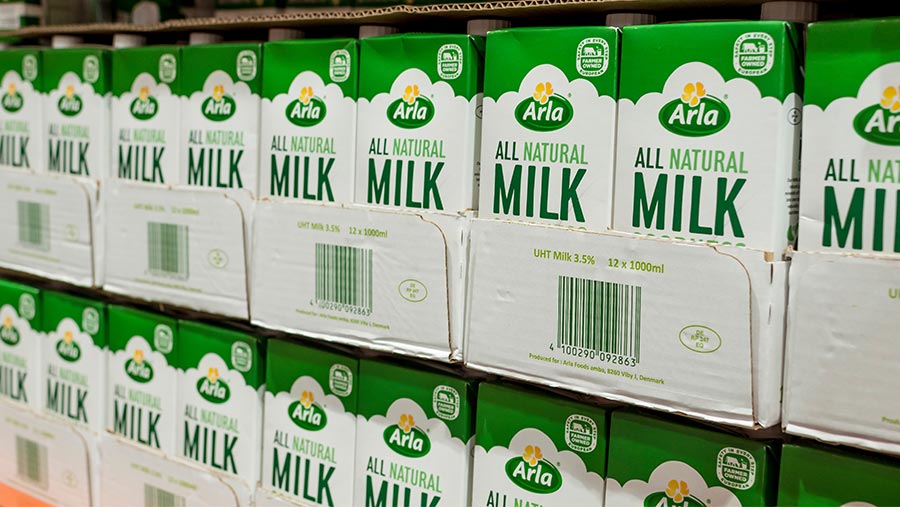 © Mdv Edwards/Adobe Stock
 Price increases and inflation pushed up revenue at Arla Foods UK by 17.5% in 2022, to total £2.6bn.
Following the strong financial results, Arla has announced plans to pay a 13th payment dividend of 2.2 euro cents/kg (1.8p/litre) to its farmer owners in March.
Dairy markets in 2022 were driven by an imbalance between supply and demand, as well as inflation across Europe.
See also: Farmgate milk prices to tumble in February and March
The farmer-owned co-operative is currently supplied by about 2,100 UK farmers. The UK market is Arla’s largest single marketplace in Europe, accounting for 38% of its European revenue.
Arla Foods’ UK managing director, Ash Amirahmadi, said the first half of last year saw inflationary pressure and uncertainty, coupled with the cost of producing milk soaring to levels never seen before.
Mr Amirahmadi said: “There is no doubt that 2023 will continue to present volatile economic conditions, and we will continue to navigate these conditions with the best interests of our farmers and our shoppers at the heart.”
As farmgate milk prices begin to fall back, Simon Ho, vice-president of finance at Arla Foods told Farmers Weekly it is currently a very fine balancing act between ensuring farmers have the confidence and financial resilience to keep producing milk, and also ensuring that prices are affordable to consumers faced with cost-of-living struggles.
Arla group accounts
Revenue for the wider Arla group totalled €13.8bn (£12.23bn) in 2022, up from €11.2bn (£9.9bn) in 2021.
The co-operative reported a net profit of €382m (£339m), with a profit share of revenue equal to 2.8%, down from 3% during the previous year.
Rising costs on-farm pushed up farmgate prices in 2022, and farmer owners received an average pre-paid milk price of 52 euro cents/kg (45p/litre) in 2022, 40% higher than the previous year.
Arla saw revenue growth across all of its global brands: Arla products accounted for 71% of revenue by brand, Lurpak accounted for 14%, Puck made up 10%, and Castello 5%.
Arla chairman Jan Toft Norgaard said 2022 was a year where inflation and disruption had an impact on both the company and its milk producers.
However, the company was able to adapt to conditions that changed quickly and dramatically, and still deliver solid results.
Outlook
In the past few months, there has been a rebalancing of supply and demand in the dairy sector, according to Arla, which has led to significant reductions in the dairy commodity markets.
The company has also forecast lower economic growth and reduced buying power due to higher inflation and interest rates shrinking consumer budgets.
The brand expects to be under pressure in 2023 and projects a volume-driven reduction of between 1.5% and 3.5%.
Arla chief executive Peder Tuborgh said: “2023 will undoubtedly be another difficult year with the challenging economic environment globally and the ongoing effects of the war in Ukraine continuing to impact the energy market and supply chains.
“We are currently seeing some easing of cost pressure on farmers, and as a result we expect the supply and demand balance to be restored on the dairy market over the course of 2023.”
Longer term, the group expects to return to better growth conditions from 2024 onwards, following major economic impacts during 2022 and 2023.