Outlook 2026: Dairy sector to see continued price pressure
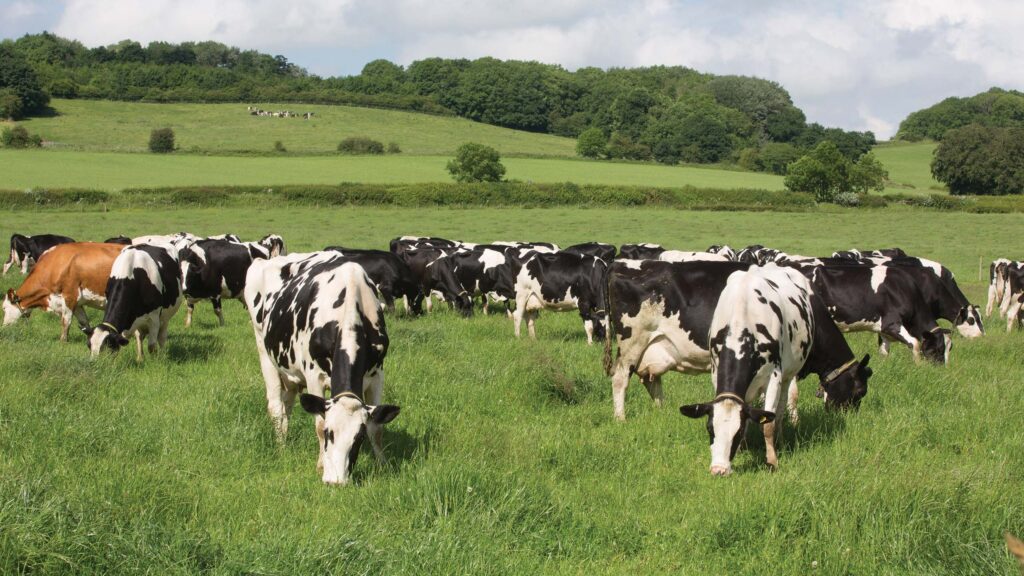 © Tim Scrivener
 The UK dairy sector is reflecting on a year of contrasts, with localised forage shortages, a once-again volatile milk price and a widening gap between milk contracts in terms of prices paid, according to Andersons partner Mike Houghton.
Things started promisingly in 2025 with a strong average farmgate milk price of 45.6p/litre in January, up from 38.92p/litre in January 2024.
Buoyed by a favourable milk-price-to-feed ratio of 1.5, a figure not seen since 2007, dairy farmers in the UK turned on the taps.
See also: Just 7,000 GB dairy farmers in production as prices slide
Production surged, with a UK record 39.02m litres tankered on 4 May.
Processors struggled to cope with the spring flush, with some milk being dumped due to factory breakdowns, haulage issues and general oversupply.
Miraculously, prices remained at a strong level throughout the flush due to processor concerns over the declining UK dairy herd, stable to poor European production caused by bluetongue, and drought on the Continent.
Worldwide dairy production also increased, with the US, New Zealand and Argentina all showing considerable growth.
This soon eclipsed global worldwide demand for milk and milk products, says Andersons partner Oliver Hall.
Summary
- After a positive start to 2025, the outlook for 2026 is much starker
- Spring’s milk production surge quickly outweighed demand, triggering significant market pressure
- Milk prices look set to weaken further as global supply continues to rise and concern builds over spring-flush management
- Engaging with milk processors to provide accurate farm milk production forecasts could be key to avoiding penalties
- Take advantage of high cull cow prices and reconsider management of marginal litres as market strives to cut supply
Price realignment
Combined with stabilising EU milk production, this imbalance made a milk price realignment inevitable.
Butter, cream and cheddar prices collapsed, and UK dairy farmers saw sharp price cuts at the farm gate from October.
The widening gulf between the haves and have-nots in the UK dairy industry has become increasingly apparent.
The southern counties of England again looked like the Sahara for much of summer 2025, resulting in forage stocks being particularly low in many parts.
Other areas also suffered from prolonged dry and warm weather, leaving many dairy farmers in England and Wales praying for a short winter.
Proactive sourcing of alternative forages or feedstocks will have been crucial.
Contrast this with farmers in north-west England and Scotland, who have had an exceptional forage year in terms of quality and quantity.
That said, it is not all rosy “up north” – spare a thought for long-suffering Scottish dairy farmers supplying Yew Tree and now Muller.
In early 2025, there was a difference of up to 16p/litre between the milk price they received and that paid to dairy farmers in southern England supplying Arla.
Contract lottery
This milk contract lottery is likely to continue into 2026, with a potentially greater premium opening for aligned supermarket suppliers: again, the haves and the have-nots.
What remains to be seen is whether UK milk processors will increase investment in the more “climate-safe” dairy areas of the country.
Barring a sharp reduction in worldwide milk supply, the milk price in 2026 looks set to weaken further, says consultant Tom Cratchley.
Rabobank is forecasting continued growth in worldwide milk output in 2026, albeit its 0.4% figure is a reduction from the 2% growth seen in 2025.
Closer to home, there is growing concern about whether UK processors can cope with the spring flush in 2026.
Several are saying that over-core volume milk might be worth just 1p/litre, or that producers may have to pay to have the milk taken away. That could well lead to producers dumping milk at the end of each month to manage supply.
Distressed milk
Neither farmers nor processors want to see distressed milk trading at low spot prices. It will become imperative to engage milk processors to try to provide accurate forecasting of milk production.
This might be key in future, with many processors likely to penalise quite heavily for over- or undersupply.
In 2025 farmers responded to market signals and understandably increased production. The market is now desperately seeking a reduction.
Now is the time to be proactive with culling, with dairy cull cow prices still at a high level.
Look at marginal litres; are there cows you shouldn’t be milking, and are there expensive parts of the diet that could be stripped out? Would it be worth drying cows off 10 days early?
While it is difficult to turn off the taps immediately, the industry needs co-operation and fewer litres, not more, especially in the run-up to the spring flush.
The sooner the industry rebalances, the quicker the recovery will be.
Friesian Farm
Andersons’ model dairy farm illustrates the roller-coaster that milk producers are riding. In just two years, Loam Farm’s business surplus is forecast to slip by more than 9p/litre due to the falling milk price and rising variable costs, taking it into the red.
A similar result will almost certainly be shared by many more producers.
Friesian Farm is intended to illustrate trends for a typical dairy farm – few can cope with such volatility.
Supply management remains key, yet the only actions to limit it currently appear to be draconian price cuts, which will force some producers out of business and halt much-needed reinvestment for many others.
Friesian Farm – summary figures (p/litre) |
||||
| Friesian Farm is a notional 220+ cow business in the Midlands with a milk contract on a constituent basis and year-round calving, aiming to maximise yield from forage. | ||||
| 2023-24 (final) | 2024-25 (final) | 2025-26 (estimate) | 2026-27 (forecast) | |
| Milk price | 36.7 | 42.9 | 43.5 | 37 |
| Total output | 39.7 | 46.4 | 48.4 | 41.1 |
| Variable costs | 17.6 | 17.8 | 20 | 18.8 |
| Overhead costs | 15.1 | 17.2 | 17.4 | 18.8 |
| Rent, finance and drawings | 6.9 | 7.2 | 7.2 | 7.5 |
| Cost of production | 39.6 | 42.3 | 44.5 | 45.1 |
| Farming margin | 0.1 | 4.1 | 3.8 | (-4) |
| BPS payment + SFI* | 1.3 | 1 + 1.5 | 0.4 + 1.5 | 0 + 1.5 |
| Business surplus | 1.4 | 6.6 | 5.7 | (-2.5) |
| Source: The Andersons Centre. * SFI payment is shown gross – costs of compliance are contained in farming costs | ||||