‘Talk to lenders’ plea to farmers as interest rates rise
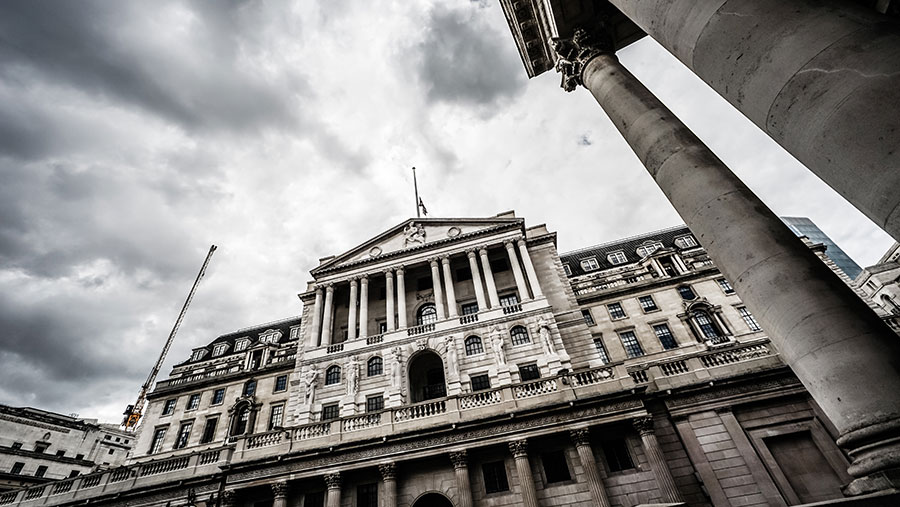 © Alex Yeung/Adobe Stock
 Rural economists and accountants have urged farmers to hold talks with lenders after the Bank of England raised interest rates by 0.75% to 3%. The rate increase is the eighth since December and the largest single hike since 1989.
The Bank made the move in a bid to control spiralling inflation which stands at 10.1%, way above the target benchmark of just 2%. Food price inflation is higher still at 11.6%, the highest for 40 years.
But both figures are dwarfed by ag-inflation which is running at 28% and input costs for farm businesses are soaring.
The interest rate rises will be a further significant blow to farmers, said NFU senior economist Sanjay Dhanda.
See also: UK’s largest solar farm sparks contrasting views
Farming will be hit harder and longer than some sectors because it depends heavily on borrowing to fund investments and improve business efficiency, Mr Dhanda said.
Further rises could occur because the global challenges affecting food and fuel prices were likely to continue for some time, he suggested.
That means those farmers who are not on fixed rates will see a considerable hike in loan payments, Mr Dhanda said.
Credit availability may also become increasingly limited, particularly for businesses with more marginal viability. This will have a direct effect on profitability, investment and future viability, he predicted.
Mr Dhanda reported that many NFU members were planning to move from variable to fixed rates in a bid to regain stability. But, while stability is key for businesses, a decision to swap to a fixed rate must be considered carefully in the current climate and taken with advice, he said.
Fixed rates are also rising and may become a long-term burden if the rate is relatively high.
“This is where an open and frank conversation with the lender is essential. These chats must also be made as early as possible and focused on extracting as much information about which way fixed rates are likely to move,” he said.
Some farmers may be tempted to fall back on overdrafts.
Overdrafts are a cheaper way to access working credit, but it is important to be judicious and avoid making large or lavish purchases, Mr Dhanda warned.
To help reduce risk overall he urged farmers to look to stability measures such as hedging forward crops that would then provide a known income level.
Collaboration with other trusted businesses for purchases, and borrowing or joining a buying group may also help to limit risks, he added.
Accountancy and rural consultant Saffery Champness echoed the NFU’s call to contact lenders.
Martyn Dobinson, a partner and member of the firm’s land and rural practice group, said interest rate rise had further turned the screw on borrowing.
Against a backdrop of rising input costs, planning ahead had become exceptionally difficult and discussion with lenders was now vital, Mr Dobinson said.
“Businesses should seek advice from their professional adviser to assess where economies can be made and where cashflow can be maintained and secured,” he said.