Will’s World: There’s (almost) no one quite like Great Grandma
 © Lee Boswell Photography
 The present Mrs Evans recently went away for a fortnight to take part in the Challenge of Rural Leadership course, run by the Worshipful Company of Farmers.
Our numerous daughters all survived being looked after solely by their father during this time, even if they did go to school looking slightly more dishevelled than usual.
Occasionally they also had to go without certain of their favourite food items for a day or two, because my housekeeping wasn’t up to the high standard to which they’re accustomed.
See also: Forward-control JCB Fastrac offers contractor plenty of versatility
Obviously, for the modern teenager this is the equivalent of being sent down a mine to work, and resulted in much dramatic sighing and eye-rolling, but they just about managed to get through it all.
However, it would be appreciated if everyone could please send thoughts and prayers for our 14-year-old, who had to suffer the great hardship and indignity of emptying the dishwasher two mornings in a row
Modern conveniences
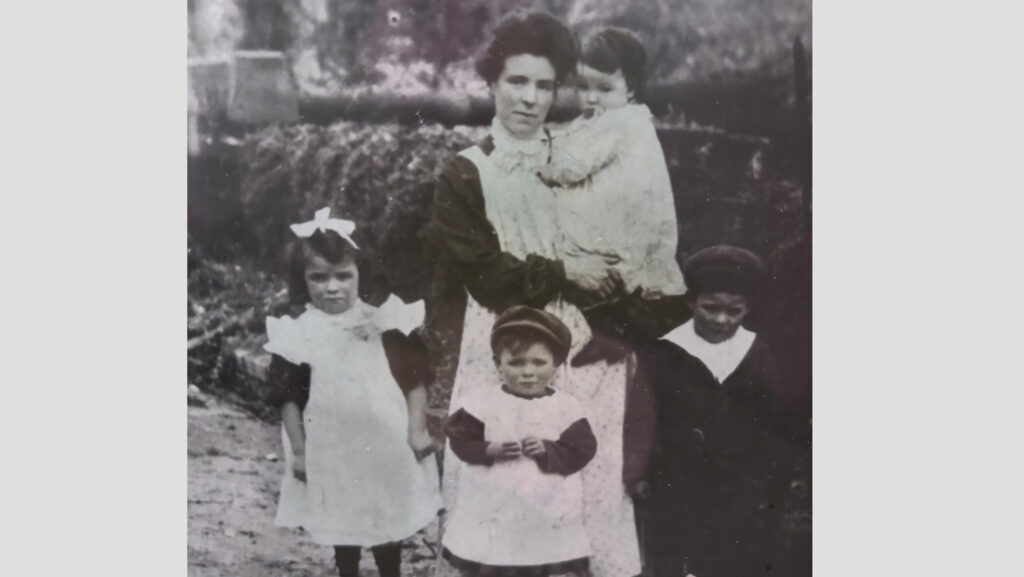
Great Grandmother Evans with four of her 10 children © Will Evans
It left me thinking about my Great Grandmother Evans, and how fortunate we are to live in a warm, comfortable home with a variety of modern appliances, and practically anything we require just a click of a button and a next-day-delivery away.
How she’d marvel at our washing machine, and the speed at which we can launder our clothes with no hard labour involved.
Washing days in her time were a different story. She’d be up at 5am to light a fire under the copper that was filled with collected rainwater.
When the water was hot enough, she’d draw it into a tub and add hard soap and lye, before starting on the clothes of the family and the farm labourers, agitating the garments thoroughly by plunging and twisting with a dolly peg.
Stains were removed by vigorous scrubbing on a corrugated washboard, then each item was rinsed in clean water before being wound through a mangle and hung out to dry.
Bread and butter
What would she say if I told her that we could buy any kind of bread we liked, and already sliced too.
Or I could show her our breadmaker and explain how we just quickly throw in the ingredients, and there’s a fresh loaf waiting for us in the morning.
She baked her own bread, but by hand in a scullery, where two stone benches held a large trough in which the dough was mixed.
She usually made 16 loaves at a time and one currant loaf, enough to feed the family and men for a fortnight. My wrists ache just thinking about it.
There was a dairy (or bwtri in Welsh) beside the farmhouse, where they’d set the fresh milk out in bowls for the cream to rise and be skimmed off.
For butter, she’d then put a few gallons of cream into a butter churn and turn the handle for half an hour, sloshing it about until the fat particles stuck together to make lumps of butter.
The buttermilk was then fed to the pigs, while the butter was formed into blocks with pats, finally being ready to eat or be sold on Great Grandfather’s milk round in the local village of Coedpoeth.
She wasn’t finished yet, though, because all the churns, bowls and jugs would have to be thoroughly scrubbed so the next batch wasn’t tainted.
Of course, this was only a part of her working routine; there was also the small matter of raising 10 children.
And what was this great lady’s name? Sarah – the same as the present Mrs Evans – which I always think is rather lovely.