Young farmers head to Westminster to debate regen farming
 © MAG/Charlie Reeve
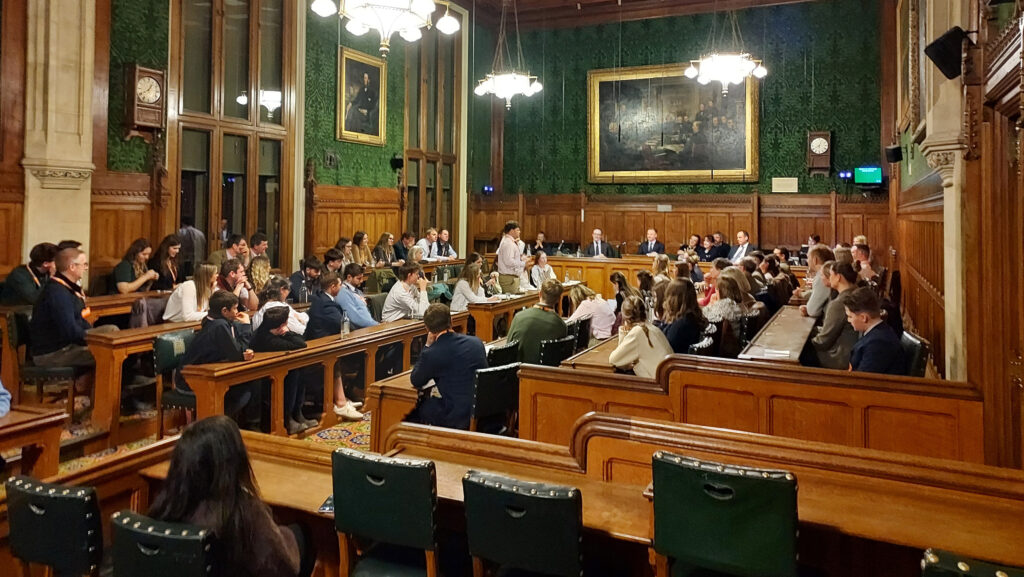
 Dozens of young farmers descended on Parliament to take part in a debate on whether regenerative farming can feed the nation.
Committee Room 14 in the House of Commons served as a debate chamber for the evening with farmers and agricultural students travelling from across the home counties and Midlands to take part.
Mid-Bedfordshire MP Blake Stephenson, who hosted the event on 11 March and opened proceedings, said the evening was designed to get young farmers together to debate the future of UK agriculture.
See also: NFU selects next cohort of young farming ambassadors
Shadow Defra farming minister Robbie Moore diligently chaired the debate, with young farmers split into a mock government and opposition to argue both sides.
Young farmers in favour of regenerative farming argued that regenerative systems help to improve soil health, which is good for the long-term productivity of land.
They also reasoned that improved soil was key in ensuring future food security.
Interjections from the backbenchers put forward other arguments in favour of agroecology and a land sharing approach to farmland.
The opposition argued that regenerative farming did not provide sufficient yields to feed the growing population.
They proposed that farmers were already producing more food with fewer inputs than ever before and argued that farmers were not using excess chemicals and fertiliser as this was not cost effective.
Farming voices
A number of farming industry voices also took part in the debate with Hertfordshire farmers John Cherry and Joanna Bowen, who founded the annual Groundswell festival.
They presented arguments in favour of regenerative farming and the benefits it provides to nature and biodiversity.
“Nature is providing so many benefits; there are now so many insects and birds on our farm since moving to a regenerative system,” said Ms Bowen.
Mr Cherry contested that the job of a farmer wasn’t just to feed the nation, but also to make enough money to be able to feed their own families.
He added that many conventional farms were struggling at present with inputs getting more expensive, while grain prices remained low.
West Sussex farmer Oliver Field and Leicestershire farmer and agricultural historian Oli Fletcher argued in favour of conventional farming systems.
Mr Field questioned where the balance was between producing enough food and providing environmental improvements.
Meanwhile, Mr Fletcher exclaimed that the danger of regenerative farming was that it shifts the purpose of farming towards nature and away from food production.
Glyphosate ‘essential’
Merseyside arable farmer Olly Harrison suggested that the invention of glyphosate had transformed agricultural production and provided a partial solution for the industry.
A vote in the room at the end of the debate showed a fairly even split between the two farming systems with the motion ultimately ruling in favour of regenerative systems due to the compelling arguments of the frontbench members.
Bedfordshire young farmer Molly Bampton was selected by MPs as the top contributor to the debate, for her eloquent and thought provoking arguments in favour of regenerative systems.
Finance Bill
The light-hearted young farmers debate took place on the same day as the third reading on the Finance Bill, which included the government’s farm inheritance tax plans.
The bill passed with 292 votes in favour and 161 votes against.
Shadow Defra secretary of state Victoria Atkins said: “Tonight, we forced the seventh vote on this government in relation to the family farm and family business tax.
“We know and absolutely understand how tough a time it has been over the last 14 months since that tax was first proposed.
“Sadly, tonight the government has voted it into law. So, despite having secured a partial U-turn, which is something that will help some farms, we know sadly that this dreadful tax will still take a toll on many families in the depths of their grief.”