

How even tiny losses in body condition impact dairy fertility
 © Tim Scrivener
 Small changes in body condition score – invisible to the human eye – can have a detrimental impact on fertility in the next lactation, a commercial study has shown.
See also: When are the best times to condition-score the dairy herd?
HerdVision’s research involved more than 3,200 cows across four herds in England.
It revealed that a minuscule 0.14 fall in body condition score (BCS) – too subtle for the human eye to detect – could extend the time it takes for cows to get in-calf by more than two weeks.
Invisible losses, visible consequences
Using HerdVision’s automated video monitoring system, which captures 2D and 3D images of cows, researchers tracked BCS at drying off (standard 60-day dry period) and again within 48 hours of calving to establish any losses during the dry period.
The data were compared against fertility, including days to conception and conception rates up to second service.
Results showed:
- 20% of cows lost 0.14 BCS or more during the dry period. This was associated with an increased interval from calving to pregnancy.
- Those that lost 0.14 BCS or more took 17 days longer to conceive, compared with animals that lost less than 0.14 BCS.
- Cows with a BCS below 2.85 at calving spent an extra eight days open compared with those scoring more than 2.85, resulting in a lost income of £40 a cow (based on each day open costing £5 a head).
- Conception rates to first and second service were poorer (see table) in cows that lost more condition.
While industry standards suggest a BCS of 2.5-3 is ideal at calving, HerdVision’s findings suggest that aiming for at least 2.85 could improve reproductive performance.
Poor fertility
Georgia Thresh, veterinary technical adviser at HerdVision, says while the results are not surprising, it is the first study to quantify how small losses in condition can make a big difference to fertility.
“A human eye would struggle to see losses of 0.14, but they are having a big impact on fertility,” she points out. “Seventeen days almost amounts to a whole [21-day] cycle.”
Georgia explains that follicle development begins 100 days before ovulation. This means the quality of eggs produced during lactation is influenced by the cow’s energy status well before she calves.
“If cows are in negative energy balance or have low blood sugar during the dry period, follicles will be poor quality, which can result in cows not holding to service or aborting early,” she says.
Researchers also examined the link between lameness and fertility. About 18% of cows were classed as lame (scoring higher than 2) between calving and final insemination.
Those affected within the first 90 days of calving took 14 extra days to conceive compared with non-lame cows and had a 12% higher culling rate.
Georgia says this reinforces the importance of early lameness detection and treatment.
Breeding strategies
She believes these data play a key role in highlighting at-risk animals to vets during fertility visits, so that different breeding strategies can be used to protect herd fertility.
“These cows may benefit from being served straight to conventional semen to improve conception rates. Other options may be extending their voluntary waiting period or using synchronisation,” she suggests.
“Part of the problem is if cows are not in optimal condition at dry off and don’t transition well, sub-optimal fertility will extend their lactation.
“If we intervene, we can improve the calving interval and prevent body condition problems in that subsequent lactation.”
She says increasing numbers of farms are installing cameras in their dry cow sheds to more regularly monitor condition during the dry period.
Hefin Richards, of Rumenation Nutrition Consultancy, believes the focus has traditionally been weighted towards preventing cows becoming fat, because they can be at higher risk of metabolic disease.
“Thin cows, like this research suggests, are a problem too,” he says. “Ideally, cows should be dried off in the right condition and stay there.”

© Tim Scrivener
Accessibility and use of data
He believes small losses in condition could be a symptom of an underlying problem such as lameness or poor rumen fill.
He says automated cameras have huge potential, but they are useful only if the data are easily accessible – and used.
“There’s so much data on farms, but if it’s all in different silos, it’s very hard to access.
“With any data, there’s no value unless you use it, and sometimes we have data overload on farms and we haven’t always got the right systems or skills to integrate different technologies with herd management software.”
Hefin says it is also useful for farmers to understand herd-level trends so they can pinpoint when and why condition loss may be happening.
He also points out that dry cow housing and feed space is a limiting factor on many UK dairy farms and often contributes to variable BCS.
“In many cases, herd size and milk yields have increased, but transition housing has not reflected this.
“Shifting calving patterns to match seasonality payments leads to additional seasonal pressure on transition housing, often at a time when heat stress is also a risk.”
He advises farmers to target a minimum of 1sq m of lying space for every 1,000 litres and a minimum of 10cm a cow of water trough space and 0.75cm of feed fence space.
How HerdVision works
© HerdVision
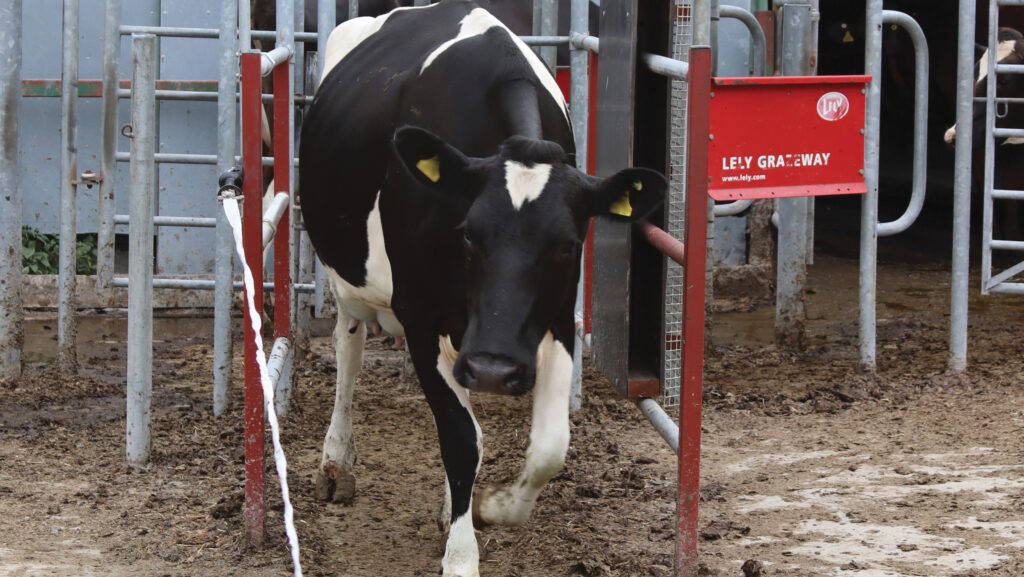
HerdVision uses a camera mounted above an area that provides a minimum of 3m of straight walkway, and electronic identification (EID) technology to automatically monitor body condition score (BCS) and lameness.
The camera has infrared capabilities, so it works under low lighting levels.
HerdVision links directly with Uniform and DairyComp and connects to other systems through Dairy Data Warehouse.
Cows at risk of poor fertility, based on the study findings, and priority cows due for therapeutic foot trimming, are listed on HerdVision’s task-based app, HerdTasker.
Through the HerdNutrition tracker tool, BCS trends can be tracked throughout lactation at herd and group levels. Monthly mobility trends are also available.
Its developer, AgSenze, is now working on a similar camera for beef animals.
This can monitor bodyweight and daily liveweight gain in animals when stationary, to prevent growth checks that can arise from stress caused by manual weighing.
The tool is also being developed to measure conformation and predict carcass cull-out grade.
AgSenze data show it can predict the weight of cattle to within 3% accuracy. The system is currently undergoing functionality tests on UK farms.
The HerdVision system costs £5,900 and includes a three-year warranty, camera and EID reader. Annual subscription fees start from £1,800/year.
Small BCS changes during dry period can impact fertility after calving |
|||
|
|
Group A (BCS change less than 0.14) |
Group B (BCS change more than 0.14) |
Difference |
|
First service conception rate |
34% |
23% |
11% |
|
Second service conception rate |
58% |
47% |
11% |
| Source: HerdVision. Notes: Herd size on the four farms in the trial ranged from 250 to 2,000 cows and were a mix of year-round housed, seasonal grazing, and autumn-calving herds. Yields ranged from 8,500 to 11,000 litres. | |||