

How cost focus unlocked beef and sheep farm’s potential
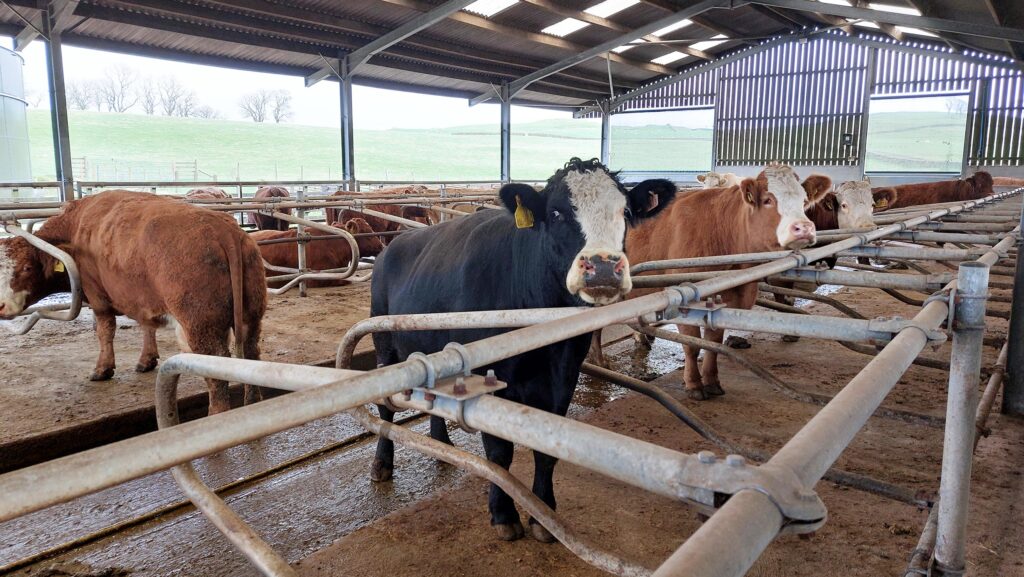 © MAG/Shirley Macmillan
 There is nothing like a debt to focus the mind – and a farming partnership restructuring that allowed Richard McCornick and his brother Craig to farm independently certainly did that.
In 2021, the McCornick family took the rare opportunity to buy a second farm.
While Craig took on the new land, Richard remained at Barnbackle Farm, Lochfoot, near Dumfries, to farm with his partner, Hayley, and his parents Andrew and Janice.
See also: 3 ways suckler beef producer sharpened business skills
Farm facts
© MAG/Shirley Macmillan
Barnbackle, Lochfoot, Dumfries
- Farming 202ha
- Growing 10ha kale and swedes for cows; 4ha hybrid kale and turnips for ewes; 8ha arable silage undersown with grass; reseeding 12ha/year, including more clover and plantain
- Boulder clays, peat, and shallow soils that burn up in dry weather
- Average rainfall 1,075-1,175mm
- 150 Angus cross Salers suckler cows bred to Simmental
- 30 pedigree Charolais cows
- Calves sold at weaning (six to seven months) weighing 350kg to Castle Douglas market
- Selling five to six Charolais breeding bulls every year at 15 months into commercial beef herds
- 750 Aberfield-cross ewes plus 250 ewe lambs
Mindful of the additional financing costs, Richard began installing electric fencing infrastructure with a view to cutting costs through rotational grazing.
To help him focus on his cashflow, he became one of the Monitor Farms Scotland – and this turned out to be a catalyst for change.
He has since fenced the whole farm, improved water supplies to grazing, shifted the calving block of his 150-cow suckler herd, and is planning to lamb outside.
He knows how much it costs him to creep feed 2kg/day to a calf to seven months of age (£30) – and what the benefit is, having adopted regular weighing and costings.
“We were getting 1.4-1.5kg daily gain before; now it’s 1.75kg/head and we were paid £5.50/kg liveweight this year,” he says.
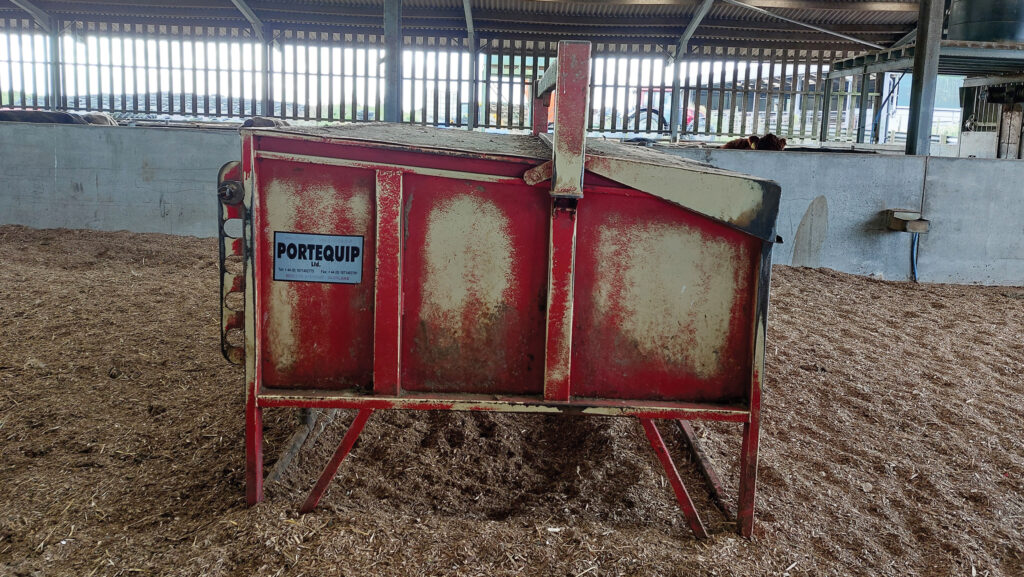
Creep feeder © MAG/Shirley Macmillan
New ways of thinking
For Richard, the best thing about taking part in the Monitor Farm programme has been the people.
He has profited from different ways of thinking, networking with like-minded, progressive farmers.
“I’ve travelled further than I have before to other farms, including France, to exchange views and ideas.
“I’ve had access to specialists such as vets, nutritionists and a grazing mentor, having previously not used outside help.
“I’m in a grazing group, working with an SAC consultant, and have Perthshire farmer John Ritchie as a grazing mentor,” he says.
One of the first outcomes from the Monitor Farm advisory committee was to get the whole farm soil mapped.
The results led to Richard applying 300t of lime to raise soil pH to 6.2.
“Our pH was very variable and down to 5.2, so it took us a few years to get it back to where it should be.
“Grazing is now firing on all cylinders, and we have reduced our fertiliser to 20t/year – only putting 25kg/ha of nitrogen on in March for some of the grazing,” he says.
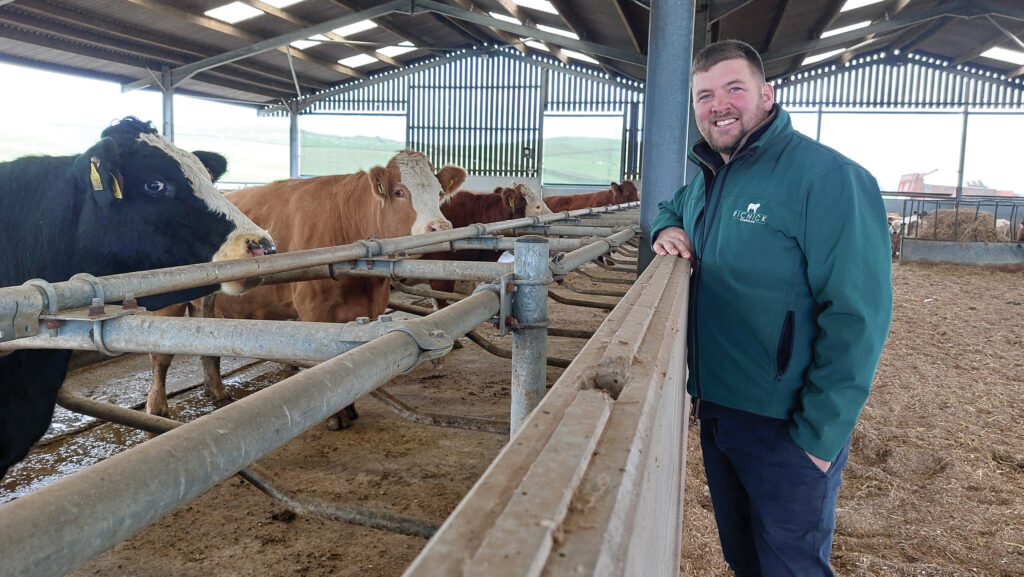
Richard McCornick © MAG/Shirley Macmillan
Grazing infrastructure
A game changer for him was improving the farm’s water supply.
Poor access to water was hindering his ability to improve grass utilisation because he could not split fields.
Groups of 70 cows plus calves drink a lot, especially in warm weather, he says.
“We have mains water, but poor pressure.
“Now we have two solar pumps accessing our private supply, fed from streams, and they pump to a header tank, which feeds troughs in every paddock we’ve created,” he explains.
Unfortunately, this worked so well that the system burned out pumps from running constantly.
This year, he fitted a timer to run two hours on, one hour off, but has found the pumps are not lasting.
Instead, Richard plans to install a bigger water pump driven by mains electricity, plus wider (26mm) water pipes to improve flow.
Following two years of full rotational grazing, Richard is keeping things simple.
Three-day rotations are the new norm, depending on group size.
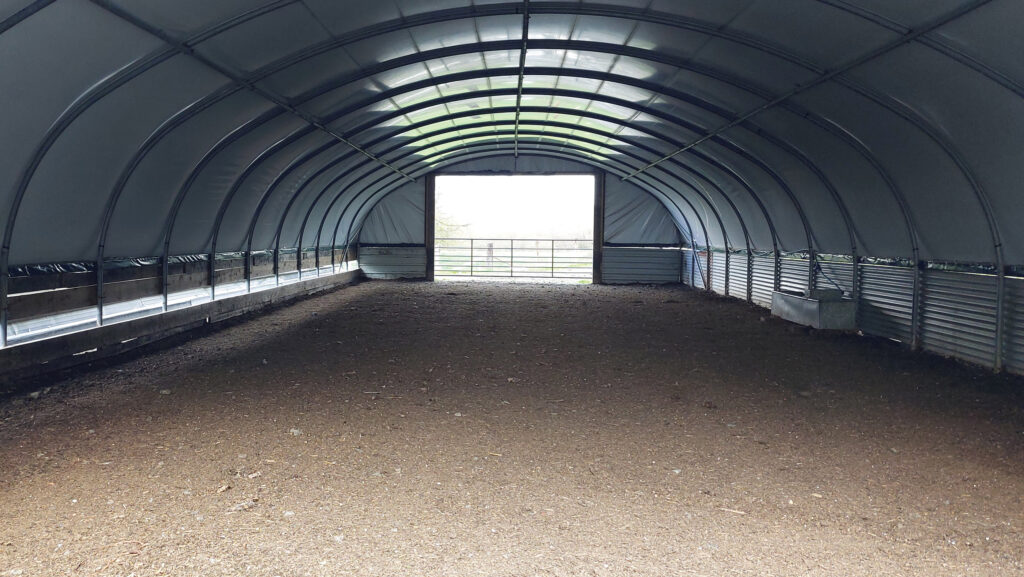
Lambing polytunnels © MAG/Shirley Macmillan
After lambing indoors, sheep and lambs are turned out from about mid-March, set stocked on their first grazing round.
After weaning, they graze in rotation one to two days ahead of cows.
“Ewes move every two to three days, and pre-tupping it’s a quicker rotation.
“Post-tupping, we get ewes to eat right down, then shut off fields on 1 December; turnout back to these paddocks is around 1 April.”
However, Richard is now at the stage where he acknowledges he could better allocate feed, so is considering buying a plate meter to measure grass.
Health improvements
Ewe management pre-lambing was changed after taking part in a veterinary study of lamb colostrum.
This revealed that passive transfer of immunity at two to three days was not good enough in Barnbackle lambs, despite tubing every lamb with colostrum.
Richard stopped tubing and, instead, increased feed space and quality for pregnant ewes, switching to a total mixed ration.
It led to better feed intakes and helped the ewe to produce more, higher quality colostrum.
Despite having good lambing facilities and modern cubicle sheds with automatic scrapers, Richard is now planning to lamb outside and shorten the housing period for his suckler cows.
He wants to cut the risk of navel ill and watery mouth in lambs, and reduce silage-making and feeding costs, taking more performance from grazed grass.
Cows already outwinter on kale until January/February, then come inside to calve. “We do get snow, so the plan B is the sheds – though they are hardy, fit cows and will dig into snow when they have kale and water. Heifers winter indoors,” he says.
Winter workload
A big bonus of these changes should be a lighter winter workload, which will give him more time for family.
Lambing later – he is pushing this back by a week every year aiming for the beginning of April – and calving the commercial cows in one block of eight weeks, rather than in spring and autumn, should also streamline the routine.

Charolais bull calf © MAG/Shirley Macmillan
By 2027, they will calve from the end of March; the Charolais herd will continue calving in January and July.
“The benefit is reduced cost, less work in winter – my only worry is cashflow [from highly seasonal production],” he says.
“In one of my next meetings, I want to work out the actual housing cost per cow.”
Use of technology
Richard is now trialling an array of technology: ear transponders in the cows, using a phone app to monitor heats; temperature and humidity sensors in the calf sheds to monitor airflow and track for pneumonia outbreaks; plus cameras to monitor calving remotely.
In addition, he is collecting farm data in a software program and wants to learn how to make more use of this to be confident in making management and breeding decisions.
In his final year as a Monitor Farm, Richard is keen to learn more about budgeting and better bookkeeping to get costs down.
“We need a system that works and is scalable, because another challenge is the lack of expansion potential for us as a family.”