

Using abattoir data to increase efficiency
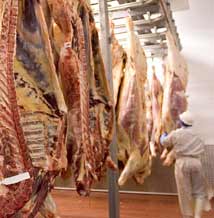
Despite genetic improvement in beef cattle, worth about £23m a year, increasing relevance of EBVs in purebred populations by using final carcass weight and grading information could see further improvement, according to SAC’s Mike Coffey.
“If weight, fatness class and conformation data collected by abattoirs could be used for genetic evaluations, this will enable faster and more accurate market signals to flow back to breeders,” said Dr Coffey.
A study conducted by SAC examined the feasibility of using carcass weights and classifications from abattoirs for the genetic evaluation of cattle carcass weight, fatness class and conformation class.
The identity of animals slaughtered at Dovecote Park, measured for conformation, fat class and weight was linked to a sire via the British Cattle Movement Service. The results showed carcass conformation and carcass fat had a moderate heritability, with some association between the two traits.
“Carcass weight resulted in a high heritability, however, the result indicates there is considerable variation among sires for the traits. The carcass of offspring of the genetically top five sires for carcass weight is expected to be, on average, 72.9kg heavier than the offspring of the worst five for this trait. This is equivalent to 24% of the mean carcass weight,” said Dr Coffey.
“Although the use of EBV’s is increasing, the uptake has been slow. And with the UK only 65% self sufficient in beef, which is on a declining trend, it’s crucial to improve performance and efficiency of livestock enterprises.
“The results of this study provide strong evidence of the existence of genetic variation in carcass traits of beef animals, and therefore improving beef quality carcass traits through genetic selection is possible.
“This means selection using carcass evaluations will increase beef output and, therefore, reduce wastage and carbon footprint, ultimately bringing farmers and processors closer together,” he said.