

How dairy farmer made savings to counter milk price drop
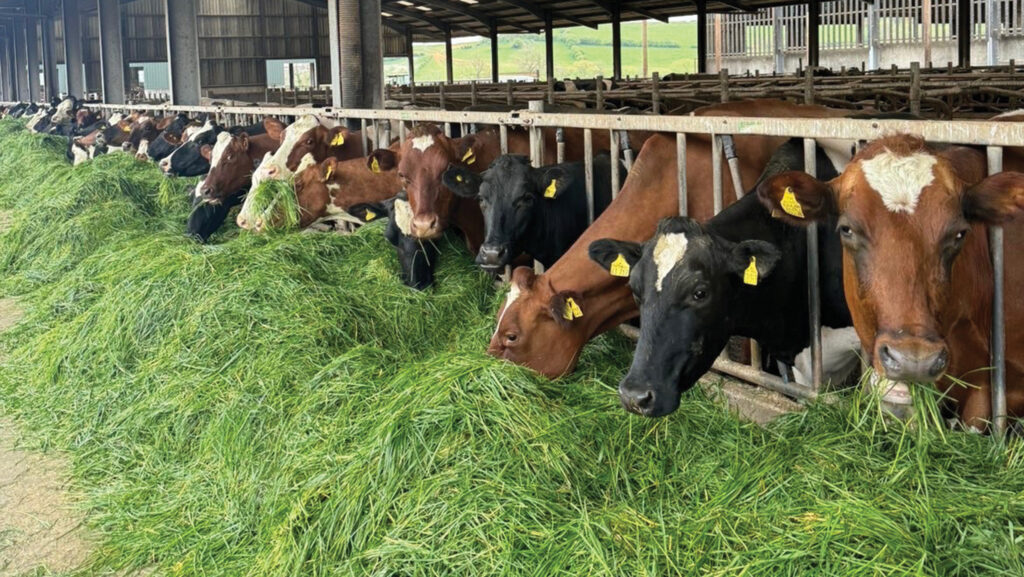 © Paul Waterfall
 Dairy producer Paul Waterfall has had to contend with an 8p/litre drop in milk income since last autumn.
The business produces 6m litres of milk annually, so this equates to nearly £500,000 in lost revenue.
He milks 1,000 block-calving cows across two tenanted units in Leicestershire in partnership with his wife, Julia.
And their son Henry recently returned to the business after travelling in Australia.
See also: 10 ways to help shield dairy herds from sharp price shocks
Farm facts
Underhill Farm and Sludgehall Farm
- 400 spring-calving New Zealand/Irish Holstein Friesian cows at Underhill Farm
- Yielding 6,000 litres at 4.65% butterfat and 3.8% protein
- Calving over 12 weeks from 14 February
- 600 autumn-calving cows (replacing Holsteins with crossbreds) at Sludgehall Farm
- Supplying Long Clawson Dairy on a cheese contract
- Both farms are tenanted
- 32,000-laying hens supplying eggs to Noble Foods
Paul says the downturn could not have come at a worse time.
Following last season’s drought, they had to purchase additional feed to cover forage shortages, which depleted cash reserves.
Now, because the cows have had supplementary feed, they are milking well at a time when many processors are imposing pricing structures to deter spring milk production.
Perfect storm
Paul supplies Long Clawson Dairy and has been on an A-B pricing structure for some time.
His milk price drops by 13% in April and 17% in May, but this is offset in the autumn by higher prices, he notes.
At the same time, rising input costs resulting from the war in Iran have added further strain.
“The milk price has crashed, and all these costs out of our control have gone mental. It’s been a triple whammy,” he says.
He adds that they also recently borrowed a significant sum to install a new parlour at their spring-calving unit.
Fortuitously, the Waterfalls diversified by adding a 32,000-bird laying flock four years ago, which has somewhat insulated the business from these price shocks.
“The good thing is, when the egg price was low, we had a good milk price, and now the returns from the poultry business are keeping the dairy afloat.
“Diversifying has been our saviour,” explains Paul.
Cost savings, however small
He calculates that their breakeven milk price currently stands at 39p/litre, leaving the business operating at a deficit.
With margins squeezed, the Waterfalls have scrutinised their comparable farm profit (CFP) with a fine-tooth comb, searching for incremental savings across every area of spend.
“There are no big savings to be made, but we have gone through everything, looking to save a fraction here and there,” he says.
One area has been electricity costs. With solar panels at each farm to reduce electricity consumption, the first port of call was making sure these were working properly.
“We have been feeding TMR [total mixed ration] this winter right by the panels, so they have got dusty.
“We cleaned them to ensure they are working optimally.”
Next, he turned his attention to timing the parlour equipment to maximise energy generated by the solar panels.
“I’ve set the timer so the compressor that services the ice bank is turned on in the day to capture energy from the solar panels.
“If there is not enough light to generate enough ice, rather than using mains electricity, we use night-time electricity, which is on a cheaper tariff.”
Grazing to alleviate pressure
Turning cows out to grass early has helped reduce feed costs and labour.
Spring calvers began grazing during the day from 2 February and are now outside full time.
Meanwhile, lower-yielding autumn calvers were turned out in the first week of March.
For the first time, Paul’s higher-yielding autumn calving cows – those giving more than 30 litres/day – have been zero-grazing and fed a buffer of grass and maize silage, rather than a partial mixed ration. This has delivered savings of 3.5p/litre.
Rations have been simplified, with expensive fats and minerals removed.
“We’ve fed the autumn calvers well in early lactation to hit peak yield and get them back in-calf.
“Now, we can try to save some money and get them milking off grass.”
Group buying and peer-to-peer learning
Being part of the Vale Farmers buying group has helped the business secure inputs at competitive prices. Feed has been forward bought until December.
Ironically, because of last year’s drought, Paul was unable to apply fertiliser, so they still have a good amount in stock.
He also received free digestate over the winter, which they are putting to good use.
The whole farm has been soil-tested, and manure is being analysed to fine-tune nutrient applications and ensure the correct amounts are applied.
But Paul says their participation in a discussion and benchmarking group is the most valuable of all.
“Being able to visit farms achieving the lowest costs helps to see what they are doing to get it.
“We are active on WhatsApp every day – it helps knowing others are in the same position as you.”
Future savings
Although capital expenditure on the new 32-64 swingover parlour has not come at a great time, it is expected to improve labour efficiency at the spring unit.
“We currently have three people on a shift – one person scraping and doing beds and two milking.
“But next winter, we will be able to push all of the cows into the collecting yard, two people will scrape and do beds, and then they will milk,” explains Paul.
This will reduce staffing requirements and lower fixed costs in the long term.
Until then, Paul continues to make incremental savings and is maximising his milk contract by ensuring he is producing high-fat, high-protein milk.
“What’s keeping us afloat is the money from the eggs, and we do have a good contract that rewards us for high milk solids.”
In the meantime, like all other dairy producers, Paul hopes the price will recover soon.
A quick recap on financial KPIs
- Breakeven milk price includes all costs minus non-milk income, such as Sustainable Farming Incentive, forage sales, calves and cull cow price income. It calculates the income required to reach zero profit and includes non-cash costs of depreciation and unpaid labour.
- Cost of production includes all costs associated with producing milk (before rent and finance, as these vary widely and are not included for benchmarking purposes). It is worthwhile including these figures when not benchmarking within a group. However, cost of production does include depreciation and an imputed cost for unpaid labour.
- Breakeven cashflow milk price considers planned reinvestment rather than depreciation, drawings not unpaid labour, and includes costs of loan repayments and tax liabilities.
Which one is used will depend on what the farmer wants to understand about their business.
It is still important to budget cashflow month by month, as milk income and costs can vary, particularly for block-calving businesses.
Source: Anna Bowen, consultant at The Andersons Centre, who was talking on a recent AHDB webinar.