

Advice on protecting grass reseeds with nurse crops
 © Tim Scrivener
 Episodes of extreme weather are adding new and recurring challenges to reseeding.
In response, some farmers are opting to establish fast-growing temporary crops with grass to protect and support the emerging ley during that critical early phase.
“Nurse” crops – named as such for their ability to nurse young grass as it establishes – offer the sward protection from drying out and suppress weeds.
See also: How a dairy is using grass data to identify paddocks for reseeding
They have a dual benefit too, offering early grazing or a light cut of forage before the grass thickens up, says forage and grassland specialist Charlie Morgan.
Leys established in late March could be grazed from mid- to late June, he suggests.
For autumn reseeding, the role of nurse crops in reducing nutrient leaching and soil erosion on bare ground is increasingly important too, he adds, as the high rainfall levels seen in November 2025 reflect.
Benefits of a cereal nurse crop
- Extra dry matter yield in establishment year
- Can be harvested as green silage at heading or taken to wholecrop
- Creates a good microclimate, sheltering the establishing pasture species from wind and heat
- Reduces impact of annual weed competition, as there is less room for weeds to develop. When harvesting as green silage or wholecrop, it removes annual weeds
Options for spring
For Charlie, the nurse crop of choice is barley for spring reseeding programmes.
“Spring barley will protect the emerging grass from the effects of too much sunshine, preserving a bit more moisture in the base, and will protect from the cold,” he says.
When grown for this purpose, barley is not taken to the grain. Instead, it is cut as a silage in the green or as a wholecrop and, if cut early enough, it can even be harvested twice.
Although the benefits of nurse crops are wide-ranging, establishment can fail in extreme heat and drought.
Grass and forage seed specialist Francis Dunne says this was evident in the summer of 2025, caused in part by cereal nurse crops drawing on what little moisture was available.
But he adds: “This is a very rare occurrence and was noticeably worse where the cover crop was thick, or uneven.”
He also believes spring barley is a good choice for a nurse crop because it is much earlier and a higher quality option than some others.
However, he notes that “if you are grazing, more aggressive species become interesting because they can be grazed earlier”. He advises removing nurse crops as soon as practicable to allow the sward to develop.
Timing and soil temperature
Barley and oats are especially useful for growing after grazed winter crops, where the ground is open and prone to weeds.
For spring sowing, both provide early cover and protect seedlings without being too aggressive. Charlie recommends drilling with grass in March or April, once soil temperature is above 8-10C.
It is risky going any earlier, he says, even if the soil conditions are right.
As recent years have demonstrated, spring weather can be very unpredictable, he adds.
While some farmers in coastal regions such as Cornwall and Pembrokeshire have successfully established a combined nurse and grass reseed as early as February, he cautions against it.
“The weather can change a lot between February and April. Even if the seed has germinated, if you get a bit of wet and then a bit of frost, the seedling will be pushed out of the ground, the roots dislodged and it will shrivel to nothing,” he warns.
“In very climate-specific areas, some farmers have a go at sowing earlier, but it is a definite no for inland. Hold off until the conditions are right – for that, you are looking no earlier than March.”
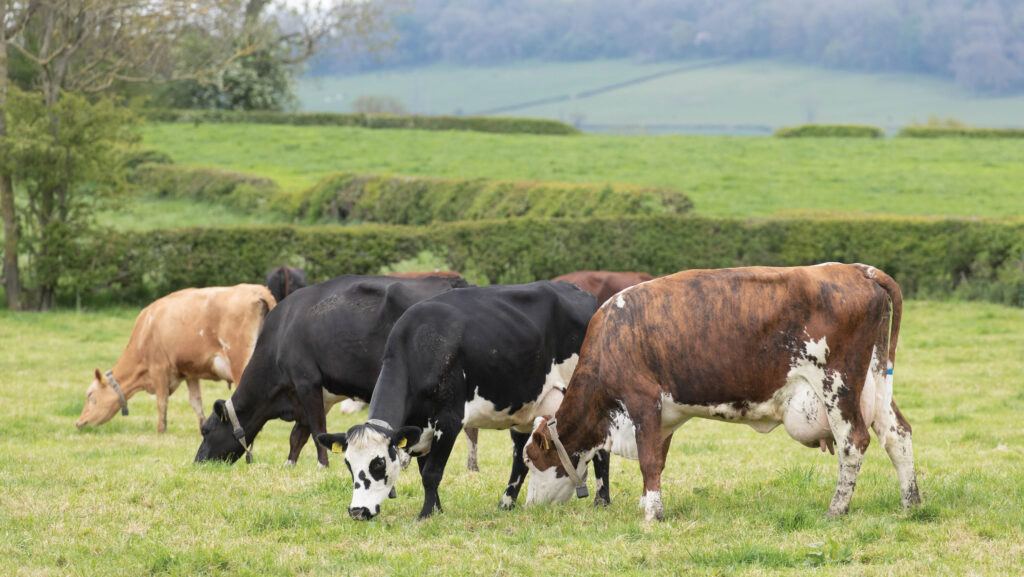
Cereal crops grown to nurse new-sown leys can be grazed, silaged or taken as wholecrop © Tim Scrivener
Seed rates
Seed rate of a nurse crop is lower than it is for dedicated barley and oat crops.
“If you are just growing barley, it is sown at 175-185kg/ha, but when you include it in a grass mixture, the grass is where the value is, so bring it down to 75-85kg/ha,” Charlie says.
“Otherwise, if the barley grows well, you can have too much cover and it will shade out the grass, leaving big bare patches of soil once the barley dies away.
“Some might slightly up the seed rate, but if you go a bit heavier, you must take the barley off earlier,” he adds.
For a nurse crop of oats, he recommends a seed rate of 60–80kg/ha, with light grazing or mowing when the cover reaches 20-25cm, to let grass take over.
“Don’t cut too low; you should just take that cover off and then you will have the reseed coming up underneath,” he says.
When barley is harvested green, its quality can match grass, as protein content can be as high as 15%.
“Cut it 10-11 weeks from germination of the grain and you will get that 15%, and that still allows enough time for the grass reseed to establish itself reasonably well,” Charlie advises.
Autumn-sown nurse crops
Forage rye has the lowest feed quality when compared with other nurse crops. However, it is more resilient than barley and oats and can therefore be established earlier.
Francis believes that triticale can be a more cost-effective, vigorous and flexible alternative but says both are appropriate.
“The advantage of forage triticale is that it is cheaper to produce, therefore slightly more economical,” he says.
Forage rye can be the more expensive option because yields are lower than cereals.
However, it will germinate and grow at a soil temperature of 3–5C, making it ideal for sowing after late-harvested crops such as fodder beet and maize.
Drilled in isolation in November or December, it will provide ground cover over the winter.
Grass seed can then be drilled or broadcast into the standing rye in February or March, once the soil temperature rises.
Environmental benefits

Undersowing in autumn avoids having bare ground in winter © Tim Scrivener
While undersowing in the autumn is far less common than in the spring, it can work well after early harvested cereals, maize or wholecrop – scenarios where the ground would otherwise be bare going into winter.
The nurse crop minimises leaching, keeps soil structure open, and allows the grass to get away quickly in spring, says Charlie.
He advises lightly grazing or topping rye early in spring to open the sward for the grass to establish. If conditions are mild and dry, winter oats can also be used, but rye is more reliable in wet or cold ground.
Forage rye offers a good option for autumn sowing too, to give winter cover and weed suppression, as it grows rapidly in cool soil.
For autumn establishment, the rye should be drilled with, or just before, grass in late August or September.
As a nurse crop, Charlie recommends a seed rate of 60–80kg/ha, half the normal amount. It should be grazed or cut in early spring before the plant heads, to allow grass to take over.
Early sown crops of triticale can be grazed in late autumn with the main grazing period from the end of February to mid-April.
They can be cut as silage in late April and have good potential for wholecrop silage harvested in late June.