

Advice on using natural predators to control nuisance flies
 © Tim Scrivener
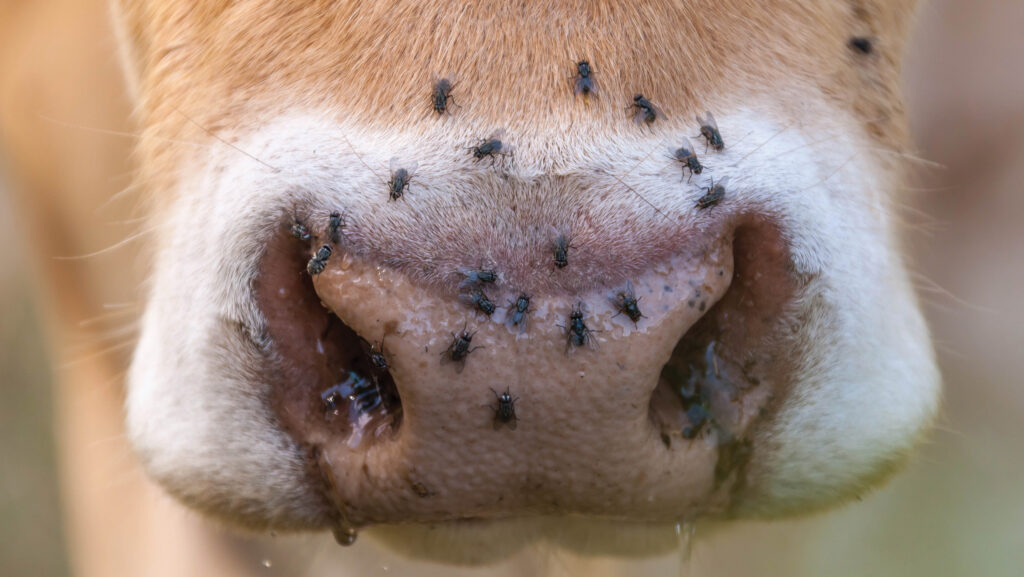
 Early birds may get worms, but livestock farmers planning fly control in winter benefit by preventing a population explosion of common and stable flies next summer.
Starting a tailored fly management programme in March using natural predators will not kill every single fly, but it will reduce numbers to manageable levels.
And it can also cut the numbers of developing flies that overwinter.
See also: How an organic egg producer eliminated nuisance flies in sheds
A further, secondary benefit could be controlling numbers of the bluetongue vector Culicoides midge in winter housing, using the mite to eat its eggs.
Fly facts
- A cow with 10-15 flies on her drops 10% in milk yield
- A fly can have two to three breeding cycles in just two weeks of warm weather
- A female can lay clutches of 100-150 eggs and do this five times in her lifetime
- From egg to hatching another fly in summer happens every five to six days
Biological flies to disrupt the life cycle of pest flies
- Biowasp Muscidifurax raptor and Spalangia cameroni – mini-wasps that target fly pupae
- Macrocheles robustulus – mites that feed off fly eggs and young fly larvae (generally used in combination with other predators); 50,000 predators treat a surface area of 250sq m
- Hydrotaea aenescens – a fly that attacks pest larvae in slurry pits
- Bucket fly trap – for use in fields, covers a radius of 30m, captures high volumes of adult flies on routes to water or sheds
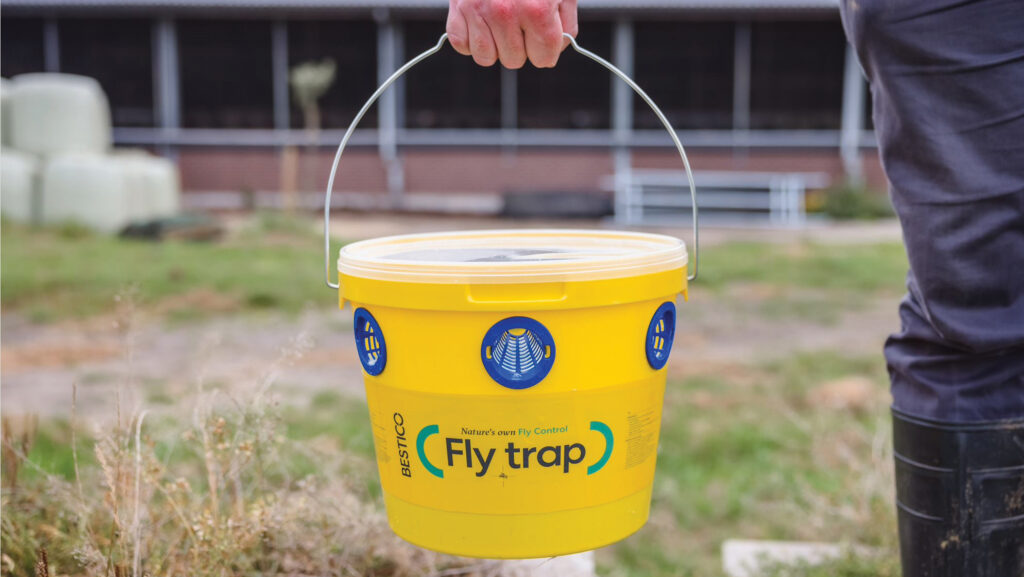
Fly trap bucket © Bestico
Source: Bestico
However, it is not yet possible to target predators in significant numbers because it is difficult to locate midge breeding sites, says Nicholas Davies, general manager for Bestico.
He reports an increasing interest in biological alternatives as the range of effective chemical control methods has dwindled.
“Fly control with chemicals tends to be a quick fix based on ‘I’ve got flies’, whereas bio control, using a parasitic wasp, predatory fly or mite, is more nuanced.
“It requires some planning because it’s not corrective: we’re trying to prevent a mass breakout of flies,” he says.
“We don’t advocate going without chemicals, but to combine them in a plan – though there are also environmental and wildlife benefits from reducing chemical use.”
Choice of predator
But it is not simply a case of purchasing a bag of insects to dot around the farm.
Getting the best out of a natural predator means selecting the right species, then locating a suitable environment, so that it can breed and establish a population that is effective in controlling the problem flies.
Bestico’s technical consultants first make a site visit to survey the farm’s ecology, looking for problem-fly breeding areas.
Then they work out a strategy of biological control built around periodic release, considering livestock numbers, housing and management, balanced with improvements in poor hygiene.
“Farmers always tell us they have a fly problem in the milking parlour, but flies are brought in with the cows – a parlour is too clean for flies to breed,” says Nicholas.
Aside from muck heaps and lagoons, he says any spilled feed, dirty vegetation surrounding buildings, or rotting organic matter makes a perfect breeding area for flies.
“We find stable-fly eggs in the cracks of dried muck,” he adds.
However, a straw-bedded area (such as a hospital yard or calf pen) is a fly magnet.
They happily reproduce in a build-up of organic matter combined with moisture from animals, or spillages from troughs and buckets.
Farm predator plan
A typical farm plan starts in March or April and lasts until September, October or November, depending on the weather.
Supplies of predator insects to control the common house fly, lesser house fly and stable fly are delivered throughout the fly season (there is also a vet distribution network) for release as directed.
This is weekly for the first eight to 12 weeks, to reduce the fly population, after which a further site assessment takes the frequency down to fortnightly, and then finally dropping it to a monthly maintenance level.
There are no binding contracts and total costs are farm specific, says technical consultant Jordan Turnbull.
“One bag of bio wasps costs £28.90 plus delivery and will treat an area of 25 calves in straw pens, or 50 cows,” he reveals.
Spend on biological control is difficult to compare as Jordan has yet to meet a livestock farmer with a fly control budget.
Chemicals, sprays and pour-ons are bought as and when required, he says.
Most farmers, he thinks, would not even consider the financial outlay, but need to reckon up the cost of flies to their business in lower intakes, lost production, animal stress and disease transmission.
Case study: Marshalls Farm, West Sussex
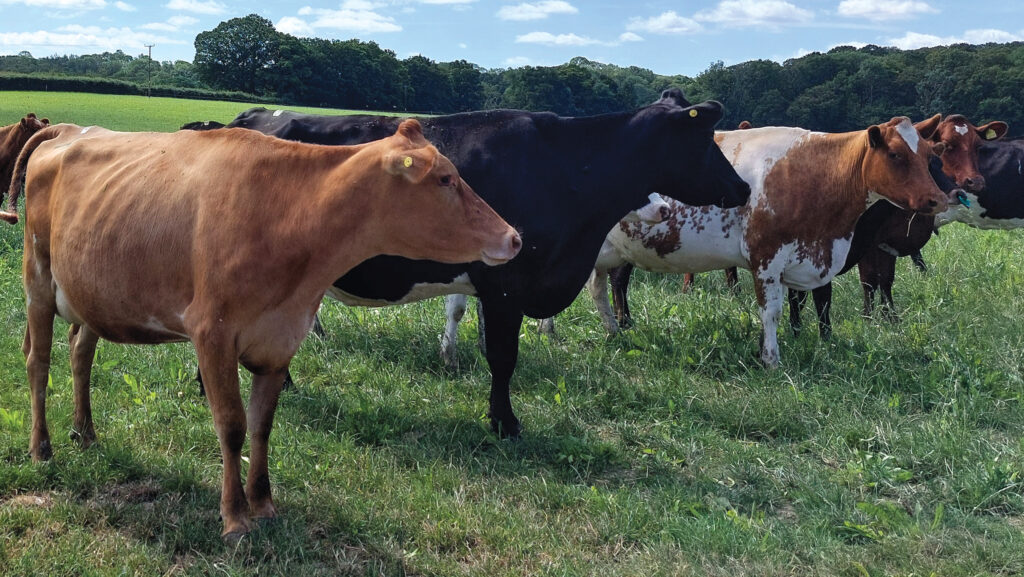
© MAG/Shirley Macmillan
Farm facts
- 320 crossbred cows
- Spring block-calving
- 100 R1s and 100 R2s
- Farming 502ha
- Average yield 5,700 litres
Patience and planning have paid off for organic milk producer Jeremy Way.
A regular application of fly predators every two weeks, from May to September, has cut the nuisance fly population at Marshalls Farm.
“There are noticeably fewer flies around the buildings and farmyard than before – and we see fewer flies in the house,” says Jeremy.
Next year will be his fourth following a control plan.
“We were told by other farmers that we would see a small impact in the first year, bigger ones in the second and third, because it is cumulative – and we have seen that.
“So it needs patience, you can’t expect results on day one.”
Being organic, the herd was struggling to find suitable fly control methods and experiencing more cases of summer mastitis, when their vet suggested bio control.
“Every year you think the flies are not too bad in June, when it’s getting hot.
Then suddenly it reaches a whole new level in July, and you have cows bunching up in paddocks,” he says.
Respite from flies
Although he likes a clean farmyard, Jeremy still finds enough good “dirty” areas to deposit fly predators around the sheds and near the collecting yard.
This has given cows respite from flies as they come in for milking and the drop in fly numbers has been nicer for the humans milking in the parlour too.
“I would say the cows are happier in the collecting yard.
“Our mastitis rate is low – we can’t compare years as we changed our recording software – but our cell count was 197,000 cells/ml in August 2022 and in August this year it was 124,000 cells/ml.
“So there are positive signs; obviously this can’t all be because of bio control, but it’s marginal gains [from lots of things].”
This year, predators were released into early November owing to warm and damp weather.
Bucket traps were also introduced to fields close to the dairy to reduce the fly population around cows when they walk into milking.
“Fly spray costs are incremental over the year, we pay per delivery.
“If it saves us two to three cases of summer mastitis a year, it probably pays for itself,” says Jeremy.