

Advice on harvesting rainwater to build farm resilience
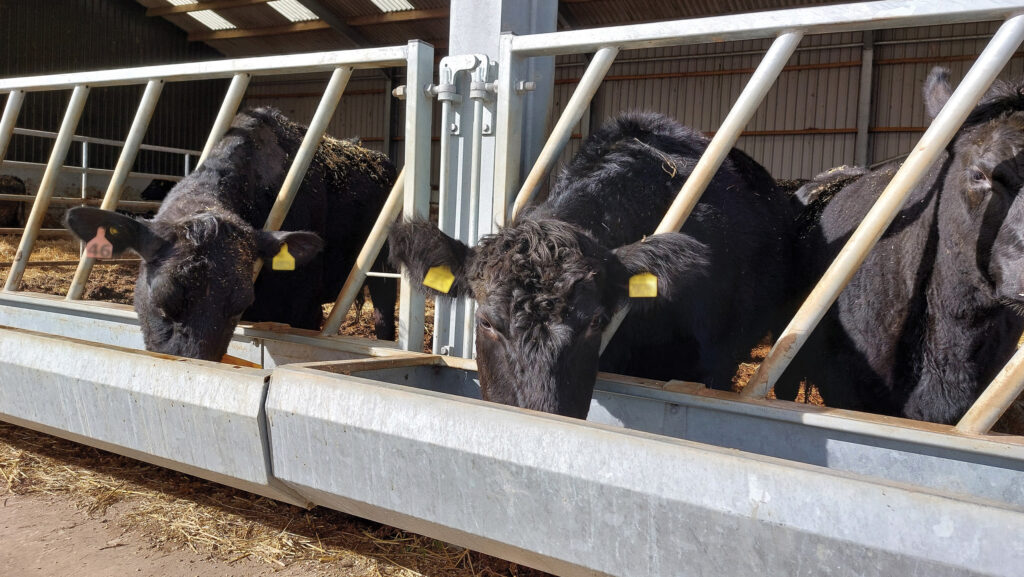 Cattle at Cowpasture Farm will be drinking rainwater and saving money later this year © MAG/Shirley Macmillan
 Wet days are not just a reminder of broken gutters and downpipes in need of repair.
They are an ideal time to look at the potential for recycling rainwater.
Calculating how much rainfall can be collected, stored and used, to offset mains water charges, will justify the investment in rainwater infrastructure.
See also: How rainwater harvesting is protecting borehole supplies
“You can divert rain out of the slurry system, or prevent it from falling on foul yard areas.
“But think about spending a bit more and capturing it – you double the benefit,” says Adas consultant Tom Brassington.
He thinks all new sheds should be incorporating some form of rainwater collection and storage, as is it cheaper when part of the original design.
(Retrofitted systems may qualify for grant aid via a water company or Catchment Sensitive Farming.)
Harvesting rainwater adds to a farm’s resilience and, in some parts of the country where water companies are struggling to supply domestic households, it gives independence of water control, says Tom.
He suggests that payback for a rainwater system should be calculated on a 10 year-basis – about the lifespan of a tank.
However, this depends on what the farm pays for a cubic metre of water.
“Also bear in mind that water prices will go up – if you do the sums on today’s price, it could be 10-20% higher in future,” he points out.
Assess water needs
Tom’s advice is to start by assessing water needs and collection potential, working out the total roofing area, together with monthly and annual rainfall volumes.
“If you are not on a borehole, look at utility bills to get an idea of your annual water use.
“Otherwise, there are standard calculations for how much a cow drinks,” he explains.
Livestock farms on borehole supplies may not make substantial savings, unless rainwater is used to supplement a shortfall in supply.
A collection and storage system can gather rain from any roof type (asbestos, fibre cement or traditional tiles and slates) provided it is sound, says Tom, although evaporation losses from flat or sloping roofs will affect the volumes collected.
Gutters and downpipes need to be intact and may need realigning – particularly with a long roof on a shed.
Gutters might also need upsizing to cope with heavy downpours.
Storage capacity
Storage tanks are sealed, black plastic to prevent light ingress and algae growth.
This preserves water quality – as does using water as it is collected, so there should be no issues with taint.
“The general rule of thumb is to be able to collect one month’s worth of water – and a 20cu m storage tank holds, on average, four weeks of rainwater,” he says.
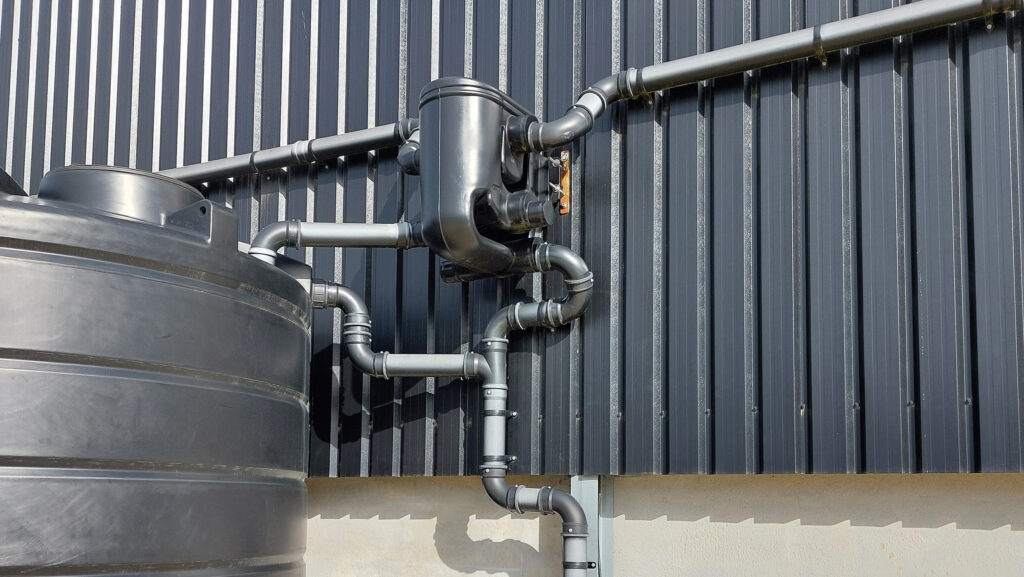
Water tank with filter and adaptor © MAG/Shirley Macmillan
Water for human consumption or washing equipment for food production (such as a milking parlour) must be potable/mains water quality.
In addition to filters, for removing debris or bird droppings, this means UV-treatment has to be installed.
“Check with your milk buyer what standards they require for water for dairy cows to drink or adding to feed mixes,” he advises.
End use determines the site of a water tank: Tom says rain is best captured where it is to be used, and gravity fed to its destination.
The simplest option is at the end of a gutter to feed troughs in the shed.
Consistent water pressure could be the only hindrance: a full tank relies on a head of water to create high pressure, but as it empties, lower pressure may create supply issues at the trough.
“Check you have the right ball cock to cope at lower pressures,” he says, adding that using the water far from collection (washing down a parlour, for instance) will require a pump, which will add cost.
Essential maintenance
Gutter maintenance becomes a must in a rainwater harvesting system – at least annually, depending on the amount of debris, vegetation, or chopped straw flying around.
Tanks merely need protection from being hit by vehicles.
“If they are in a vulnerable position, protect them with a post and rail; if they are not on a concrete pad, rats will try to burrow underneath,” says Tom.
Case study: Cowpasture Farm, near Huntingdon, Cambridgeshire
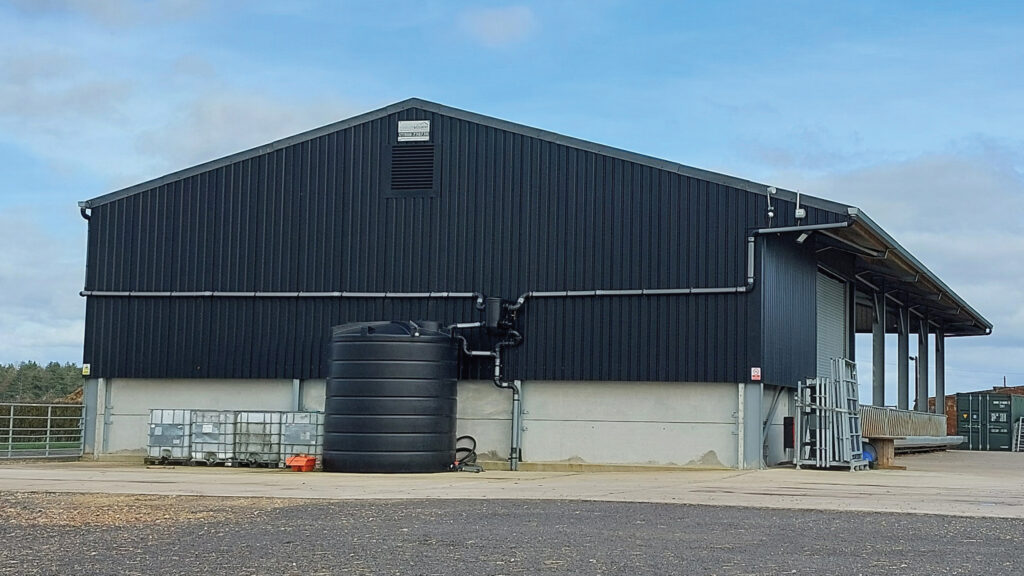
A 15,000-litre tank was added to a new shed at Cowpasture Farm © MAG/Shirley Macmillan
Savings of £600/year from using harvested rainwater rather than mains water in the sprayer will increase this year when Matt and Stacey Branson install an additional rainwater tank for cattle.
With 30 animals drinking 1,000 litres a day at Cowpasture Farm, Stacey says they are keen to switch to rainwater in the troughs.
Farm facts
Cowpasture Farm, near Huntingdon, Cambridgeshire
- Farming 89ha of cereals, permanent pasture and multispecies leys
- 10 pedigree Aberdeen Angus and 45 Angus-cross cows
- Spring calving
- 12 replacements
- Three bulls
- Steers sold as stores at 12-14 months
- Heifers finished at 22-24 months
“We have used it in temporary troughs and the cattle prefer it.
“We have the capital grant this year and will put a 10,000-litre tank at the opposite end of the shed.”
In 2020, the Branson family redesigned their old yard around modern farm machinery, a suckler herd, and separating clean and dirty water.
Surface water now drains into a series of sediment ponds, before eventually reaching the nearest watercourse.
A 36.6×15.2m shed was erected to hold a workshop and store, plus two straw-bedded yards.
Galvanised box guttering now feeds rain from the 574sq m roof area into a 15,000-litre tank.
Water quality
Only 70% of rainwater goes into the tank; 30% is used to steadily flush through the filter, aerating as it goes.
Matt says this helps improve quality during storage and sediment is easily drained out when it settles at the bottom.
He explains that the tank is positioned out of the way, so it cannot be caught by passing tractors or visiting lorries.
“We use half of the tank water when spraying, but it never runs out, as by June we’ve usually had more rain to top it up,” he says.
As well as filters, the couple plan to install UV-treatment on the second tank to avoid the possibility of dead birds affecting water quality.
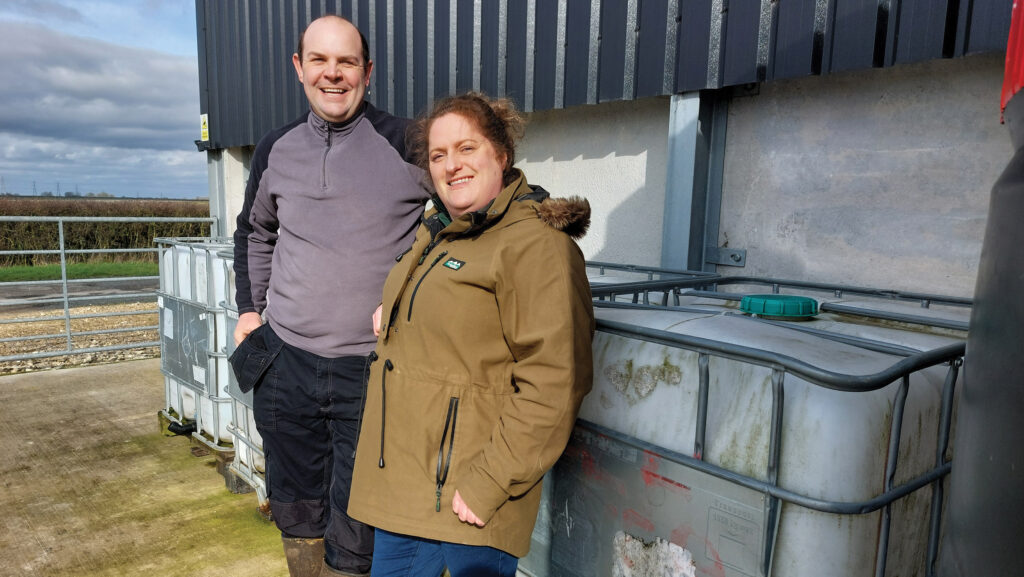
Matt and Stacey Branson © MAG/Shirley Macmillan
Matt thinks they might also need a pump to supply enough pressure.
“We don’t have any trees about so there are no leaves to clean out of gutters, but I clean the filter two or three times a year,” he adds.
Stacey advises anyone considering rainwater tanks to invest in the best quality and calculate livestock water usage over two to three months.
“You want a quick turnover of rainwater, not having it sit there for long periods – I would say no more than three months – especially if it’s for drinking water.”
Emergency use
A bonus from stored rainwater is extra resilience in case of fire, she adds.
The local fire brigade travelled three miles for water to tackle a severe combine fire in a neighbour’s field in 2022.
Stacey reports that using the tank water “wasn’t approved use” and so she worked with Cambridgeshire Fire Service to ensure that the farm had the required adaptor.
It means that in future emergencies, their rainwater can be used by a fire engine.