

How farm-designed solar energiser powers fencing year-round
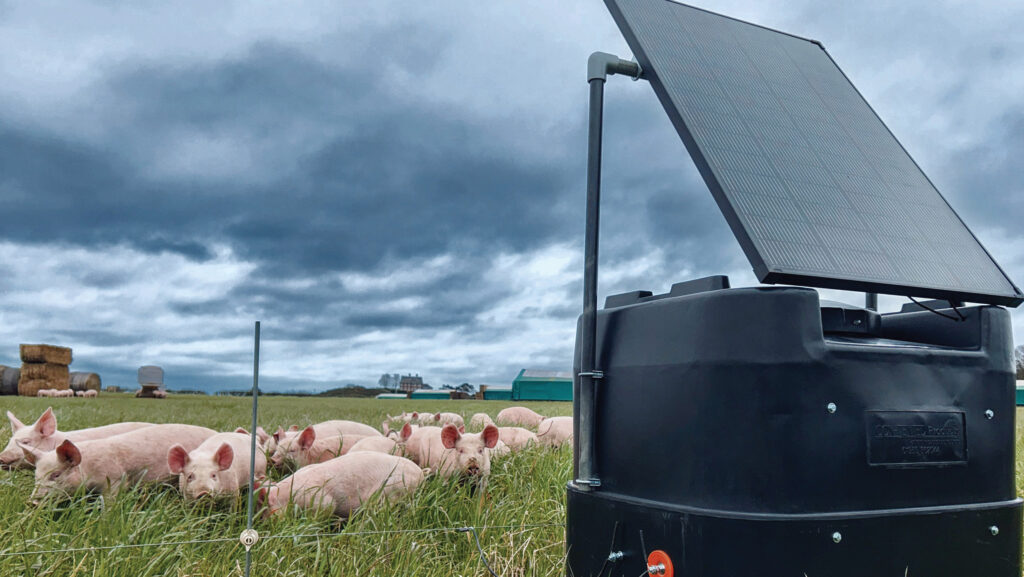 © Con-Tented Products
 A solar-powered energiser that does away with routine charging of batteries to power electric fencing on outdoor pig units year round has been developed by a Norfolk pig manager.
See also: 5 ways to keep disease out of outdoor pig herds
Most systems continue to rely on 12V batteries to run energisers – a dependable but labour-intensive setup requiring regular transport, charging and replacement, says Rob McGregor, who works for NFL Livestock.
For producers operating across multiple sites, that reliance on battery rotation is becoming increasingly difficult to justify.
“On a typical 1,000-sow outdoor unit, four or five energisers may be in operation at any one time, each requiring its own battery,” he says.
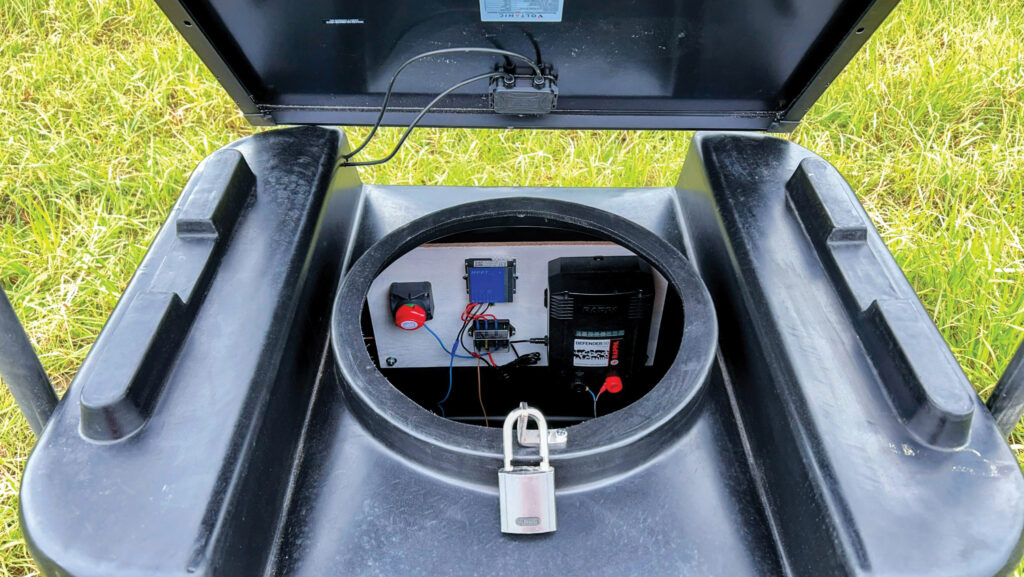
A trickle recharge via solar avoids the need to handle batteries © Con-Tented Products
“Maintaining charge across dispersed fields involves repeated journeys, vehicle use and time that could be directed elsewhere.
“It’s a job that has always been accepted as part of the system. But when you break it down, it’s a significant demand on labour and resources for something that is critical to the whole unit.”
Reliability and handling issues
The implications extend beyond labour. Battery performance is inherently variable, particularly where units are located on land without access to mains power.
Frequent deep discharge cycles shorten battery life, while handling and transport increase wear. There are also safety considerations linked to charging and handling lead-acid batteries, says Rob.
At the same time, consistent fence performance is essential. Any drop in voltage can compromise stock control, with implications for both productivity and biosecurity.
“Maintaining a reliable fence is fundamental,” he says. “If pigs get out, the situation can escalate quickly.”
From top-up to year-round charging
It is these challenges that have led Rob to look at developing an alternative over recent years.
While attempts to reduce reliance on battery rotation are not new – both wind and solar have been explored – historically, these systems have acted as supplementary charging rather than a complete replacement, he explains.
“Solar has been around for a long time, but it was always more of a top-up. You still needed to take batteries off-site to recharge, particularly through winter.”
Recent developments in solar panel efficiency, voltage regulation and battery design have changed that position, and by combining improved components, Rob has developed a self-contained solar-powered energiser system capable of operating year round without routine battery replacement.
The unit integrates a solar panel, regulator and sealed battery within an insulated casing. A consistent charge is maintained through continuous trickle input, rather than repeated discharge cycles.
A single installation can power about 12ha (30 acres) of paddocks – equivalent to about 300-350 sows – allowing systems to be scaled according to unit size and layout.
Practical benefits
The primary advantage is the removal of routine battery handling, says Rob. Once installed, the system requires minimal intervention, reducing labour, fuel use and machinery movements associated with battery transport.
Battery lifespan is also improved. By avoiding repeated full discharge cycles, the system maintains charge within optimal parameters, extending service life.
“You’re not constantly running batteries flat and recharging them,” he adds. “That alone makes a significant difference to longevity.”
There are also indirect benefits in terms of system reliability. With a consistent power source, the risk of fence failure is reduced, supporting stock control and day-to-day management.
That reliability becomes increasingly important as units expand and become more fragmented, with pigs spread across multiple blocks of land, notes Rob.
Cost and payback
At about £950/unit, the initial investment is higher than conventional battery setups.
However, the payback is realised through a combination of reduced labour, extended battery life and improved operational efficiency, believes Rob.
“It’s not just one saving. It’s the accumulation of small gains across labour, fuel, equipment wear and time.”
Additional savings come from reduced vehicle movements and fewer unplanned interventions to deal with flat batteries.
The system can also be used for other types of livestock, particularly in systems operating in remote or extensive environments without access to mains power.
“If you’re grazing livestock in areas where there’s no infrastructure, this kind of approach makes fencing far more manageable,” he adds.
From concept to manufacture
Early versions of the system were developed and tested on-farm, but bringing the concept to a wider audience has required input from Con-Tented Products, for which Rob also works as a consultant.
Manufacturing refinements, including standardised component layouts and precision-cut panels, have improved consistency and durability, while retaining the practical focus of the original design.
The system has been trialled across a number of commercial units, helping to refine performance under different conditions and confirm its suitability for wider use.
“This has all been about solving a practical problem on farm,” he says. “If something reduces workload and improves reliability, then it has value.”
Farmer-developed shade reduces heat stress risk
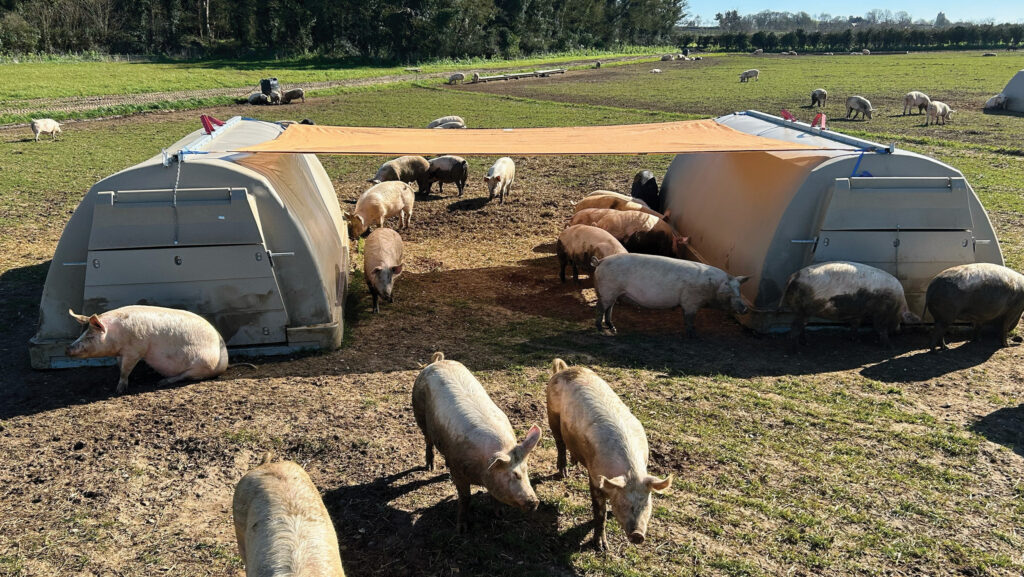
Modern pig arks act as anchors for shade fabric © Con-Tented Products
Heat stress is an increasing challenge for outdoor pig systems, with prolonged periods of high temperatures becoming more common.
Recent seasons have seen extended periods of high and very high UV levels – particularly across eastern counties – increasing pressure on outdoor herds.
For Norfolk manager Rob McGregor, that shift has prompted a rethink of how shade is provided in dry sow paddocks – leading to the development of a simple, farm-built solution.
Earlier attempts to introduce shade structures proved difficult to maintain, often relying on posts and basic materials that were quickly damaged or degraded in outdoor conditions.
“We tried it years ago, but it was high maintenance and didn’t last,” he admits.
The breakthrough came with changes in hut design. Modern dry sow arks are significantly larger and heavier than earlier models, creating an opportunity to use them as anchor points rather than installing separate structures.
Shade and airflow
By suspending shade fabric between huts, Rob has developed a system that is quick to install, robust in use and easy to manage.
Using woven material produced by Silo Stop, the shades block about 75% of sunlight while allowing heat to dissipate, avoiding the build-up associated with solid coverings.
“They don’t trap heat – that’s the key,” says Rob. “You’re reducing the intensity of the sun but still allowing airflow.”
The shaded area provides a noticeable drop in temperature, encouraging pigs to spread more evenly across the paddock rather than concentrating in huts or wallows.
“Instead of everything piling into one place, you get a much better distribution of animals,” he adds.
While wallows remain an important cooling tool, they are labour-intensive to establish and maintain, requiring water, machinery and ongoing management. Shade provides a complementary option that can be deployed quickly and left in place.
At about £155 for a 6x4m unit – typically serving up to 30 sows – Rob reckons the cost is relatively modest, particularly when set against the potential to reduce heat stress and associated production losses.
“It’s about making small changes that work with the system,” he says. “If it improves comfort and reduces pressure, then it’s worth doing.”
Both products will be debuted at this year’s British Pig & Poultry Fair, 13-14 May 2026