

How to achieve the best results with outdoor calving
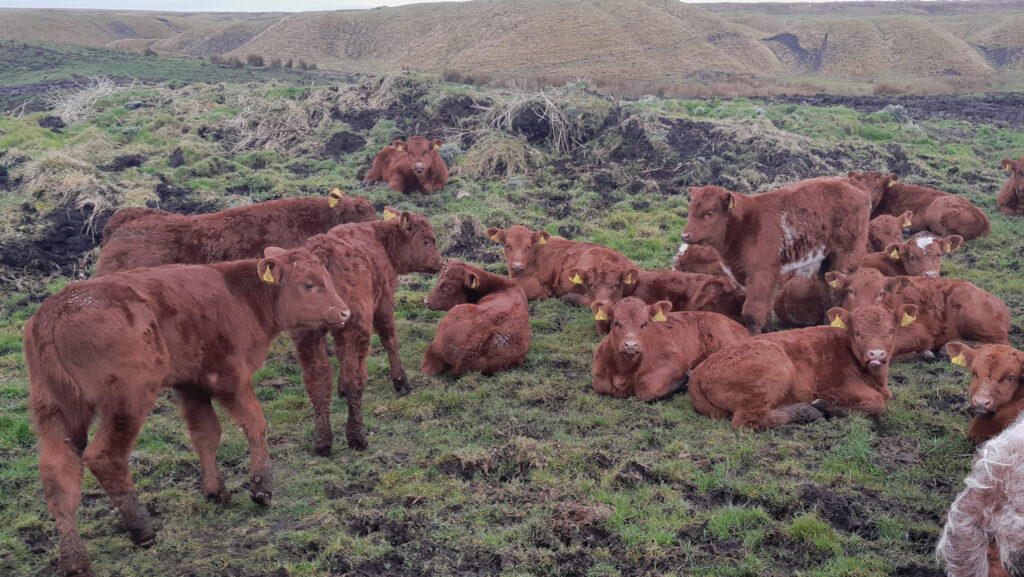 Calves at Lower Chesterhope Farm © David Stanners
 Calving suckler cows outside successfully needs the right body condition, good shelter, and a plan B for extreme weather events and emergencies.
Although outdoor calving immediately lowers housing and bedding costs, for it to work well the right cow type is essential.
The animal has to be fit for calving outside, suited to an outwintered environment, with good foraging ability and easy calving, says consultant vet Colin Mason with Ruminant Revival.
See also: How a Yorkshire suckler herd is achieving 96% calves weaned
However, he adds that it is sensible to be able to house more vulnerable animals, to avoid welfare risks. These include:
- Older cows (10 years and above)
- Those carrying twins (pregnancy test at eight to 12 weeks to identify twins earlier)
- First-calving heifers (they need careful management).
Colin says it is also important to have contingency plans in place.
Manage body condition
Monitoring and managing body condition – especially in late pregnancy – underpin good calving, particularly for outdoors.
“The risk from outwintering is when [fit cows] have to deal with cold, wet weather day after day – it soon brings condition down. Cows cope brilliantly with cold and dry weather,” says Colin.
On a scoring scale of 1 to 5, he advises calving at a score of 2.5 to 3.
The lean cow is the one to watch, as she tends to have more calving difficulties and poor colostrum quality.
For calving in March and April, cows want to be in the right condition from Christmas Day. The aim is to hold it steady, without trying to gain or lose weight.
“A tight calving pattern also helps, alongside good herd fertility: if 70% of cows are calving in the first three weeks, it means they are at the same stage, and so it makes group management of body condition easier,” he says.
Provide shelter
However, cows still need some form of natural shelter when calving outside – hillocks in upland areas, hedges, walls or trees.
“So that in the first 24-48 hours, when the calf is most vulnerable, they can easily shelter – it’s critical.”
The calving area also needs good, easy access to make checking cow and calf manageable, as well as being able to get them back to the yard when there is an issue.
Do not disturb
Ideally, calving cows should not be disturbed, though Colin points out that herds on a grazing rotation reduce pathogen build-up on paddocks by moving after calving.
“Be careful how much and when you move them. Cows like to choose their calving location, and it is important to remember not to move them in the first stage of labour, as this delays calving and increases the risk of stillbirth,” he warns.
Check mineral status
Mineral supplementation based on a farm’s specific trace element status is another essential for calving well and good calf viability.
Colin advises working with the vet to review soil types and analysis, alongside blood test results to establish mineral status, then deciding whether to supplement via licks or boluses.
Hygiene benefits from calving outdoors
One big advantage of calving outside is better hygiene.
The disease challenge is significantly reduced (for navels, calf scour), whereas in sheds there is a gradual build-up of pathogens as calving progresses.
Poor ventilation can also become a problem where cows are housed for long periods.
A quick and easy calving, producing a strong viable calf, with vigour, that suckles colostrum starts a good cycle, says Colin.
Good robustness and health from birth lead to better growth rates and lifetime performance.
Case study: David and Annabel Stanners
David and Annabel Stanners © David Danners
Farm facts: Lower Chesterhope Farm, Hexham, Northumberland
- 243ha
- 330m above sea level
- 400 EasyDam cross ewes lambing 10 April
- 70 Luing cows
- 10-12 replacement heifers kept each year
- Remaining cattle sold one month post-weaning
- Five cattle finished a year to sell to local and holiday let customers
Calving half of their 70-cow Luing herd outside not only reduces winter housing costs, but also improves health and hygiene for David and Annabel Stanners at Lower Chesterhope Farm, Northumberland.
They are producing an average eight to nine calves a cow with a target of 10.
Calving starts on 10 February and lasts nine weeks. The aim is to be finished before lambing starts.
David says there is no difference in mortality rates between the indoor and outdoor calved animals. Any issues tend to be in heifers, and they calve inside for ease of management.
“There is no drama with cows on the fell – calving just happens,” he says.
“One of the great things is the lack of infection because cows are not tightly stocked: we get no pneumonia and no scour in calves.”
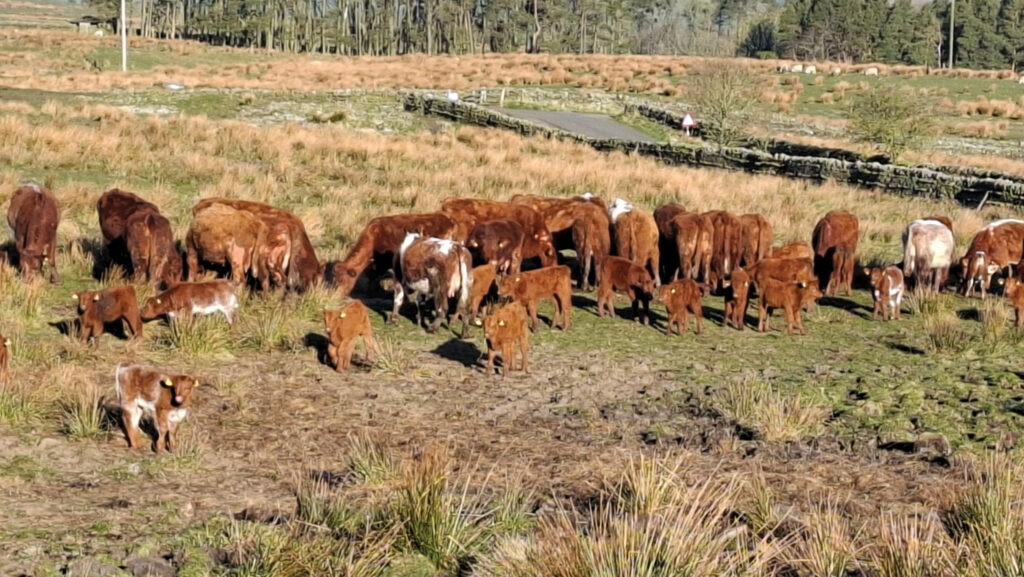
Searching for newborns is time consuming, but rewards with vigorous healthy calves © David Stanners
Sweet spot
While having the right breed is fundamental, David says they try to get the “sweet spot” in cow temperament: good mothers that are not over-protective of their calves.
Similarly, calving outside needs to maintain a low stocking rate for hygiene reasons, while also growing sufficient grass for the cows without fertiliser inputs.
Good ground is critical as well, he says. Cows calve on two blocks of fell land totalling 80ha (198 acres).
All boundaries and internal divisions are dry-stone walls, which provide shelter, plus there are two blocks of spruce plantations.
However, David also makes use of the farm’s legacy as an iron ore mine. Spoil heaps (now with flat tops for cows to lie on) and hollows offer cows shelter and a quiet calving spot.
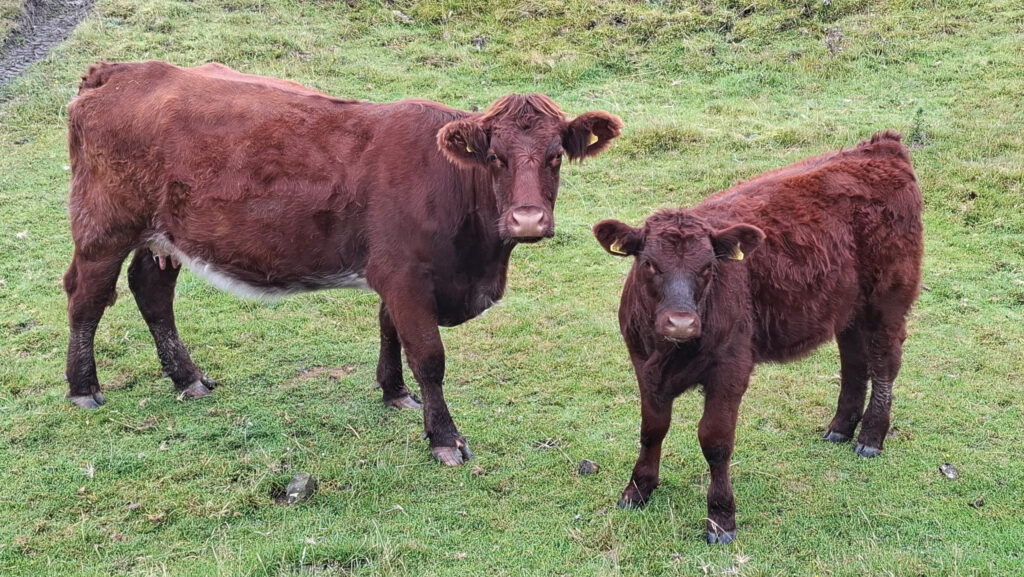
© David Stanners
Optimum condition
“We have 11.5km of wall; there is loads of shelter. But it makes it hard trying to find cows because there are lots of pit holes.
“The cows can find somewhere clean, dry and sheltered to have their calf,” he says.
“In autumn after weaning, we put 30 of our fittest cows on the fell – they might lose a bit of condition over winter from 3.5 to 2.5 at calving, but this means there are no difficulties with calving.
“They are fit, active, and the exercise means they have good muscle tone and they are working at their optimum.”
The cows are left to forage (drinking from natural springs that do not freeze, even in sub-zero temperatures) and are only fed after calving.
Heifers, second calvers and any poor cows (thin, or old) are housed for calving.
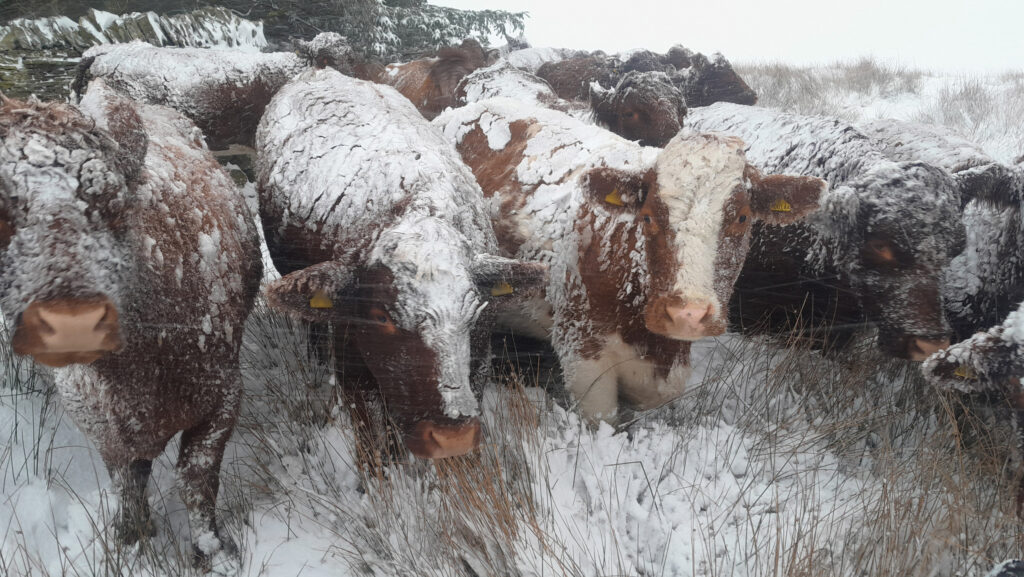
The Luing herd calving outside in winter © David Stanners
Post-calving diet
Once the two groups have calved, and are both on the fell, he feeds them one bale of silage for 30 cows a day, plus 2kg a head a day of mineralised rolls offering 12.5MJ of metabolisable energy/kg dry matter and 17% protein.
“I take the bale up with the tractor and roll it out so they can all feed, but it’s not their total diet, they have to then graze,” he explains.
A bolus of iodine, cobalt and selenium given in January covers the calving and mating period.
There are a couple of downsides to calving out on the fell: the time it takes, and having to walk a cow home when there is a problem.
“It is time consuming. You can spend hours looking for cows and calves; 99% of the time when you find them all is well,” says David.
But he adds that as more acreage goes into Country Stewardship, a bonus would be funding for virtual fencing collars, allowing him to target his search simply by using a phone app.