

Automated heat detection brings savings
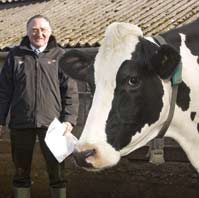
With expanding herd size and a general shortage of labour, making time for heat detection is a problem on many farms.
The need to get more cows in calf and keep calving intervals short is even more necessary when considering the £5 a cow cost for every day open.
With a calving interval above 400 days, it was a point not lost on dairy farmer and consultant, Max Sealy, who farms 200 dairy cows at Whitelands Farm, Kington Langley, Wiltshire.
“In 2007 we had a calving interval of 425 days and a submission rate of 68%. Our aim was to expand cow numbers from 150 to 240 cows with our own replacements,” says Mr Sealy. “With such fertility issues, achieving these numbers was going to be difficult, so we decided it was time to make some serious changes.”
The herd is run as one milking group on a complete TMR system and calves in a tight window between March and August. This in itself makes maintaining a tight calving interval even more important. “If we don’t maintain a tight calving interval, feed efficiency drops and we simply do not breed enough replacements.”
Despite visually observing cows three times a day and tail chalking, heats were not being picked up. “We were convinced cows were bulling, but they were bulling quietly and late at night, hence why we weren’t seeing them.” Silent bullers were also costing the farm money in unnecessary vet visits.
When thinking about a new system, Mr Sealy wanted to maximise labour efficiency and make the system as simple and manageable as possible. “I divide my time between the farm and consultancy work, which means the herdsman often has a lot to deal with. I wanted to leave in place a system someone could easily manage when I’m not here while still taking responsibility for AI.”
After visiting a neighbouring farm that had installed Heatime, Mr Sealy decided installing a fertility management system could be the answer. “Heatime had shown cows were bulling for a short time late at night, which confirmed my suspicions.”
Heatime, is an activity monitor system that continuously records cow activity 24 hours a day seven days a week. This works on the principle that a cow’s activity increases dramatically when in oestrus.
The activity monitor is strapped to a cow’s neck, and stores activity information until the cow walks under a receiver at milking.
The data is relayed to a display monitor in the farm office. The system then highlights cows with abnormally high or low activity. The data can be easily displayed on a graph, so the exact time and duration of heats can be observed.
“Not only were we trying to increase heat detection efficiency, we were also aiming to improve our genetic base and breed good quality replacements that would thrive in our system.
“Semex AI-24 seemed to be a good solution to our problems.” AI-24 combines the benefits of the Heatime, heat detection system with a farm-specific breeding programme and technical support.
“One of the reasons I chose the Semex AI-24 program rather that the Heatime system alone was because of the Promate Breeding Program.
“I want good, strong, long-lasting cows that graze well and eat large amounts of forage to make the most of our system and Canadian cows seem to fit the bill.”
John Stratton, Semex area manager, says Semex aims to offer a tool to work with farmers and offer ongoing support. “The Promate Breeding Program is a flexible breeding management tool that can be designed specifically for individual farms.
“As part of the programme, we work with farm records to design a breeding programme specific to individual cows. The farmer usually selects a group of bulls he likes. We then walk round the cows together and mark two or three traits on each cow that we want to improve and decide on the appropriate mating.
“We are always considering where we are going and what we are trying to achieve,” stresses Mr Stratton. “The key is to have an objective approach and adopt corrective or complementary mating specific to each cow.”
Mr Sealy says this approach has allowed more targeted bull selection. “When a cow is due to be served, we can now go straight to the list in the office and easily identify which bull that cow needs to be put to. With the help and support that comes with the system we have been able to build up herd genetics.”
Whitelands Farm has seen marked improvements since installing the system. “We are picking up heats much earlier – 46% of heats are now detected in the 18-25 day interval compared with just 30% prior to AI-24. As a result, our calving interval has improved dramatically to 390 days.”
Like Mr Sealy, herdsman Mike Williams has been impressed with the new system. “It is often difficult to find the time for heat detection,” he says. “By acting as another pair of eyes, Heatime has really freed up my time. The real bonus is how easy it is to use.”
“It goes without saying that this system can only work alongside good records and good management practices. But there is no doubt in our minds that AI-24 is a valuable tool.”
Mr Sealy adds: “By reducing our calving interval by 35 days we are saving ourselves an average £175 a cow. Just by doing this the system will easily pay for itself.
“The key is the simplicity of the system. Ultimately, good systems work because they are simple.”