

Farmer Focus: Cameras in calving shed well worth the money
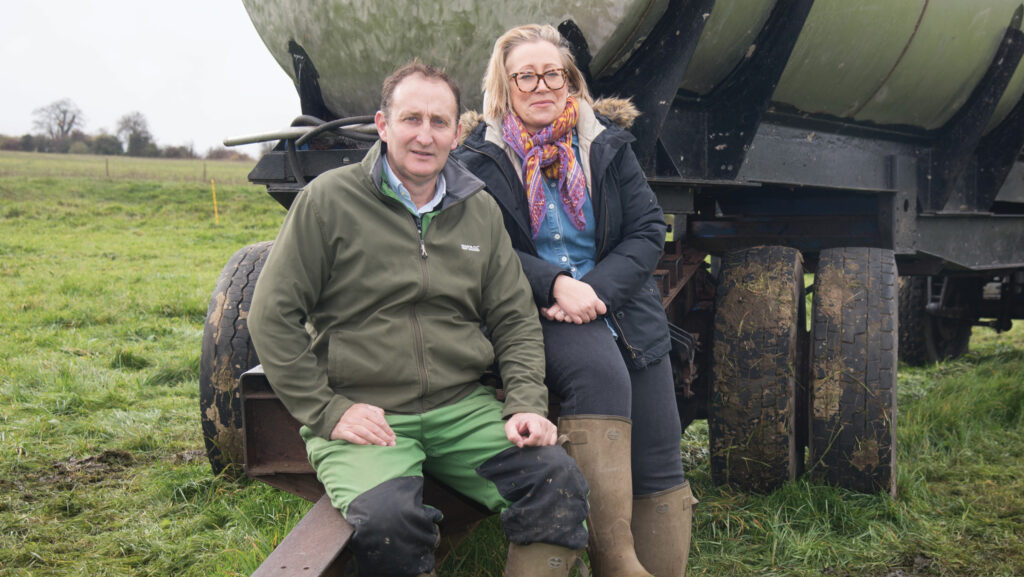 Dan and Catherine Mercer © Hugh Nutt
 It has been a good start to calving so far, with just under 70% of the herd having successfully calved within the first month.
The recent dry spell of weather has helped with turning out and, despite it becoming cold over the past few days, both cows and calves seem to be doing well.
How pelvic scoring has helped improve suckler herd health
About the author
The grass is still slow to grow; however, being on chalk means that we have been able to access grazing even in what were very wet areas just a few weeks ago.
Luckily, we can monitor calving with relative ease, having installed cameras in the sheds a while back.
We’ve found this has saved many unnecessary trips back and forth up to the yard, especially late evening and in the early hours, and they have paid for themselves several times over.
Having the app on our phones has also given us the confidence to be able to step away from the calving shed and get on with the all-important spring drilling.
We are pleased that our two-year-old Angus and Shorthorn home-bred heifers have all calved without assistance and the calves are up feeding straight away.
Once anything has calved, and we are sure that the calves have had adequate colostrum, they are tagged and turned out immediately.
With advice from our vet, Bea Yates at the George Veterinary Group, we religiously pelvic measure heifers that we hope will be coming into the herd, to check they are suitable.
This alone has had such a positive impact on calving. Unquestionably, one of the best changes we have ever implemented in our business was to change our livestock system.
It has saved not only time and money, but it’s also done away with the labour-intensive system we were tied to, breeding continentals that were not suited to our location or system.
Some of these heifers, along with their calves, will shortly go up onto a neolithic hill fort on Salisbury Plain.
It will be our first time using virtual fencing collars to monitor the cattle, so it will be a new experience for us.
Access to the area is fairly limited with any vehicle because of the location and the sensitivity of the site (a site of special scientific interest), but having the collars will help keep track of them – well, hopefully.