

Farmer Focus: Dairy business course focuses on cost control
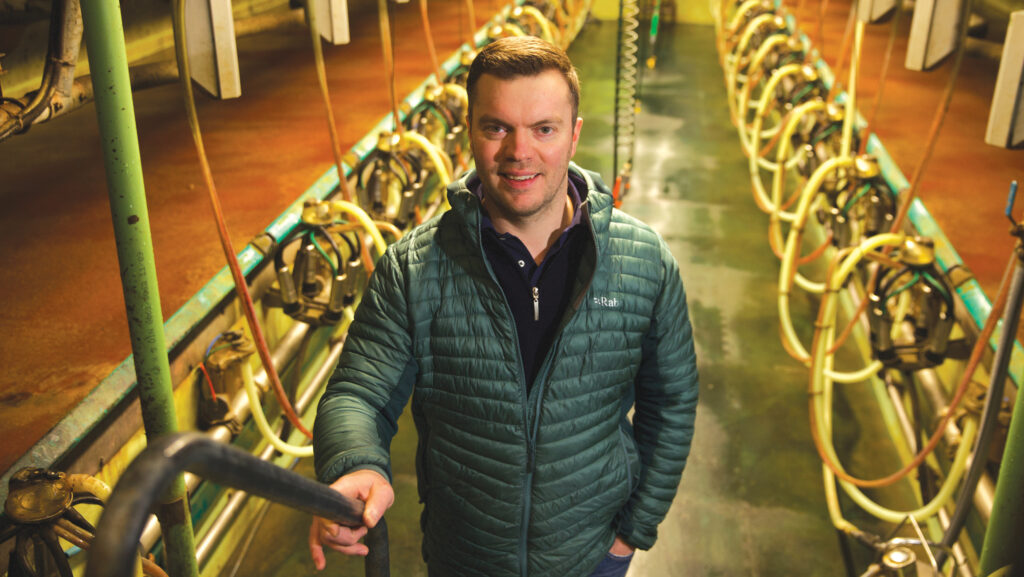 Colin Murdoch © Jeff Holmes
 Santa surpassed himself this year and managed to get a Scalextric track down the chimney. Apparently, it was for the boys, but I had a great time reliving my youth.
What I wasn’t prepared for was my seven-year-old beating me after only a few hours of practice, but it certainly got the adrenaline going.
I look forward to the first day I can take him go-karting and get my own back for a brief time.
See also: How to create a resilient dairy business
About the author

I’ve just returned from the third of five blocks of the Advanced Dairy Management course near Penrith. I would encourage anyone to do it, as it is really focusing the mind on how we can do better as a business.
This part of the course was primarily talking about finance and cost control. We discussed, at length, the aggregation of marginal gains.
What may sound complicated, in practice is actually very straightforward.
If you break down everything possible that goes into running a dairy farm – from lighting, to fuel, to feeding, for example – and improve them all by 1%, you will get a significant benefit when you put them all together.
We can’t influence the milk price, but we can control costs.
We’ve been lucky enough to avoid any of the snow of recent weeks in our corner of the country, although we did have a really decent cold and dry spell at the turn of the year.
This allowed us to get the first 30ha (74 acres) ready for ploughing, with all muck and slurry applied.
Unfortunately, normal service has resumed and it’s back to constant rain and inside jobs.
We weighed all the store cattle last week with the new scales, which were an absolute delight to work with compared with the old ones.
Even though we’ve been selling beef crosses as calves recently, we’ll be using the scales to monitor Jersey heifer growth rates more closely to try and push for calving at least a month earlier – small but important gains.
For the past few years, we’ve relied on straight nitrogen fertiliser for grassland, with enough phosphorus and potassium coming from slurry. Indices have remained on target, but I’ll need to get out for a walk the next dry day and take some more samples, as we try and test one-third of the farm each year.