

Farmer Focus: Keeping a watchful eye on milk margins
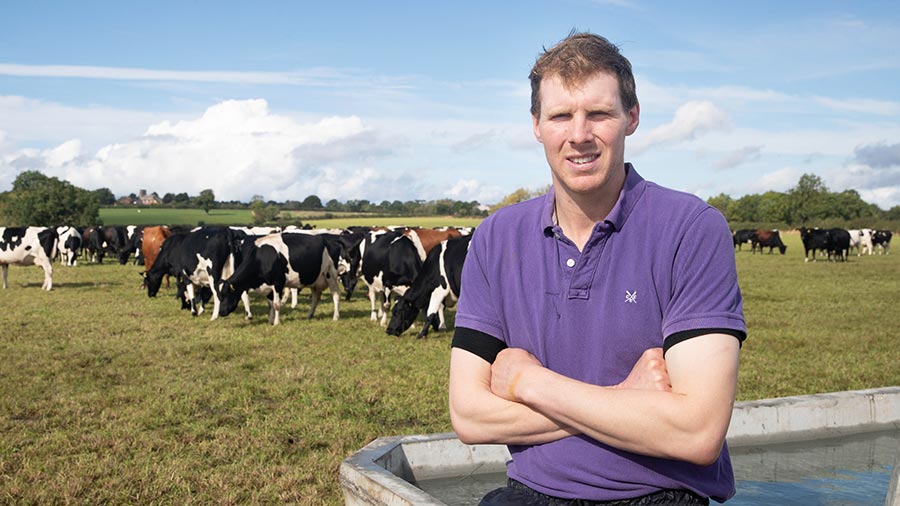 © Tim Scrivener
 We began 2021 in a strong position. The herd milked well over winter, and we turned out in February.
Early turnouts can be a struggle here, with 80% of the grazing platform on heavy, magnesium-rich soils.
We hit our target of grazing 60% of the platform by 28 March. However, soil temperatures stunted growth throughout April, meaning a late first cut was 1% lower in protein and 0.4MJ/kg lower in energy than the 2020 analysis.
About the author

That said, the rest of the growing season was kind. We grew 9.5t dry matter (DM)/ha average on our organic system.
Grass supply matched demand through dry-off and into calving and finished with an average farm cover of 2.5t DM/ha to take into spring.
See also: Advice on closing paddocks for winter
In February, TB lesions were found on a cull cow which had passed a skin test a week earlier. In total we lost 30 animals from subsequent tests, only testing clear in mid-October.
By this point 500 calves had been born. A rotavirus outbreak made things harder, but the team handled it well, keeping losses to a minimum. We will review and consider vaccination next year.
We’re slightly under budget for litres sold, but milk solids are up. The aim is to peak at 2kg milk solids/day from 6kg of cake and 13kg of fodder beet.
We budgeted to feed an 18% protein cake but almost a third of forage is lucerne, so we can save about £30/t on concentrate cost with a 16% cake.
Milk price increases have somewhat tracked Global Dairy Trade (GDT) price index rises on the back of strong global demand and tight supply.
Historically, milk price rises have been followed by volatile price drops.
When I was in New Zealand in 2014-15, the year started with an $8.40/kg (£4.28/kg) milk solids payout and the papers were full of adverts for robotic milkers and total mixed ration feeder wagons.
A year on, the payout was $4.40/kg (£2.24/kg) milk solids, and the adverts were for grass seed and mineral boluses. Obviously, this is an extreme example, but it carries an important message.
We must ask how profits will look if the milk price starts with a two rather than a three, given current commodity prices.
Surely last year’s profits need spending wisely, to either reduce debts or invest in systems/infrastructure to limit exposure to future low milk prices?