

Farmer Focus: Late calving pays off after record wet January
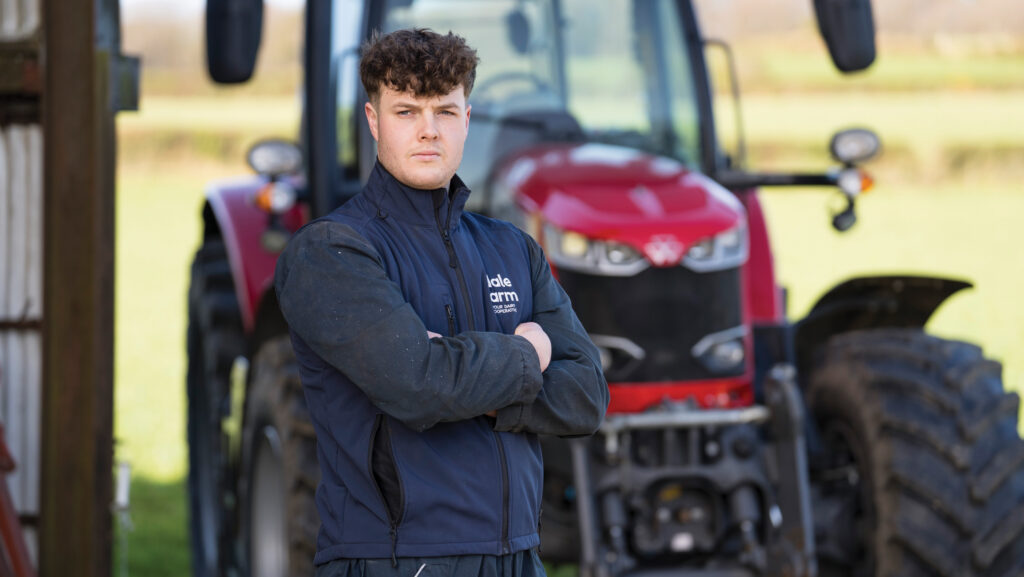 Ewan McCracken © Steffan Hill
 As I write, the slurry spreading ban is being lifted in Northern Ireland, commencing the annual rush to get the slurry tanks emptied.
However, with almost double the average January rainfall recorded this year, the tankers will be sitting in the shed for another few days yet.
See also: How new slurry store sets up dairy to optimise spreading
About the author

When Dad first moved from an autumn-calving system to a grass-centred spring one 30 years ago, he was well aware of the risks.
Having to rely so heavily on the ground conditions and grass availability at this time of year, he adapted the New Zealand system to fit our topography.
To achieve our goal of maximising milk from grass forage, there are some key elements of our system that allow us to adapt to a wet spring.
First, cow conformation. With our average herd weight sitting at about 530kg, the New Zealand-Friesian Kiwi crossbreed reduces compaction and poaching in wetter soils.
By contrast, the usual Holstein or British Friesian breeds can weigh up to 100kg more.
Second, we take advantage of the Kiwi-cross’s natural ability to convert grass to milk efficiently when it comes to early grazing.
Using the on/off grazing rule, we limit the cows’ silage intake the night before grazing, ensuring the grazing mob has a large appetite for the next morning.
This allows us to utilise the natural cycle of the cow, whereby they subsequently spend two to three hours rapidly grazing the sward to residuals as close to 1,500kg dry matter/ha.
They later return to the shed once their intake demands have been met.
This technique is only possible when combined with multiple access points to each paddock, which prevents the same zones being visited twice.
You can quickly notice that the impact of 200 cows starts looking like that of 800 cows when you use the same gateway four times in one day for two grazing sessions…
The most notable adaptation to the system is the delayed calving start date, with the first heifers not due to calve until 26 February.
The date – three weeks later than the average spring herd starts calving – was chosen to reduce the amount of milk produced using expensive silage, by matching our farm’s shorter growing season.
Our “magic day”, where grass growth equals demand, is two weeks later than lowland farms, nearby.
As 2026 is set to be an expensive year, every grazing is critical.