

Monitoring KPIs monthly can pay dividends
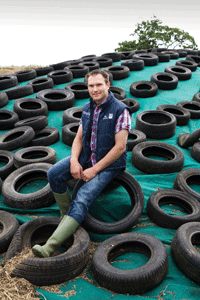
Controversy over large-scale dairying has placed the industry under pressure to improve herd health and welfare. Aly Balsom talks to Farmers Weekly Dairy Farmer of the Year Neil Baker to find out how performance recording can push the industry in the right direction
When it comes to herd health and production, most farmers have a wealth of information at their finger tips. However, all the recording in the world doesn’t mean anything unless figures are acted on, and even less when only certain farm staff know about them.
As one of the largest dairy farmers in the country, milking 1000 cows, many activists could raise concerns over cow welfare at Rushywood Farm, Crewkerne. But according to farm owner Mr Baker, monitoring herd-specific Key Performance Indicators (KPIs) on a monthly basis and displaying targets in the farm office pays dividends in terms of herd health and has pushed performance figures way above the national average.
KPIs are comparable to the warning indicators in a pilot’s cock pit, explains Kite consultant, Mike Bray. “Each morning when you walk into the dairy office you should view your KPI wall chart and from this know where to focus your time. Any area outside the acceptable target range should be highlighted and acted on straight away.”
Although emphasis on each specific area will vary from farm to farm, Mr Bray suggests the following as important indicators of herd performance.
1. Dry matter intakes (kg a cow a day)
Why is it important? When intakes head in the wrong direction, milk production and pregnancy rates could be severely hit. Keeping track of DMI can encourage more efficient feed use and more accurate costings.
| How it works at Rushywood Farm To monitor daily DMI, any TMR not eaten by the high-yielding group is weighed out in the mixer wagon. This figure is used to decide whether any adjustments to the ration are necessary. The high, fresh and heifer groups are always overfed by 10% so the waste feed can be fed to the low-yielding group. “You don’t want the high group to have an empty trough – it may appear more cost-effective to make the highs clear up their ration, but yields will drop.” |
|---|
Consultant view – Mike Bray
The important thing is to record and alter the ration in response to wastage, says Mr Bray. “When farmers do not want to weigh out daily feed wastage, it is possible to make an estimate on DMI from ration wastage and plot patterns this way.”
2) Number of confirmed pregnancies (weekly or monthly)
Pregnancies drive herd performance – without getting cows in calf, calving patterns will slip and yields will drop.
| How it works at Rushywood Farm With the aim of expanding the herd to 1200 cows next year, the farm must generate sufficient replacements. As such, recording the number of black and white heifer pregnancies and setting monthly targets is a valuable tool. “Before recording heifer pregnancies, we never bred enough replacements for expansion. Now we work on a target of 134 heifers served a month to black and white bulls to generate 55 positive pregnancies a month and 300 heifers a year.” Once black and white services have been met, remaining heifers are served to beef. |
|---|
Consultant view – Mike Bray
How many pregnancies do you need to maintain your calving pattern? In a 100-cow herd with a 25% replacement rate and a calving interval of 390 days, you will need six a month. This figure could be used as your target line on the pregnancy graph and monthly figures plotted against this.
3) Percentage of cows mobile
Mobility is the most important KPI on farm – when you get this right, everything else will fall into place; a cow will eat more, have higher yields and good fertility.
| How it works at Rushywood Farm Since monitoring and setting mobility targets, lameness incidence has dropped from 25% in 2007 to just 8%. “By recording we were able to highlight exactly where we were at and act on it,” explains Mr Baker. “We now employ an independent technician to mobility score and trim our cows’ feet. “Lameness blindness in farm staff is incurable, so an independent person dealing with lame cows is more likely to spot problem cows and deal with them.” For Mr Baker, one case of lameness is one too many, so when lameness has flat lined on the KPI graph recently, further investigation has been carried out to find the cause of the problem. “By looking at lameness patterns on individual feet, we noticed digital dermatitis was more prominent on back-right than back-left feet. This was linked to the footbath being too short for all feet to be treated. We will now extend the bath to address this issue.” |
|---|
Consultant view – Mike Bray
As an industry we must address the fact that 40% of the national herd walks with a limp. A herd should generally be mobility scored every month.
Ideally, 90% of the herd should have a mobility score of 0-1%. This can be used as your target line on your graph. Depending on your starting lameness incidence, you could also plot a diagonal target line across the year, ranging from 60-90%.
4) Average daily milk yields
Milk production ultimately drives profit, so ask yourself if you are producing expected milk volumes.
| How it works at Rushywood Farm “If you don’t record anything else, record this,” stresses Mr Baker. “Be honest with yourself about actual milk production from total cows in milk.” |
|---|
Consultant view – Mike Bray
All producers should be able to record weekly average milk yields using milk tank recordings and then set production targets from expected calvings.
5) Number of mastitis cases a week
Monitoring mastitis incidence can flag up any problems, such as parlour routine or environmental issues.
| How it works at Rushywood Farm Tracking the number of clinical mastitis cases has reduced mastitis incidence to just one case in November this year. “By monitoring and plotting mastitis levels on the graph every month, it is easy to pick up any changes – for example in August, cases shot up to 16. In a way, this was good as we knew we had to improve. By training staff to concentrate on parlour routine, maintain cubicle beds and ensure cows are not rushed into the parlour, we have driven down the number of mastitis cases.” |
|---|
Consultant view – Mike Bray
25 cases for every 100 cows is the gold standard for mastitis incidence. This equates to two cases a month. Targets will vary depending on individual farms, but in a herd with an incidence of 60 cases for every 100 cows, the target could be 40 cases in 12 months’ time.
6) Fresh cow index
The percentage of total culls occurring in the first 60 days of lactation.
| How it works at Rushywood Farm The fresh cow index is an excellent way of condensing information on how well a farm is transitioning cows through calving and into lactation, says Mr Baker. “Any cull during the first 60 days will be forced, be it because of milk fever or displaced abomasums.” At the moment, 12.7% of culls leave the herd in the first 60 days. “It’s a difficult figure to go back and get from records, but it is well worth doing,” he says. Employing a herd health manager whose sole responsibility is to look after calving, fresh and sick animals, also ensures cows are given maximum attention during this critical period. |
|---|
Consultant view – Mike Bray
In the UK, the target should be an 8% culling rate in the two months post-calving.
WHY USE KPIS?
• Focuses your management – most management decisions are made on guess work. Graphing data allows more targeted action points for the day
• Improves communication – the more you provide feedback to you staff, train them and set achievable goals, the more your cows will reward you
• Improves margins – by reviewing performance levels and setting targets to deliver higher profit