

Benefits of premium turkey contract for beef and sheep farm
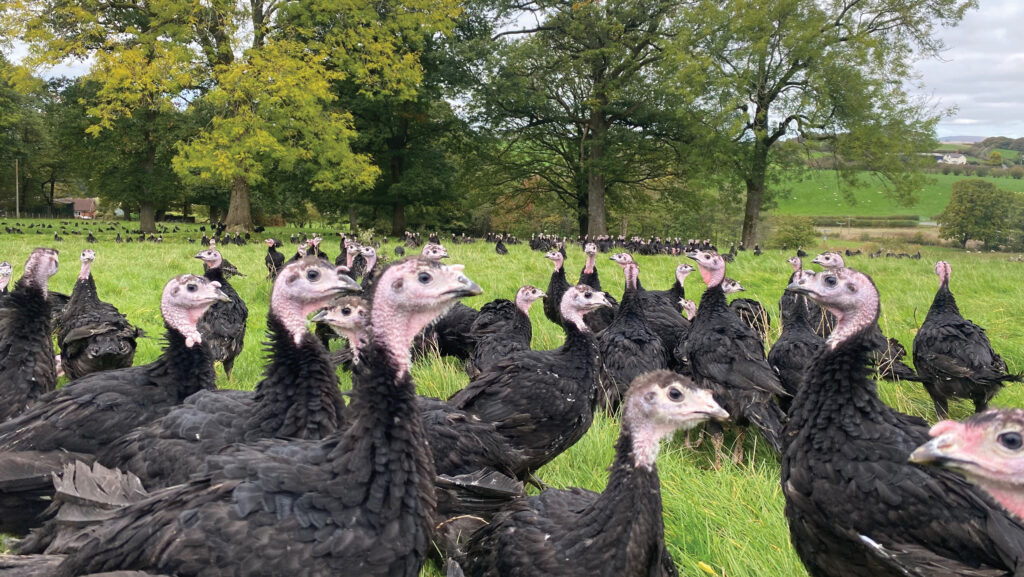 © Will Lewis
 Growing turkeys is allowing a Powys farm to earn an additional income stream from its beef and sheep sheds at a time of the year when they would otherwise have stood empty.
Father and son David and Will Lewis farm 170ha (420 acres) of land at Treforgan Farm, Dolau, and rent a further 32ha (79 acres), producing suckler beef from an 80-cow herd and lamb from their flock of 1,000 breeding ewes.
Their entrepreneurial outlook sees them ever alert to opportunities to generate additional income sources to support the future viability of their farming business.
See also: How a free-range egg producer is achieving an 86-week lay
Farm facts
Treforgan Farm, Dolau, Powys
- 80 Salers suckler cows
- 1,000 Beulah Speckled Face, Mule and Texel ewes
- Charolais calves sold at weaning sales in October
- Salers heifers retained, bulls finished at 350-400kg deadweight
- March-born lambs sold liveweight through Builth Wells market
- Speckled tup lambs finished in the autumn and sold deadweight to Dunbia
- Holiday let diversification in converted mill
Growing 6,000 turkeys for a major poultry producer and processor offered that opportunity. With cattle and sheep sheds empty from September until the beginning of December, adapting these to house poultry means those buildings now earn an income in those months.
The agreement is with Capestone Organic Poultry, a Pembrokeshire-based business that supplies poultry to premium retailers.
With demand for Capestone’s birds growing, the company developed a business model for outsourcing some of its production, including Heritage Bronze turkeys for the Christmas market.
Key requirements
David and Will heard of that opportunity through word of mouth. “We have buildings that are in good condition and appropriate for adapting, and good access for articulated lorries – two of the key things Capestone was looking for,” explains Will who, at 30, is the second generation of his family to farm at Treforgan.
“After a couple of meetings with representatives of the company on the farm, both parties could see that growing turkeys here would work.”
The shed they have adapted is divided into three sections, but all sit under one roof. The Lewises made a one-off initial investment of about £30,000 in feeders and drinkers, but they anticipate a payback period of four to five years on their outlay in the turkey enterprise.
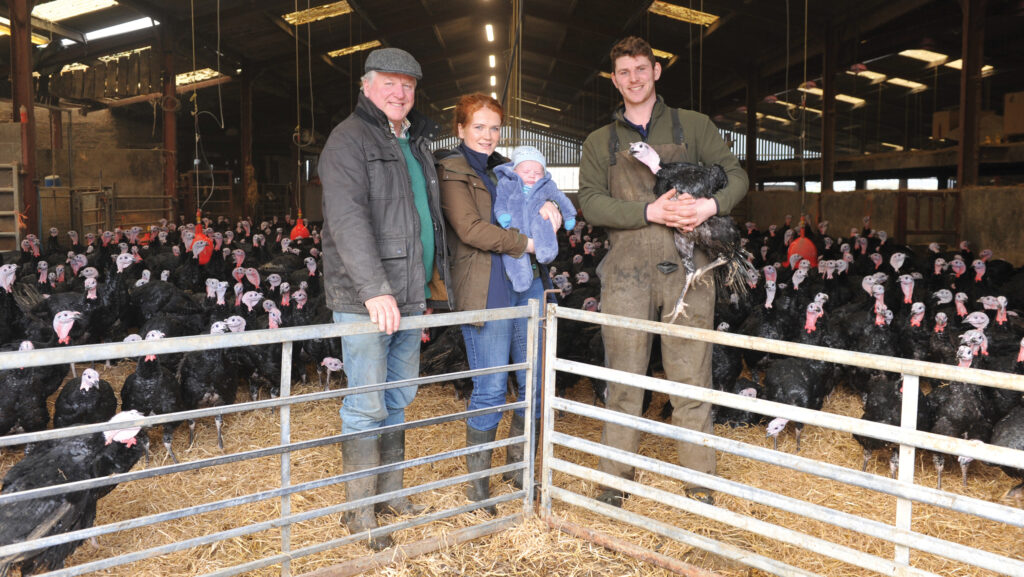
David, Grace, Henri and Will Lewis © Debbie James
“Setting the shed up did involve quite a bit of work and time, but now the drinkers and feeders are in place, it will be easy from now on because they winch up into the roof when the cattle and sheep are housed, and are lowered again when the stock are turned out to grass,” explains Will.
Under the terms of the five-year agreement, the Lewises provide water, straw, electricity and labour. Capestone supplies the birds, feed, veterinary and medicine costs and field officer support.
In addition, litter from the shed provides valuable nutrients for the farm.
Stockmanship skills
The first crop of 6,000 turkeys arrived at Treforgan on 26 September 2025, off heat, at six weeks of age. The turkeys grew well and were ready for processing after 10 weeks.
“If you do a good-quality job, the targets are very attainable,” says Will.
Capestone sets targets, including growth, feed conversion efficiency and mortality rates, and bird welfare.
“It is right that we are set these targets because Capestone supplies a premium product and they want premium producers. At the end of the day, it’s a quality product,” he reasons.
Hitting those targets is down to good stockmanship, he adds. “It’s about keeping an eye on everything – any hot and cold spots in the shed, making sure the litter is clean, that the birds are fed and watered constantly.
It’s all very basic stockmanship but to a high level and every day.”
Technical support
As first-time growers, the support provided by Capestone has been appreciated. There were two site visits before the feed equipment was ordered, another visit while it was being set up and one on the day after the birds were delivered.
“They have been very, very supportive. They are at the end of the phone 24/7 for any advice or anything that we need,” says David. “It has been a steep learning curve but not a difficult one.
There have been no major issues, it’s just about doing a good job, the same as with any stockmanship.”
The turkey enterprise has been audited several times, including by RSPCA and Red Tractor. “They were very thorough inspections, and we passed all with no problems,” says Will.
Under assurance scheme guidance, these sheds allow for 6,200 birds, but numbers have been reduced slightly to ensure the birds have plenty of space
. “It’s a happy, comfortable number,” he says.
To gain free-range certification, 0.4ha (1 acre) of range for every 1,000 birds must be provided.
There also needs to be plenty of door space on the sheds to allow the birds to roam freely: 1m of door space for every 4sq m of shed space, Will explains.
A strict requirement to keep records on daily feed and water intakes and mortalities ensures Capestone can keep a close eye on what is going on without necessarily visiting.
“This has been good during periods of bird flu risk,” David points out.
Workload
Will estimates the time commitment of the enterprise at an average of two hours a day, sometimes more, involving four visits to the shed daily.
“The day-to-day management of the birds has been easy. It is just a case of checking and sorting them,” he says, adding that littering takes a couple of hours twice a week.
It is a workload that suits David and Will because it is their quiet period – the sheep start lambing in March and the cattle calve in the same month
. The cattle are wintered on hill land and housed in mid-December, once the turkeys have left, and the ewes come inside in February ahead of lambing.
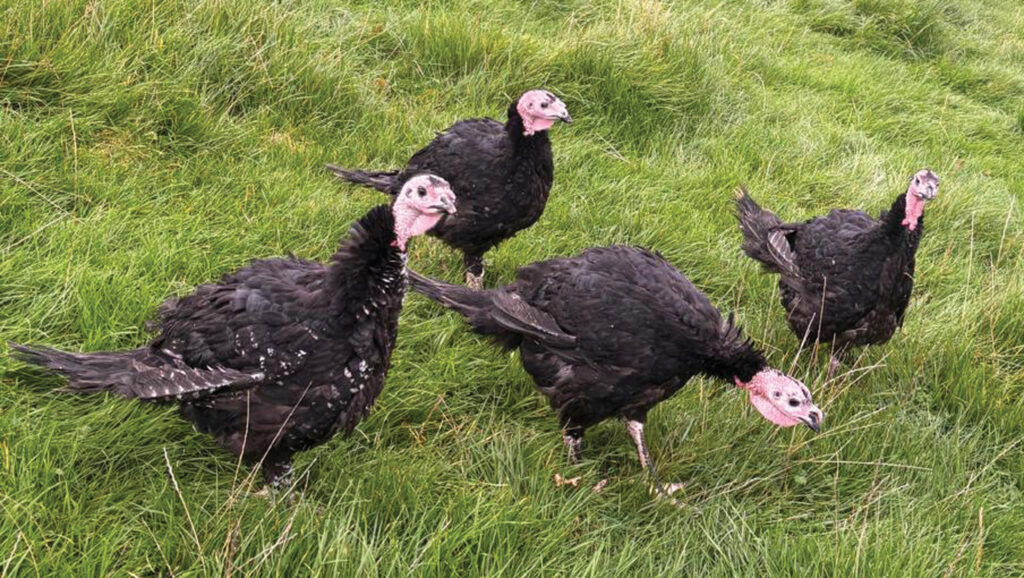
© Will Lewis
“We might ordinarily have housed the cattle three weeks earlier, but the turkeys provide us with another income, which is worth altering our other farming systems for,” says Will.
Payment is calculated through a combination of kill weights, feed consumption and other parameters, he adds.
“As long as everything is within Capestone’s limits, we are paid a fixed rate per bird.”
Good fit
Growing turkeys is proving a good fit for the system at Treforgan. “It seems to have slotted straight in,” says Will.
“Dad built the sheds 10 years ago for the sheep and cattle, but they have lent themselves incredibly well to the turkeys, as they are the right size, length and width.
“They weren’t built for this purpose but have converted really well.”