

Changing layer breed boosts free range margins
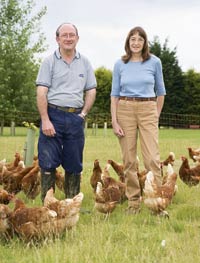
Switching to a heavier-type breed has boosted margins for one egg business, as Poultry World found out
Things started to go wrong for David and Ruth White with their second and third flocks, which saw an 18% fall in margin and 44 fewer eggs per hen housed.
Five years ago, the couple took over the 5600-bird free-range unit at Willow Tree Farm near Mildenhall in Suffolk producing eggs for Noble Foods, as part of their Marks and Spencer contract. Their first flock, placed in 2004, performed well producing 316 eggs a bird housed to 72.5 weeks returning a margin over pullet and feed cost of £8.88 a bird.
But performance started to fall with the subsequent two flocks (see Table 1), placed in 2005 and 2006, giving a declining performance of 302 and 272.7 eggs per bird housed, respectively. This was against the backdrop of falling egg prices and increasing feed costs.
They realised that they needed to act and turned to neighbouring free-range producer Jason Cooper for advice. At the time, Mr Cooper was working with Tom Barron Independent Hatcheries and the Whites decided to switch to a breed developed specifically for free range.
The couple took delivery of their fourth flock of ISA Warrens and Mr Cooper agreed to monitor performance from day one.
As a free-range producer, Mr Cooper has a simple philosophy, “let the birds do the talking and act on what they tell you.” This is particularly important in the crucial early weeks when bodyweight monitoring is essential along with managing the lighting programme.
He also stresses the importance of the rearing phase, which he says cannot be overemphasised pointing out that rearing does not come to an abrupt end when pullets are delivered on egg units at 16-17 weeks of age, but continues through to peak production.
During this time he places great importance on regular flock monitoring of bodyweight and evenness, early production and egg weight progression.
As the ISA Warren is a heavier bird, some 100g more than some other breeds, it was critical to ensure bodyweight progresses in line with breed targets. Failing to reach the breed targets means it is likely that production will be more difficult to achieve, as will egg size.
At the same time, lighting should be held at 10 hours a day until 19/20 weeks of age assuming correct bodyweight is achieved, after which hourly increments can be given each week to a maximum of 16 hours a day as advised by the breed company.
Mr Cooper’s next tip is to weigh a sample of eggs daily in the early stages to make sure that egg size remains on target. In fact he reckons that those producers who weigh eggs daily until 40 weeks of age are far better placed to ensure egg size doesn’t not run out of control.
His rule of thumb is to aim for an average egg weight of 66g by 40 weeks of age and thereafter allow egg weight to rise to 66.5-67g. This he says will produce the optimum egg size to production ratio or, in simple terms optimum egg mass output.
“Too often producers rely on packing station returns to get information on egg weight which in my experience is often too late. If there is a problem with egg weight, the delay in obtaining the data from the packer will mean remedial action will take longer to achieve the desired objective,” said Mr Cooper.
With the fourth flock, the White’s successfully arrested the decline in egg numbers and improved margins. But it is not just the physical performance that impressed them, egg quality was particularly good at the end of lay.
“The shell colour and texture was almost as good as when birds came into lay,” said Mr White.
As to the future, they recently placed their second flock of the breed which at 22 weeks of age were at 22% production. Bodyweights had been taken on the day of the visit averaged out at 1863g, some 28g over target, with an evenness of 92.7%.
1: Flock results (5600 birds housed weeks 17-72.5) | ||||
Flock 1 | Flock 2 | Flock 3 | Flock 4 | |
Housed hen average (eggs) | 316 | 302.4 | 272.7 | 318.7 |
Feed intake (g/bird) | 124.4 | 133.9 | 132.6 | 129.8 |
Feed cost* (£/bird) | 6.75 | 7.20 | 7.43 | 8.94 |
Pullet cost (£) | 2.68 | 2.78 | 2.81 | 2.95 |
Egg income** (£/bird) | 18.30 | 17.25 | 17.60 | 22.41 |
Margin over feed and pullet (£/bird) | 8.88 | 7.27 | 7.36 | 10.52 |
*Feed cost varied £138-£175.6/t **Average egg price varied from 69.5 – 84.4p/doz | ||||
2: Flock 4 performance | |
Birds placed | 28 December 2007 |
Birds depleted | 19 Jan 2009 |
Housed hen average (eggs) | 318.7 (8.2 eggs over target) |
Peak production | 97.2% at 28 weeks |
Weeks over 90% | 27 |
Weeks over 80% | 49 |
Production at depletion (%) | 78.3 |
Liveability (%) | 92.7 |
Egg weight at 40 weeks (g) | 66 |
Egg weight at depletion (g) | 66.6 |
Comparison of margins assuming same input costs | ||||
Flock 1 | Flock 2 | Flock 3 | Flock 4 | |
Margin over feed and pullet (£/bird) | 10.71 | 9.10 | 7.10 | 10.53 |