

How bokashi is helping a poultry farm’s nutrient management
 © Hendrix Genetics
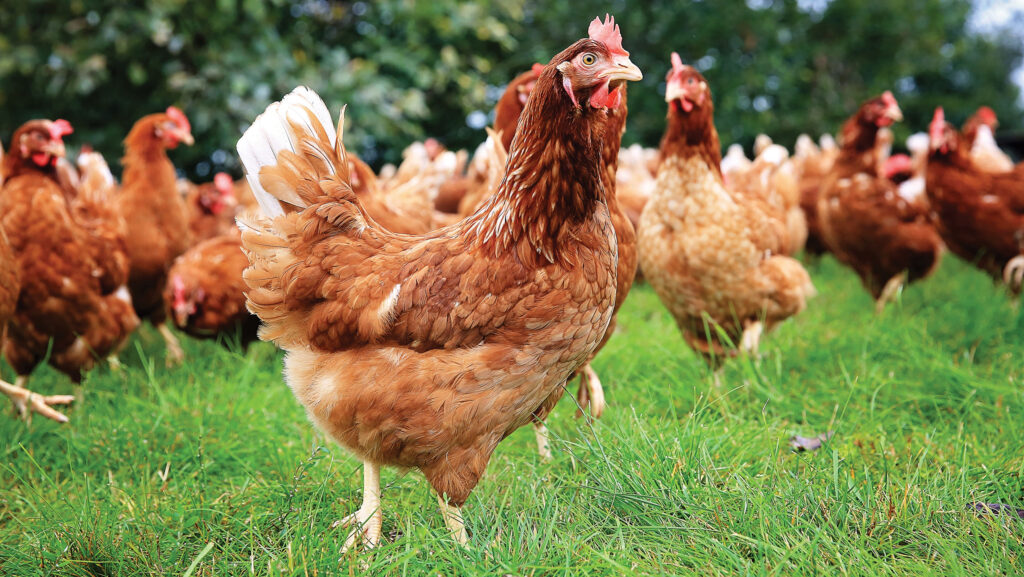
 At Woodend Farm on the Scottish Borders, manure produced by the farm’s 32,000 free-range hens is mixed with woodchip, chopped straw and an inoculant rich in microbes.
By sealing this in an anaerobic environment, bacteria, yeast and fungi will pre-digest the manure and other material.
See also: How litter can be treated on-farm to heat broiler sheds
This process is thought to have multiple benefits for manure management, including reducing nutrient losses at storage and ammonia volatilisation during and after spreading.
Although scientific research to back up some of these perceived benefits is lacking, the Seed family are convinced by the “bokashi” process.
Farm facts
Woodend Farm, near Duns, Berwickshire
- 190ha farmed
- Arable rotation of oats, wheat, barley and beans
- Direct-drilling of all crops
- Bovans Brown hens
- Eleventh flock cycle
- Eggs supplied to Glenrath Farms
- 75kW wind turbine, 175kW solar PV, 950 kW straw biomass boiler with thermal store
John and Louise and their son, Donald, run a regenerative farming system near Duns, Berwickshire, and are moving further towards a “closed loop” system by growing 50% of their hens’ feed and spreading the flock’s manure on their arable land.
The birds produce about 600t of manure annually which, until 2024, was stacked in a shed over the winter.
It was then applied to seed-beds in March and April, after the end of the closed period for spreading in this nitrate vulnerable zone.
What is bokashi?
Bokashi is a Japanese word describing well-fermented organic matter. The organisms responsible for that fermentation thrive in anaerobic conditions.
Aside from its use in agriculture to speed up the breakdown of animal manures mixed with bedding, bokashi is used for managing food waste.
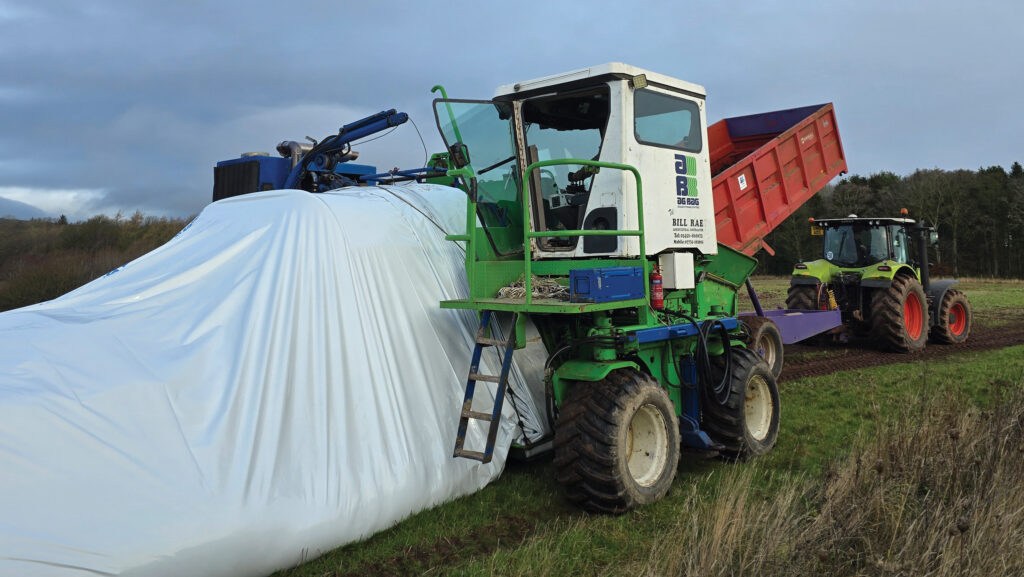
Tipping mixture into the AgBag machine © John Seed
Mixing process
In autumn 2024, the business took a different approach, using a mixer wagon purchased second-hand to combine muck with home-produced straw and woodchip (see “Bokashi “recipe”).
The mix was treated with Actiferm, a liquid product containing a broad spectrum of bacteria, yeast and fungi, including phototrophic and actinobacteria.
It was then sealed in an AgBag tube, where the temperature during storage is about 30-40C.
After 12 weeks, analysis of the fermented material showed a nitrogen (N) content of 12kg/t, 5kg/t phosphate (P) and 6kg/t potash (K).
The farm’s untreated wet manure, which did not include chopped straw or woodchip, had 22kg/t N, 10kg/t P and 11kg/t K.
Dr Audrey Litterick, of Earthcare Technical, who advised Woodend Farm on its bokashi trial, says it is important to bear in mind that manures are inherently variable.
“Additional samples must be tested in order to draw firm conclusions on the impact of bokashi treatment on manure nutrient concentrations,” she cautions.
There was also a clear difference in the composition and smell of the bokashi compared with standard manure.
“It didn’t have the intense ammonia odour of wet poultry manure, and the mix was much drier and less clumped than the manure in its pre-treated form,” says John.
It was applied to winter wheat seed-beds at a rate of 5t/ha and spread easily and evenly, he adds. “It produced a stable, crumbly material with excellent spreading characteristics.”
During that first-year trial, it was sealed for 12 weeks between bagging and use, for practical reasons.
John points out that storage could be much shorter if needed, as stabilisation continues in the soil.
Woodend Farm bokashi ‘recipe’
One tonne of wet poultry manure is combined with 350kg dry chopped bean and oat straw and 300kg shredded woodchip, a ratio set after the dry and wet muck, straw and woodchip were analysed.
© John Seed
Cost benefit
The fermentation system is “practical, affordable, and compliant”, he says, calculating that the bokashi process costs the business £9-£10/t; he estimates gains to be £15-£20/t from retaining nutrients in the manure.
In 2024, one-third of the muck was fermented; in 2025, it was all treated – this time by clamping, because of a mechanical failure in the mixer wagon.
For the Seeds, phosphate efficiency is the main reason for changing the way they manage their muck.
Their shift to fermenting poultry manure has been a process of experimenting and monitoring, because there is little published research in the UK on bokashi systems for poultry manure, although it is gaining more recognition internationally.
Farm-based evidence
John is frustrated that no independent data exist on how much ammonia or N is retained through anaerobic composting or bokashi fermentation.
“That absence of data means farmers like us have had to lead the discovery process ourselves — testing, measuring and refining the system with little external reference,” he says.
Most official models and emissions factors are based on open-air composting or slurry systems, not the controlled, low-loss fermentation process used to produce bokashi.
“There are no established emissions factors or policy frameworks for fermented manures, and most guidance still assumes traditional systems,” John points out.
“As a result, we’ve had to rely on evidence from our own trials, supported by external testing, and build confidence through transparency and documentation.”
Environmental gains
The trial at Woodend Farm is ongoing and, as John explains, very much a learning process, but he sees tangible benefits in bokashi and hopes that in future, the system will be taken into account by planners when considering applications for poultry enterprises.
Fermentation represents a “critical bridge” between compliance and regeneration, he says.
“It’s a way for us to meet environmental obligations while improving productivity and resilience.”
Minimal losses, but more research needed
According to Dr Audrey Litterick, the potential benefits of fermenting manure are significant.
But she also acknowledges that research funding is needed to scientifically prove that.
It is very likely, however, that nutrient losses from volatilisation and leaching will be reduced in a fully enclosed fermentation system compared with storing manure in a roofed shed, she maintains.
There has only been one scientific study to compare bokashi treatment with composting and that involved green waste, not animal manure.
This study clearly demonstrated there were negligible losses of nutrients during fermentation, compared with mass losses during composting.
“Logic, common sense and a basic understanding of manure management suggests that nutrient leaching, ammonia volatilisation and carbon losses will be minimal from a sealed AgBag system,” Audrey says.