

Novel equipment helps in the battle against poultry disease
Manual labour has traditionally been employed for the thorough terminal cleaning and disinfection of poultry buildings, but two enterprising cleaning contractors in north-east England have developed an automated system for disinfection.
They claim their specially adapted vineyard sprayer carries out the task to a much higher standard, and with less risk to the operator. Another innovation is their purpose-built gas burner, used on floors to tackle infective organisms such as coccidia.
Consistency of chemical solution and application, as well as improved operator safety, are the main benefits of automated disinfection, according to Martyn Scott and Nigel Appleyard.
Mr Scott runs Agriwash UK, covering Yorkshire and the north-east, while Mr Appleyard has a team of around 40 staff working from his company headquarters in Market Rasen, Lincolnshire. They are involved in several collaborative projects, and have a range of poultry producer clients, including PD Hook and Cranberry Foods.
Until recently, they were using an adapted, trailed vineyard sprayer drawn by a cabless, compact tractor. The original model is commonly used for spraying almonds, kiwi fruit and grapes elsewhere in the world. However, while they judged the system more effective than manual disinfection, it was felt that it compromised operator safety, because the breathing equipment necessary to protect staff from inhaling fumes was considered far from ideal.
Further development has led to the launch of their current version, which has been in use for the past few months. The hydrostatic machine is still based on the vineyard sprayer, but has since been adapted into a sealed, self-propelled unit, capable of disinfecting around 18,580sq m (200,000sq ft) of housing in just four hours. Air conditioning is installed, for the driver’s benefit.
Running on four-wheel drive, which makes it highly manoeuvrable, the machine has a 70hp, Italian diesel VM engine. The 2300-litre tank is mainly used for liquid disinfectants, although it can also handle powders, depending on client requirements. The calibration is set with reference to a dilution chart, which gives the recommended rate of the chemical agent on a square footage basis.
The machine’s applicator has 12 individual spray nozzles, operating at around 40 bar pressure, with a built-in agitation system. Spray coverage is up to 8m (26.2ft) high, and to a width of about 23m (75.5ft). As the machine moves through the poultry house, the sprayer applies a thorough coating of disinfectant to every aspect of the building, including walls, ceilings, and all internal furniture and equipment.
It also disinfects its own exterior casing, after completing the task in each building. Despite its efficacy, it is not always possible to use the machine in confined spaces, which is the reason why it also carries a hand-operated lance.
“We don’t believe that a team of manual workers can achieve the same level of consistency of application as our machines,” says Mr Scott. “Normally, separate teams of workers will be deployed, with each group assigned a set number of individual houses. With the best will in the world, it is unlikely that each unit will end up being disinfected to exactly the same standard – human error will always be a factor.”
While Mr Scott admits that the automated system is slightly more expensive than the conventional method, he feels that its greater efficiency fully justifies the extra cost. Another benefit is the time saving, he adds.
“We estimate that the automated system halves the amount of time it takes to disinfect. This allows more time for drying, before the next batch of birds comes in.
“In recent years, the prevention of contagious diseases on poultry units has become increasingly important. There have also been scientific advances in disease diagnosis, with swab testing commonplace, and a wider range of performance targets to aim for.
“Our customers spend a lot of money on chemicals, to ensure that their flocks are given the best possible protection from disease. It is our job to make sure they get the full benefit from their investment.”
The two men also have teams available for contract litter removal, pre-cleaning and washing. However, Mr Scott says for washing in particular, it is unlikely that manual labour will be superseded by machines in the near future.
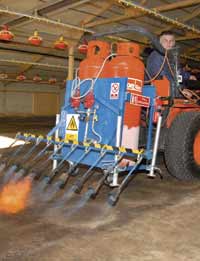
The gas burner designed by Mr Scott and Mr Appleyard is 1.8m (6ft) feet wide, with the frame rear-mounted on three-point linkage, attached to a 25 horse power Kubota tractor. As well as the row of burning nozzles, it also carries its own wash and disinfection system, which gives the exterior a thorough cleaning between houses.
Each gas burning machine carries either two or four gas tanks. This multiple bottle design allows the machine to source gas flow from all the tanks at the same time, which prevents the pipe work from freezing up during the winter. The two-bottle gas burner version can cover 20,000sq m (nearly 216,000sq ft), before it has to be refilled.
The pair claim that the equipment is effective against a range of disease-causing organisms, including bacteria such as E coli, yeast and moulds. Other benefits include no run-off, which eliminates the risk of possible watercourse pollution.
The system, which has been adopted by virtually all their poultry producer customers, is priced to compete with chemical treatment, says Mr Scott. It has been designed with help from gas supplier, Calor. Despite the equipment having the ability to raise the ambient temperature in the house to up to 22C, Mr Scott assures producers that it will not cause any damage to concrete.
“Gas burning was popular 20 years ago, but its use gradually declined, as new chemical liquids became available. Now it has gone full circle, and we think it will grow in popularity in the future.”
“A number of effective disinfectants have already been withdrawn, because of health and safety issues,” he says. “Looking ahead, it is possible that gas may end up being the only option.”
Case study: PD Hook’s Sheffield Farm, Lincolnshire
Manager John Sycamore looks after a broiler unit with 10 sheds, each containing 37,000 birds. The farm also employs an assistant manager and a stockman. All the washing down and automated disinfection is carried out by Mr Scott and Mr Appleyard. Mr Sycamore considers these tasks a high priority, to minimise the risk of disease carry-over between batches.
“The disinfection machine is quicker, and more powerful than anything that can be achieved by hand, using a lance,” says Mr Sycamore. “Its sprayer mechanism gets into every little nook and cranny.”
Sheffield Farm has only recently started booking the gas burner for the floors, having previously used a chemical product for disinfection.
“Gas burning makes sense, because burning has been used as a means of disinfection for many years and for all sorts of application,” he says.
“The floor is always a problem area, because that’s where everything ends up after washing down. This farm has never really been troubled by coccidiosis, but I’m always happy to try anything that has the potential to keep infections at bay.”