

Rumination monitoring saves money and lives
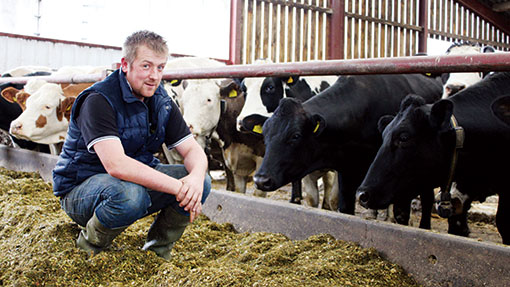
Automated rumination monitoring is helping one Shropshire dairy farm pick up health problems early and increase treatment success, as Farmers Weekly reports.
Dairy producer Jonathan Scott believes investing in the latest rumination monitoring technology will help drive cow health improvements and meet consumer demands for reduced antibiotic use.
Eighteen months ago he introduced a revolutionary rumination recording programme to run alongside his existing automated heat detection system at Hanmer Mill Farm, Whitchurch.
The automated management system combines the widely used neck-mounted cow activity monitor for picking up bulling cows with a microphone for detecting rumination rates.
Rumination activity is a useful gauge of cow health and welfare and can act as an early warning sign for health problems. As a result, Mr Scott has been able to pick up problems such as mastitis, lameness and displaced abomasums early, allowing him to drive down incidence by adopting prompt and effective treatment.
In the long term he hopes this will help reduce overall medicine use, by increasing treatment success.
“In the next four to five years we [as an industry] are going to have antibiotic use drilled into us,” he says. “We need to be proactive and reduce antibiotic use ourselves. And anything that can improve health and fertility has got to be positive.”
The farm, which Mr Scott runs in partnership with his parents David and Pauline and wife Emma, had traditionally run a herd of all-year-round calving, 10,000 litre, pedigree Holsteins. However, when Mr Scott got involved with the business about five years ago, they decided to instigate a herd overhaul to help drive performance.
Part of this included the introduction of an automated heat detection system to help bring the calving interval down from 439 days to the current 397 days, and reduce the time pressure needed for visually spotting bulling cows. Later they also decided to move to autumn block calving and introduce Fleckvieh cross Holstein genetics. Now the flying herd of 230 cows is half cross-bred.
“The heat detection system will really help us achieve our autumn calving block,” says Mr Scott. “And because we’re going to have so many fresh calved cows all at once, the new rumination system will really help pick up any health problems at this critical stage.”
On average, a cow will ruminate for between 450 and 550 minutes a day, with levels naturally increasing around midnight and decreasing nearer to midday. An abnormal drop in rumination rates can be an indicator of illness, nutritional disorders, metabolic disease, stress or oestrus.
“Rumination monitoring also reduces the number of false positive bullers,” explains Mr Scott. “We can double check if a cow is truly in heat, as rumination rates drop when a cow is bulling, while her activity will increase.”
The farm currently has 175 collars, with 75 including the rumination monitor alongside the activity monitor.
“At the moment, we are prioritising the Holstein cows with the rumination collars, as they’re the ones that tend to be prone to problems,” says Mr Scott.
The aim is to gradually replace all collars with the new system and put them on all animals, including dry cows. At present, activity and rumination data is downloaded twice a day as cows walk under infra-red readers mounted on entry to the herringbone parlour.
As the farm moves all cows over to the system, they may mount another reader over the water trough in the dry cow shed or move to an antennae system to download information regularly.
Heatime Health Program
Fabdec’s Heatime Health program automatically generates two reports; one for fertility and one for health, with each cow receiving a health index based on her activity level and rumination rates, which will indicate if her rumination drops suddenly by more than 200 minutes or declines by 50 minutes a day for three consecutive days.
Steve Thurgood, sales manager for Fabdec, explains that when a cow’s health index reaches 86, she is automatically flagged up on a health list.
“When the index reaches 80 a cow will be highlighted yellow, and when it goes below 75, her entry will turn red. This enables cows with potential health problems to be picked up and treated early,” he says.
Mr Scott says when a cow goes red or is yellow for three or four days, he will temperature check her, assess rumen function using a stethoscope, and check locomotion and udder health. “If her rumen’s not turning over I may tube her with vitamins, minerals and probiotics, or if it’s a twisted stomach, I’ll call the vet,” he says.
Mr Thurgood explains how the fresh calved cow is targeted to have a rumination rate of 200 minutes a day on calving down.
“This should then increase by 50 minutes a day to reach 450 by day six and then maintain up until day 14,” he says.
At Hanmer Mill Farm, rumination data has been particularly useful at picking up the early signs of acidosis and allowing management to be addressed.
“When it comes to acidosis, we may see a drop in rumination rates, before we see a dip in milk yield,” explains Mr Scott. “This tends to be in the fresh calvers, so we’ll examine her and give her glycol over three days. Generally if you catch it early she’ll get right.”
The data has also highlighted the impact of ration changes on rumination rates. “We noticed if you change from one clamp to another or introduce maize silage, it takes the cows a few days to adjust. Rumination rates decrease and we’ve seen milk drop off by about 1.5 litres a cow a day.”
As a result, the farm now introduces ration changes gradually and starts feeding the second grass silage clamp before the first runs out. “By doing this, we’ve seen less milk drop and sometimes an increase in milk,” says Mr Scott. “Not losing 1.5 litres a cow over two weeks soon adds up, so it must be saving us money.”
Mr Scott also believes rumination data is a useful tool when monitoring mastitis cases. “Rumination rate will generally pick up after you treat a cow for mastitis,” he says.
By monitoring rumination rates, the decision can be made as to whether another treatment may be more appropriate. By doing so Mr Scott believes mastitis is being cured faster, and milk is getting back in the tank quicker.
This process runs alongside working closely with the farm’s vet to ensure the right medicine is used to treat the mastitis causing pathogens on farm.
They have also noted that rumination rates will drop on the early onset of lameness, and this awareness allows for faster treatment and reduced levels of chronic lameness in the herd.
On one occasion, a sudden drop in rumination rate also highlighted a cow that had swallowed a wire, says Mr Scott. “Her rumination fell through the floor and she went red on the health list. We rumen bolused her and put her on antibiotics – it saved her life.”
Read more on dairy precision technology