

How new slurry store sets up dairy to optimise spreading
Investing in six months of covered slurry storage, an integral stirrer and a separator has future-proofed an 850-cow dairy herd’s ability to produce milk and comply with environmental standards.
The store’s tensioned roof is reducing ammonia emissions and cutting the amount of rain collected.
And with the capacity to store 5,400cu m of muck at Lydney Park Farm in Gloucestershire, the business can now focus on recouping some of its investment by using slurry as a fertiliser.
See also: Advice on investing in a cover for a slurry lagoon or tank
Farm facts: Lydney Park Farm, Gloucestershire
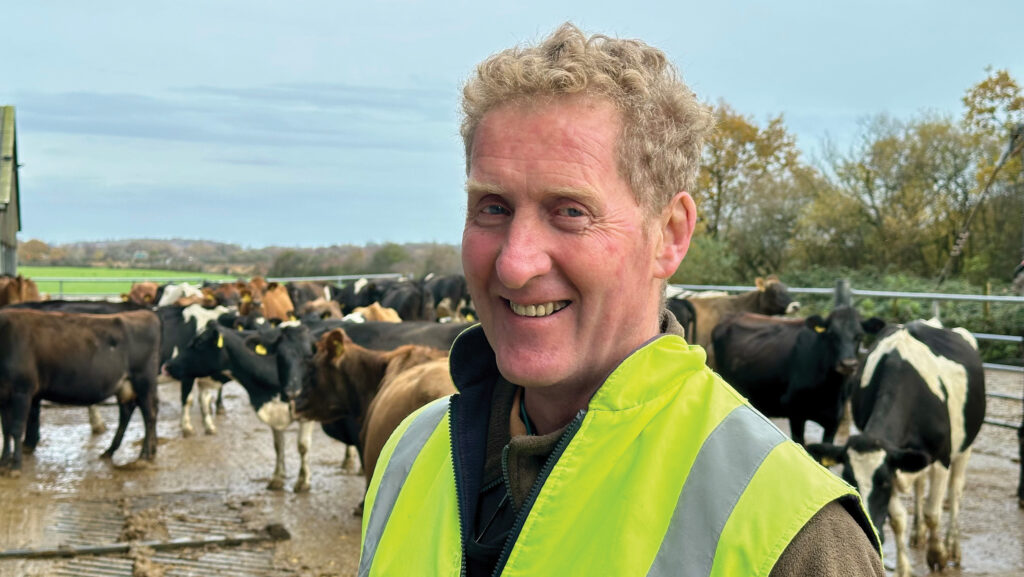
Dairy Manager Keith Davis © MAG/Judith Tooth
- 850 Jersey-crosses
- Yield 5,200 litres at 5.22% fat and 4.07% protein from 1.1t concentrates
- Spring block-calving
- Housing November to February
- Milk solid to Yeo Valley via First Milk
- Soils – heavy river silt
- Flat topography
The farm had already saved £37,000/year by lowering purchased fertiliser rates from 220kg nitrogen (N)/ha to 150kg N/ha, according to dairy manager Keith Davis.
However, there is potential to go further: dropping to 100kg N/ha could save another £26,000 at today’s prices, while also targeting an uplift in soil nutrient indices to individual paddocks.
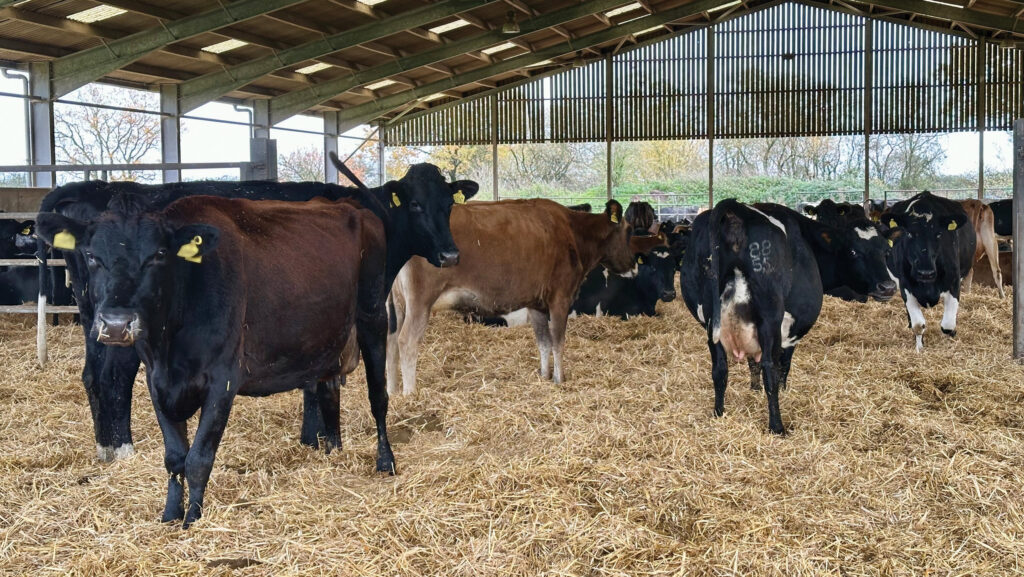
The straw yard has capacity for 200 milkers © MAG/Judith Tooth
Another small bonus will come in the milk cheque, as the farm’s contract pays “a bit more” for a matrix of environmental tasks – including nitrogen use below 150kg/ha a year, he says.
Slurry is collected each winter from 500 cows housed in cubicles (bedded with sawdust and scraped automatically) and a further 200 milkers in a loose straw yard mucked out fortnightly.
Manure is taken to the youngstock block for storing and spreading; 150 outwintered pregnant heifers join the herd each spring.
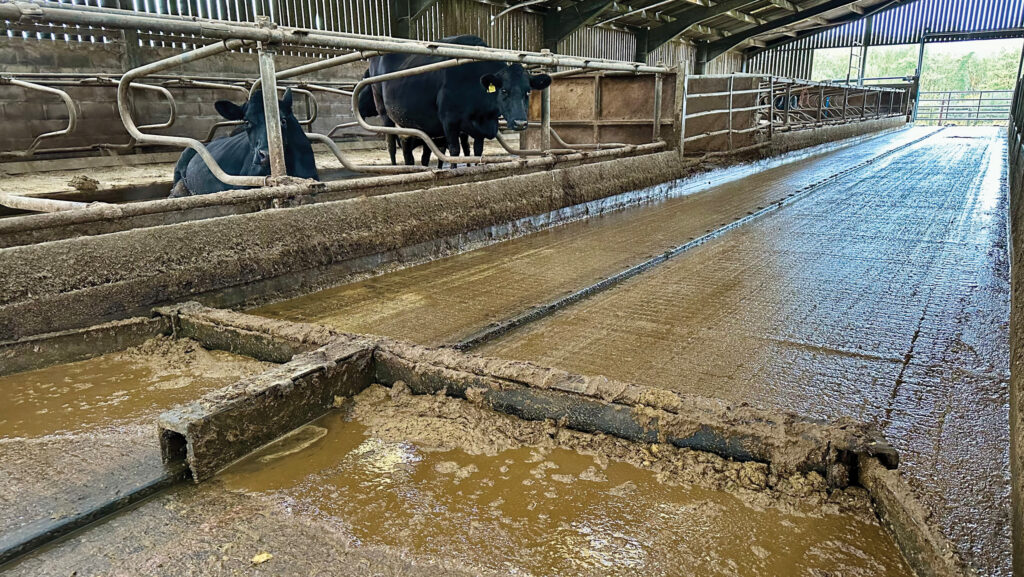
Automated slurry scraper in cubicle shed © MAG/Judith Tooth
Outdated system
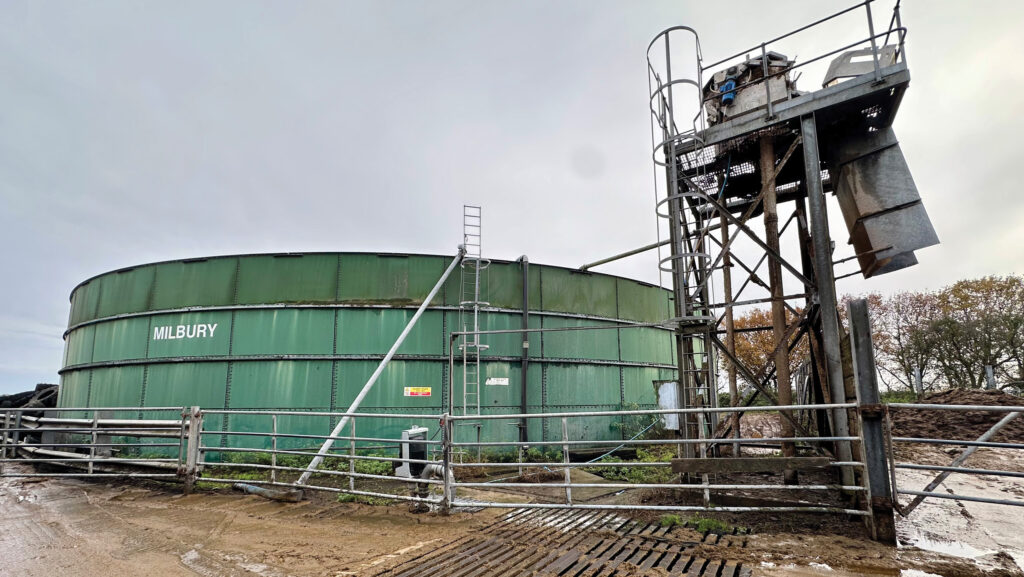
Existing slurry store at Lydney Park © MAG/Judith Tooth
The original slurry storage and handling system was set up in 1997 on a greenfield site for a 350-cow housed, high-yielding herd.
Even though management changed to a grazing-based system with just four months indoors, cow numbers grew, so they could only hold two months of slurry, says Keith.
And while they had a separator, it was unreliable and spent long periods not working. Slurry was spread using the contractor’s umbilical system.
A rethink of the whole slurry setup was prompted by the new guidance of Farming Rules for Water in 2022, and a visit from Dr Brendan Horan of Teagasc, in 2023, as part of becoming an AHDB strategic dairy farm.
Brendan told the Lydney Park team they were missing an opportunity in making better use of slurry as a nutrient source.
“We were trying to get rid of a waste product,” admits Keith.
The farm is not in a nitrate vulnerable zone, but the grazing platform is on a floodplain and can be under water for two or three weeks each winter.
“This meant we couldn’t spread, and we also have very flat ground with no higher ground for spreading, so we had to pick and choose where to go,” he explains.
Potential for improvement
“With proper storage, Brendan said we could reduce putting on slurry N in winter when the grass plant can’t use it, but spread it when conditions were ideal.
And we could grow more grass with less nitrogen. He also wanted us to have low emissions, and use a dribble bar for spreading.”
Paperwork took some time, but secured the business £180,000 of grant funding towards new kit.
To qualify, the new store had to have a roof and provide six months’ capacity.
It also needed planning permission, which then dictated the site, outside the floodplain.
This meant, rather than being gravity-fed at the bottom of the farmyard, the store had to go beside the sheds, and some concrete dug up to connect it to existing infrastructure.
New storage
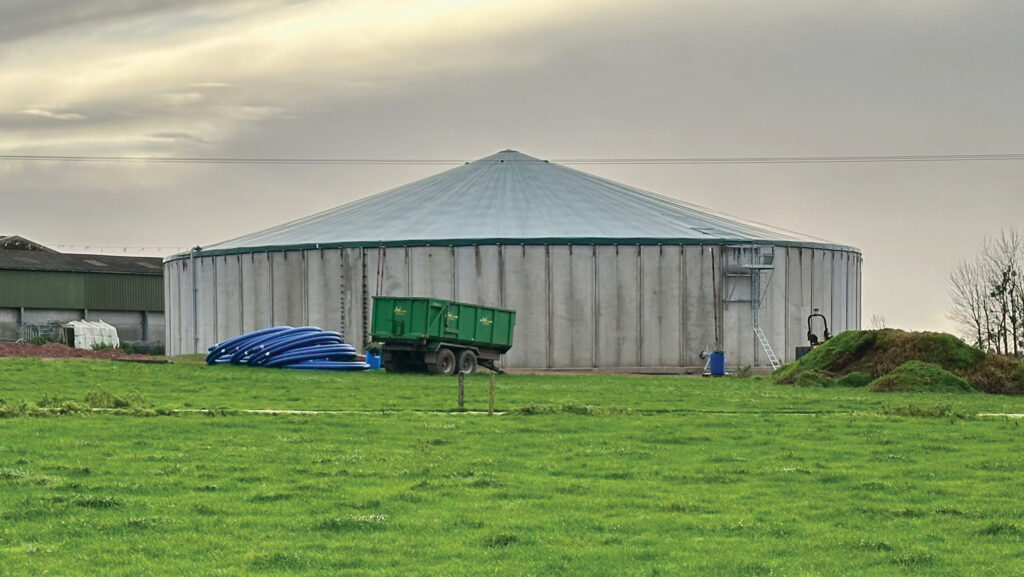
New slurry store at Lydney Park © MAG/Judith Tooth
The total spend of almost £500,000 included a concrete-panelled tank, a cover (with an inspection flap in the roof), a concrete base, separator, and one stirrer, plus new pipework and the groundworks.
The new tank, which cost £380,000, has been linked to the existing 3,400cu m store, and the solids store enlarged and improved.
Roof rainwater is collected and diverted into managed drainage channels.
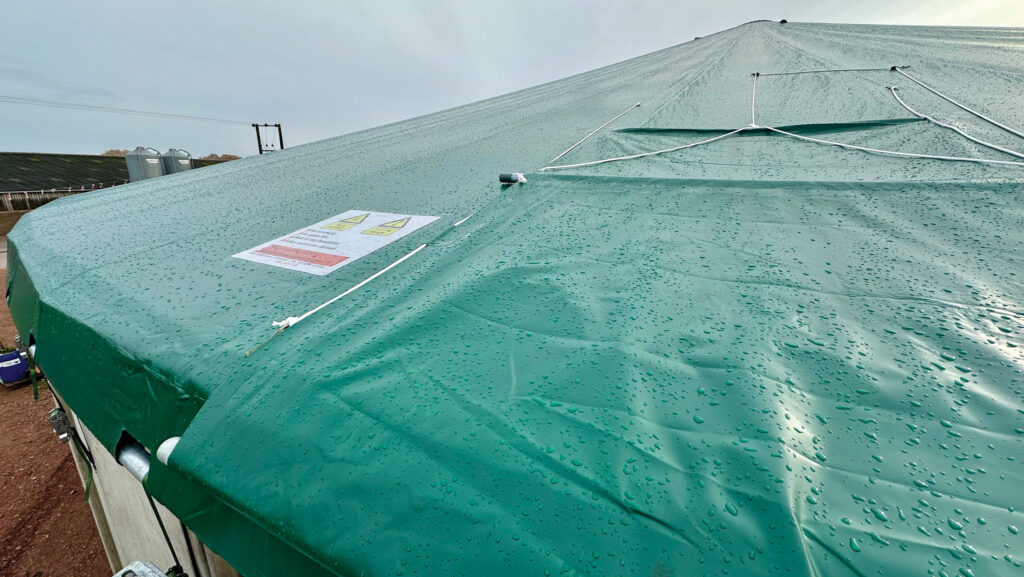
New slurry cover inspection flap © MAG/Judith Tooth
Keith says they got their contractor’s input to work out the most efficient logistics for transporting and spreading.
The request was for an exit pipe out in the field, so that slurry pipes were set to go under the farm road, not over it.
Keith says this allows the contractor to park his machinery out of the way and pump slurry whenever is convenient.
The plan is to continue separating slurry, and fill the original tank first, then the new one.
Solids will be carted to the support block grazed by youngstock.
“We couldn’t get much slurry to the youngstock grazing [down a narrow lane, passing close to houses], so it is low in P and K. But it will be practical to take solids,” says Keith.
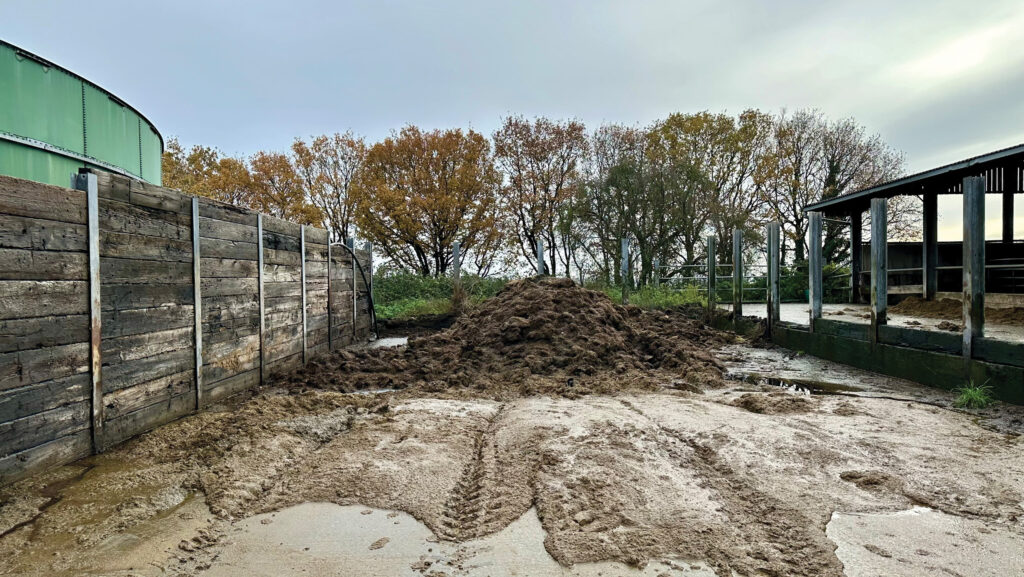
Solids store retaining walls to be completed © MAG/Judith Tooth
Slurry applications
Slurry will be stirred for two days before applying it to paddocks, and this will start as soon as a big enough area has been grazed.
“By the end of February, we will have grazed 30% of the platform and will start spreading a low rate in mid-March,” he says.
“From then on, we can apply it regularly and consider how much purchased nitrogen to cut back.
“We’ll apply to paddocks monthly in rotation, so that by about October the stores will be empty again [in time for winter housing].”
Applications rates will remain at 16.85 and 22.47cu m/ha (1,500 and 2,000 gallons/acre) – not enough to kill clover – and it will be analysed through a laboratory at the start and finish of the season.
As it takes a week to receive the results, Keith says it will not affect timing of application, but will be used to calculate how much nutrient has been spread; artificial inputs can then be adjusted accordingly.
Previous analysis revealed the nutrient content in every cubic metre was 1kg nitrogen; 1.1kg phosphorus; 2.3kg potassium.
Learning curve
However, relying on slurry as a fertiliser will be a learning process, he thinks.
“We need to learn our response rate – we plate meter weekly to measure grass growth, and soil test every three years – and how much nitrogen we’ll lose in summer through volatilisation.
“We’d like to get our 150kg N lower: it looks a long way away, but might be easier than we think.”
Swards now contain more clover, and the bottom 15% performing paddocks have been reseeded with leys containing ryegrass, red and white clovers, plantain and sheep’s parsley.
This means that the whole platform has potential to be productive.
Yet there is no calculation needed for payback on the farm’s investment. Keith views it as a licence to produce milk within current legislation.
“If you’re in dairy farming for the long term, you have got to do it.
“But Brendan’s report also gave us confidence that the tower wasn’t just about compliance – it was also a way to make the whole unit more efficient and future-proof it.”
The numbers
- 13 Average grass dry matter grown (t/ha)
- 1,081 –Annual rainfall (mm)
- 2 Height above sea level (m)
- 300 Milking platform (ha)