

Starter crumb v mini pellet: Which is best for chicks?
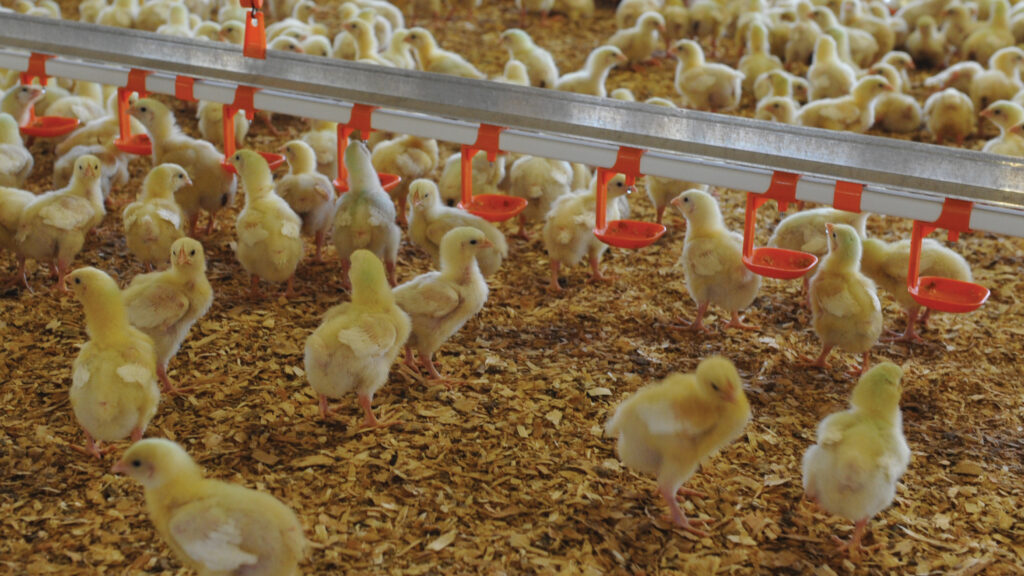 Feed format and texture influence chick intakes and feeding behaviour © Debbie James
 Early feed intake is vital to get birds off to a good start – in those crucial first seven days, good nutrition underpins musculoskeletal development and the growth of internal organs, and stimulates the gut.
A starter crumb has historically been the mainstay of chick diets in commercial broiler systems, but mini pellets suitable for very young birds are changing a decades-old feed strategy.
While chick crumb is still the go-to feed for most producers, some are persuaded by the results of trials that suggest mini pellets offer greater uniformity to diets.
See also: How nutraceuticals can aid poultry nutrition and health
This complete diet in pellet form was launched about 10 years ago, yet the move to the different feed format has been slow.
Industry analysts suggest that the integrator system, which accounts for a big percentage of UK broiler production, is one of the reasons.
Influence of industry structure
Integrators have remained traditional in their milling procedures, whereas the national feed compounders have moved towards the manufacture of a mini pellet.
Broiler producers supplying integrations are contractually committed to buy their feed from them.
In contrast, farms supplying the independent market often have the option to source either a mini pellet or a crumb as a starter diet.
With a number of changes required to the milling process to make good-quality mini pellets, any benefits must primarily offset the increased milling costs associated with manufacture and also deliver improved broiler performance.
Very early brooding performance relates in part to very low levels of selective feeding (resulting in potentially higher feed intakes) and a more even nutrient intake, leading to improved digestion and gut development.
Feeding behaviour
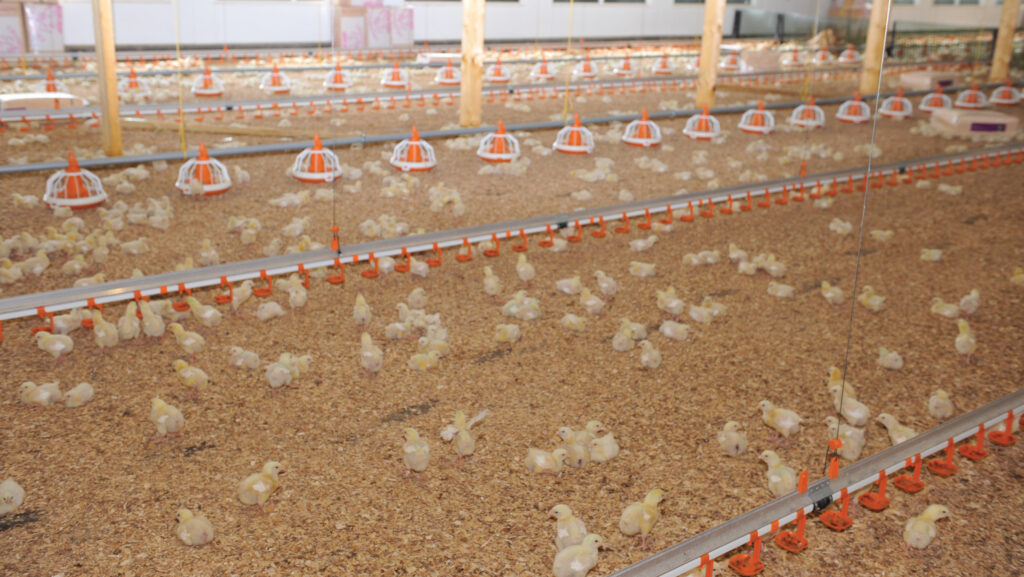
Optimum rearing barn conditions help encourage feed and water intakes © Debbie James
The pros and cons of different feeds in very early brood performance are difficult to quantify, says independent broiler farming consultant Chris Durrant.
However, observing chick feeding behaviour immediately post-placement suggests that feeding activity is enhanced with the mini pellet, he says.
His assessment of crop-fills between six and eight hours after placement supports this observation.
On the other hand, crop-fill measurements are very subjective, and the perceived difference may simply relate to the increased hardness of the mini pellet, says Chris.
“The literature would imply there is an improvement from feeding a mini pellet – however, on farm it is much more difficult to prove,” he says.
“The main reason is that the specification of starter diets varies, and this has a more significant effect on seven-day weights.
“My personal view is that the day-old broiler chick is particle-sensitive – they like particles big enough to be pecked effectively by their beaks.”
Seven-day weight assessment
Increased feed intake immediately post-placement and improved early gut development can be assessed from the seven-day weight.
At seven days, a chick’s weight should be four-and-a-half to five times higher than it was at one day old – the better the average daily weight gain, the lower the feed conversion ratio.
“Furthermore, the early establishment of the skeletal frame allows for increased muscle development,” says Chris.
Higher feed intake can provide several benefits – factors that are directly responsible for lifetime performance improvements:
- Enhanced early gut development
- Efficient establishment of the microbiome – colonisation with “good” bacteria
- Increased absorption of nutrients and yolk-sac utilisation
- Efficient development of the immune defence system and enzyme production
- Appetite stimulation.
Resilience to enteric challenges
It is the early improvement in gut development that enables enhanced feed uptake and the utilisation of the dietary ingredients in the different rations, says Chris.
The initial development of the chick’s gut over the first 12 hours on farm is critical in underpinning the health of the gut for the rest of the bird’s life.
As a result, it is likely to be more resistant to enteric challenges – particularly coccidiosis, a disease that can have a major impact on performance, he says.
The bird’s ability to deal with that disease challenge will have a significant effect on its final weight.
As well as any enteric challenges resulting from changes in diet, gut health can be impacted by vaccination and thinning too.
To capture performance and financial benefits from feeding a mini-pellet, optimal brooding performance is essential, says Chris.
“Impaired brooding performance invariably results in no added weight gain, but an oncost from the higher cost of the mini pellet.”
Strategies for optimising brooding performance
The focus should be on chick behaviour post-placement, a stage when chicks rely almost entirely on temperature and light to find feed and water.
1. Temperature
Focus on the temperature gradient of the bedding material from the walls to the middle – use a good-quality infrared thermometer to measure this.
Chicks are very sensitive to warmth, especially through their feet and body contact with the litter.
Achieving the correct air temperature is relatively easy and is especially important in older housing.
As a guide, optimal floor gradients range between a minimum of 30C (walls) to a maximum of 33C (middle of housing).
2. Light
The most overlooked component of optimal brooding performance is light.
Early feeding and drinking activity is again driven by lux levels and, more specifically, the lux gradient across the house. Post-placement, aim for about 21-25 lux.
The level of chick noise in the house is a good indicator of whether chicks are comfortable with light levels.
When lux gradients are too high, they get agitated, and this adversely affects early water and feed intake.
Combined with an associated increase in stress levels, mortality levels are often elevated.
3. Feed and rows of paper
Spread paper the size of a dinner plate evenly across the house from wall to wall.
Some chicks will be more hesitant and take longer to find the feed, therefore an even availability of feed and paper is beneficial.
Always observe the relative uptake of the feed across the rows to ensure allocation is correct and feed wastage is kept to a minimum.
4. Water temperature in drinker lines
High water temperature restricts early water and feed intake.
Optimal temperature is about 16-20C. If it feels comfortable to the hand, it is about right for the chicks.
5. Chick placement
Distribute chicks evenly across the house, as overcrowding delays access to feed and water and reduces thermal comfort levels.
Once chicks have imprinted on an area, it is very difficult to get them to move away.
6. Crop fill assessments
Between six and eight hours post-placement, 75-85% of chicks should have a detectable crop fill.