

Tackle feather pecking with good practice
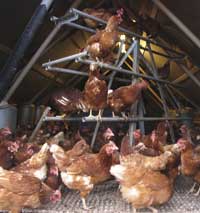
With DEFRA poised to delay a ban on beak trimming, two case studies by Compassion in World Farming show how feather pecking can be reduced by good management. Jeremy Hunt reports
Reduced feather pecking and cannibalism has been achieved on two British poultry units involved in studies to determine best management practice.
The free-range egg producers, based in Wiltshire and Devon, both maintain flocks of Columbian Blacktails – a composite breed based on Light Sussex and Rhode Island Red genetics – producing eggs for Waitrose via Stonegate under high welfare systems.
The Columbian Blacktail is noted for its docility, so helping reduce the desire of birds to engage in feather pecking.
But the studies have highlighted a range of other factors that must be addressed if these behavioural issues are to be overcome once beak-trimming is outlawed.
“Providing good access to the range and a rich litter in the house encourages birds to forage appropriately and that will reduce the urge to feather peck,” says Richard Kempsey, agricultural director of Stonegate.
“Straw is good for indoor foraging because it contains interesting bits of food and adds fibre to the diet. Getting birds outside on the range also helps reduce stocking density in the shed – and high stocking density is a big risk factor for feather pecking.
“Cannibalism can be a result of nutritional deficiency, especially of protein and key amino-acids such as methionine and lysine. Hens consuming each other’s blood and tissues is a way of obtaining protein that’s missing from the diet. Good nutrition – in both rearing and laying stages – is a key factor in preventing feather pecking,” says Mr Kempsey.
CASE STUDY ONE
Wiltshire poultry farmer Gerald Osborne runs his unit with stockperson Rachel Rivers and carries a laying flock of 4000 Columbian Blacktails and 4000 pullets – each in groups of 2000 birds.
According to Ms Rivers, the key to reducing feather pecking – which hasn’t been a problem on their unit at Lawn Farm, Pewsey – is the rearing system.
“We ensure the pullets are fully educated into the ways of adult life while still in the rearing environment, and that the transition from rearing to the laying house is kept as smooth as possible,” she says.
In the rearing house, pullets have access to slats and perches from week one, and outdoor access to a concrete veranda from week eight.
“Before the birds are let out at eight-to-10 weeks we put trailers out to provide cover. They soon start exploring,” says Mr Osborne.
“If the birds are suddenly given access to range conditions for the first time when they are put into the laying house, it takes them until 22 weeks to properly learn how to use the range.
“On our system they range from the first day. And I agree with the opinion that the longer they are kept inside during the rearing stage, the longer they stay in once they start laying – and the longer they are inside the higher the occurrence of feather pecking.”
Mr Osborne also favours letting young birds out early in the day to ensure they can achieve as much activity and foraging as possible.
The system at Lawn Farm enables pullets to learn to use slats and perches by providing them in the rearing house.
Using the range and being able to perch from an early stage reduces the stocking density on the floor of the house at a time of major stress for the growing bird – a high risk stage for the onset of feather pecking.
Increasing the amount of human contact – and even playing music to the birds – is also believed to enhance the environment and focus attention away from habitual feather pecking.
Birds at Lawn Farm are transferred to the laying shed at 16 weeks, which gives them two weeks to become accustomed to the laying accommodation.
They remain on the same diet to minimise the stress caused by the change of environment.
CASE STUDY TWO
Nutritional problems – thought to be associated with protein and amino-acid content – were considered to be the main cause of feather pecking in the first flock of Columbian Blacktails run by Devon organic producers Ian and Yta Batchelor.
A second flock was beak-trimmed to try and avoid the problem, but stricter enforcement by the Soil Association over beak-trimming meant that the Batchelors faced a difficult situation when a third flock of the same breed arrived as pullets suffering from severe feather-pecking.
The couple describe this batch as “a nightmare” and lost 100 out of 1800 pullets despite applying various tactics to reduce stress. The birds were given access to outside within two or three days of arrival, and provided with straw bales and scratching areas.
The flock was quickly switched to a high protein diet and the sheds were “walked” to add stimulus and reduce stress.
The Batchelors noticed that after three weeks of implementing the anti-feather pecking measures there was a gradual improvement. Subsequent flocks have had fewer problems and have arrived without having suffered previous feather pecking.
Compassion in World Farming says the move towards more enriched rearing facilities in organic rearing helped reduce the feather pecking problem and Mr Batchelor believes that work done on the genetics of the Columbian Blacktail has also made the birds more docile.
In line with other research in Austria, it may also be significant that the diet in early lay is particularly high in protein (19.19% protein, 0.39% methionine).
At Sutton Barton Farm the birds remain on the rearing diet from the day they arrive at 16 weeks old and then move to the new early laying diet. At 35 weeks, the diet is adjusted to a 16% protein ration to reduce production of over-sized eggs.
Mr Batchelor says it’s important to eliminate potential stress points as early as possible, before birds start laying, and to allow them a brief adjustment to their new environment.
“But it’s also necessary to get them used to all environmental changes before they come into lay. We keep our birds on the rearing diet for the first week after they arrive, but then transfer them on to the laying diet a week or two prior to the onset of lay.
“Lighting periods are extended slowly from 12 to 14 hours over a two-to-three week period,” he says.
Each new flock is kept inside for two to three days to adjust to their new environment, but are then allowed out so they are actively ranging before they come into lay.
Routines, such as letting-out time and feeding time, are quickly established. Each shed holds 600 birds and has the advantage of fewer birds being easily able to access popholes.
Although the Batchelors still experience some feather pecking in their flocks, they say the management strategies they have introduced have had a beneficial impact.
AUSTRIAN EXPERIENCE
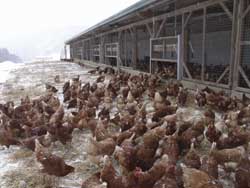 Compassion in World Farming believes that new approaches to management – both in the UK and in Austria – are proving that feather pecking and cannibalism can be significantly reduced without the need for beak trimming.
Phil Brooks, of CIWF, says the research undertaken in Austria by Knut Niebuhr has proved that large-scale commercial flocks can show a marked reduction in feather pecking by adopting various management strategies to influence behaviour.
“As well as the use of higher protein feeds at 19%, the Austrian research has proved how birds with traits for docility – such as the Lomond Brown – resort less to feather pecking. It has also highlighted the important influence the rearing period can have.
“Pullets that are educated with regard to perches and slats, and are familiar with the environment in which they will be kept as layers, suffer very little from feather pecking,” said Mr Brooks.
He adds that encouraging pullets to learn how to use high perches, enabling them move away from birds that are foraging, also has a beneficial effect. Providing “winter gardens” – areas where birds can forage for food in the winter months when they are less inclined to forage outside – is another important factor in helping to reduce the urge to feather peck.
“The aim should be to let young birds learn how to live in the environment they find themselves in when they are adults. There’s no doubt that the birds most at risk are those on low-level perches.”