On test: Kawasaki back with keenly priced Brute Force 450 ATV
 © James Andrews
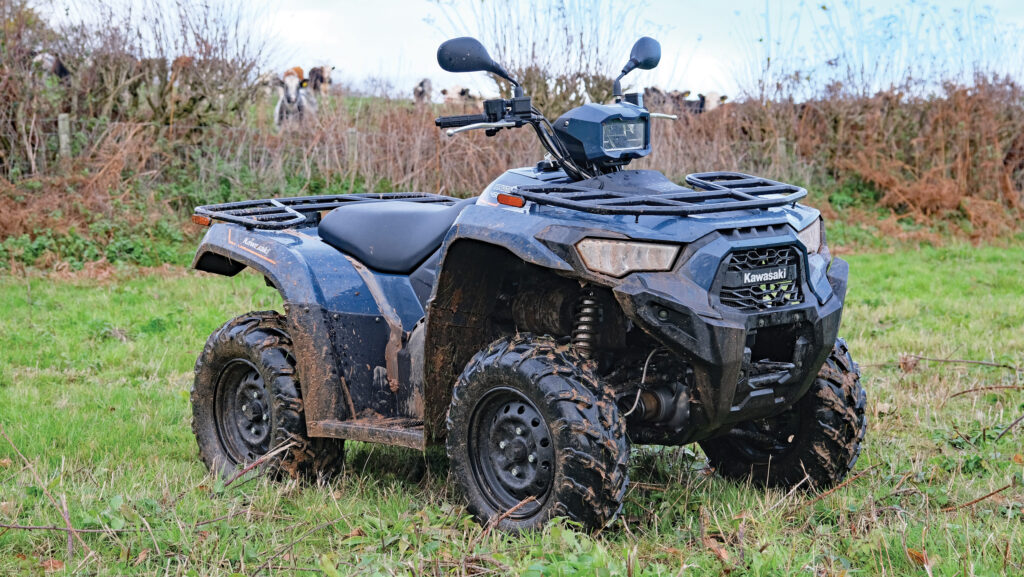
 You’d be forgiven for thinking Kawasaki had forgotten about agricultural ATVs.
Ever since the Mule rose to prominence, the Japanese firm’s attentions seem to have been focused on steering wheels and cabs rather than handlebars and rain-soaked seats.
See also: ATV buyer’s guide 2025-26
So much so, in fact, that for aeons just one 750cc V-twin bruiser of a quad bike was left holding the fort.
That changed earlier this year when a nimble Brute Force 450 joined the stable. And with a £5,328 price tag, it means business.
How, you might ask, is it possible for a well-respected brand to roll out bikes at the same price as the cheap-and-cheerful outfits?
Well, as the old adage goes: if you can’t beat ’em, join ’em.
Rather than going it alone, the Japanese marque has entrusted the building of this budget-friendly model to a brand that’s already got form in the area – Taiwanese concern Kymco.
Kawasaki says its own engineers remain heavily involved, shaping the bodywork, refining the design and ensuring the finished machine meets the company’s usual standards.
Even so, a quick flick through the spec sheets reveals that the Brute Force has plenty in common with Kymco’s MXU 465.
Both, for example, are fitted with a 443cc single-cylinder petrol engine putting out 33hp. Both have switchable four-wheel drive and a lockable limited-slip front diff. And both can carry 34kg on the front rack and 68kg at the rear.
Is it well-built?
If we hadn’t spilled the beans, many buyers would be hard pushed to spot that this bike wasn’t built in-house – albeit with some tension on the purse strings.
Body panels are made out of decent-grade plastic, suspension wishbones look solid enough and the controls, for the most part, have a quality feel.
Kawasaki has put plenty of thought into the design, too, pairing back the fripperies to make sure it’s got the basics covered.
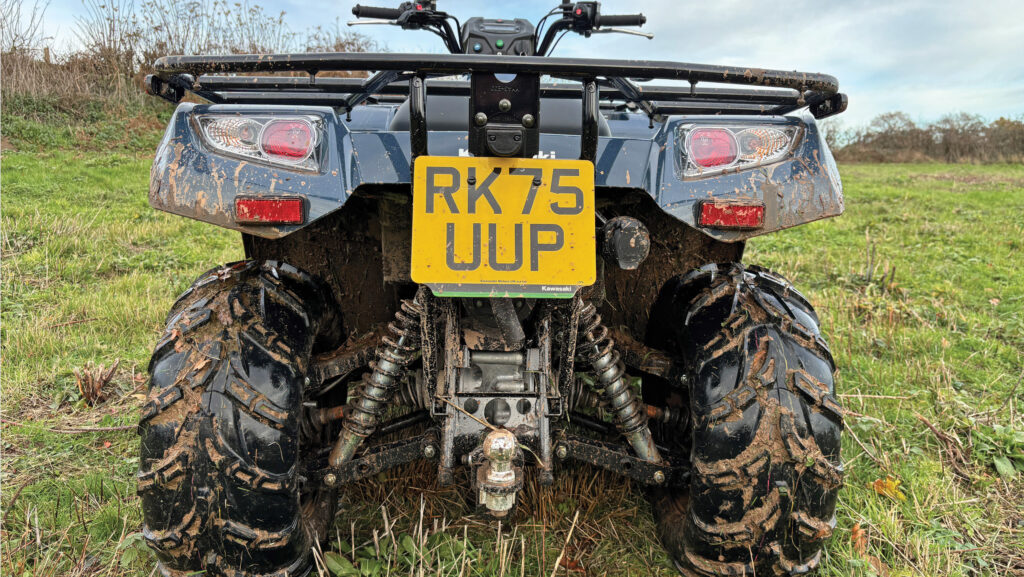
There’s no power steering, front winch or alloy wheels, but it is T-category approved, with LED road lights and indicators, making it easy to register for road use.
It’s also got a powerful work light on the handlebars that’s great for checking on stock in the dark.
What’s it like to ride?
The first thing you notice about the 450 is its compact proportions. Climbing onto some modern bikes, particularly North American ones, is akin to mounting a shire horse.
So the Brute Force’s 880mm seat height, 2m length and 1.1m width are a refreshing change, making it handy to hop on and pilot through tight yards or over undulating terrain.
Steering lock is decent, too, and the bars are easy to turn, even though it doesn’t give any assistance.
Yes, more effort is required during low-speed manoeuvres, but the lack of a power steering system helps keep the cost down and it’s one less thing to play up in the future.
As for the engine, it’s smooth and pulls as a 450cc should, hitting a limiter when the bike gets to 40mph.
It is a bit of a screamer, though, so feels a little more frantic at high revs than some Japanese bikes fitted with lower-revving plodders.
Another consequence is that the footrests can vibrate at a slightly unpleasant frequency when travelling at certain speeds. It’s worth adjusting the throttle slightly to calm things down, otherwise riders will find themselves easing their feet off the rests.
There are no fancy drive modes, but it does have a tortoise button on the dash that prevents the engine speed going over 4,000rpm.
It’s hard to see many uses for this, particularly as the engine pops and farts like a flatulent grandparent as soon as it hits the limiter. The throttle lever offers plenty of control, though, so riders are better off holding it at the speed they want.
© James Andrews
Suspension is another area where the bike punches above its weight, with independent wishbones on all corners and bump-eating coil-over shocks.
Damping isn’t as good as some higher end bikes that seem to iron out every lump, but it’s perfectly acceptable.
Kawasaki Brute Force 450
- Engine 443cc single-cylinder petrol
- Power/torque 33hp/33Nm
- Transmission Belt CVT
- Drivetrain Selectable four-wheel drive with locking front diff
- Suspension Dual A-arms front and rear
- Brakes Hydraulic discs front and rear
- Towing capacity 140kg
- Load rack capacity 34kg front/68kg rear
- Starting price £5,328
How about the transmission?
No complaints here. Like most ATVs (Hondas excluded) the Brute Force is fitted with a belt-type CVT with high, low and reverse gears.
The belt grips well and delivers excellent engine braking on a steep hill without engaging any fancy descent modes. This means there’s rarely any need to use the brakes, reducing the risk of wheels locking up and sliding.
© James Andrews
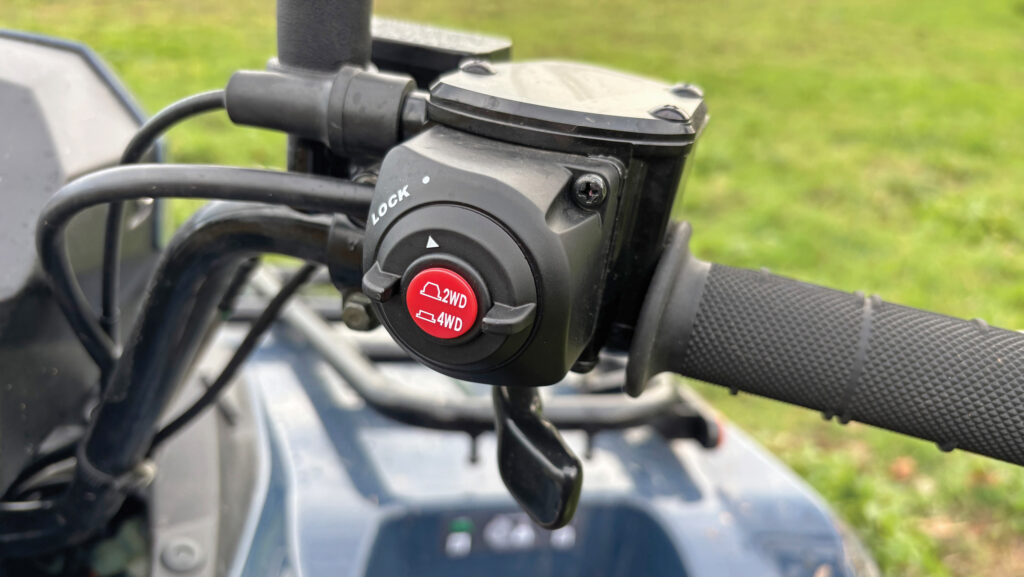
The four-wheel drive system is also on point, with a button on the handlebar to engage and disengage the system, as well as a locker for the limited-slip front differential.
Shifting between high and low ranges and reverse is suitably slick, with a neat lever on the front fender. A slight stretch is required to reach this, unlike brands that put them nearer the bars, but the bonus is that there’s no risk of clonking a knee on it.
It’s also clearly labelled and a breeze to shift, requiring only the occasional rocking of the bike when stopped on a steep slope or rapidly shunting from forward to reverse.
© James Andrews
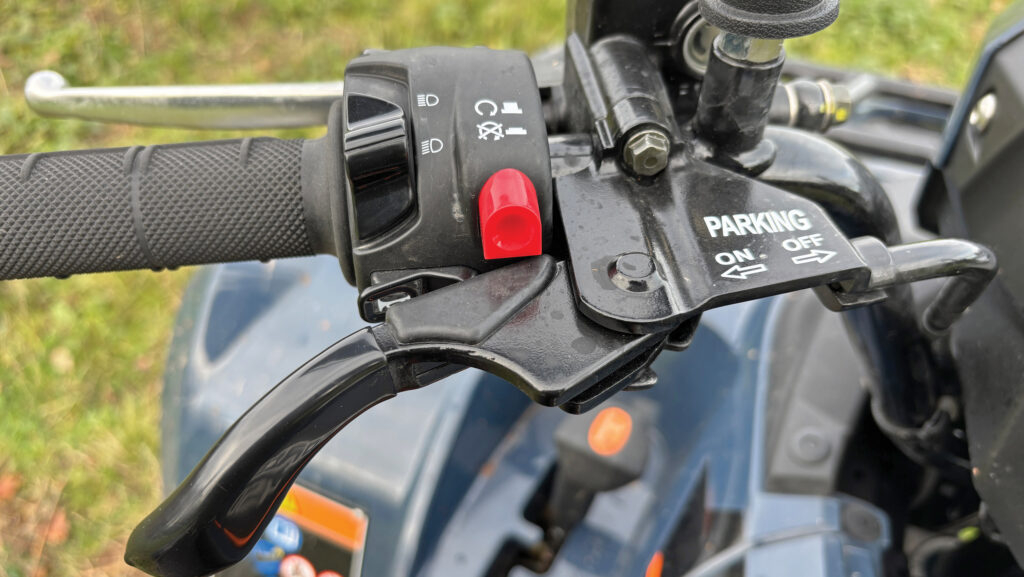
More of a love-hate feature is the large handbrake lever. It’s easy to grab and engage, but it does clutter up the handlebars and can act as a hook, snagging baggy sleeves.
However, the crown for the most irritating item goes to the incessant warning buzzer, which chimes in whenever the bike is stationary with the engine running.
Silence can be achieved with a quick dab of the brakes, only for it to pipe up again 10 seconds later. Sometimes it will even have a go when the bike is crawling along at slow speeds.
Buyers will soon be reaching for the wire cutters…
What about towing and carrying?
The Brute Force’s sturdy metal racks are standard fare, but Kawasaki has gone to the trouble of adding neat little prongs on the underside to make it easy to strap down a load.
There is less in the way of storage for smaller items, though, with just a small tray under the seat and a cupholder.
The official towing capacity of 140kg is also rather lowly. However, the power of the bike and strength of the back end would suggest it can cope with far more.
Farmers Weekly verdict
There’s a lot to like about the Brute Force 450: compact proportions, decent power and a keen price.
It has all the features a farm quad bike needs without the fancy extras that add cost and complexity.
Some buyers will be put off by the fact that it isn’t built by Kawasaki, but the price will help push any concerns to the back of the mind.
Just look at what fellow Japanese brands are charging – Yamaha’s Kodiak 450 starts at £8,760, Honda’s TRX420 Fourtrax is priced from £8,150 and Suzuki’s King Quad 500 kicks off at £10,679.
Yes, these are all more polished than the Brute Force, but for an outlay of £5,328, it seems mighty good value for money.
Oh, and the fact Kawasaki is willing to put its name on the front means it must be pretty well put together.
Likes and gripes
Likes
- Compact proportions
- Decent power
- Seems well-built
- Keenly priced
Gripes
- Irritating warning buzzer
- Slight vibration through foot rests
- Very little storage space
- No power steering option