Chafer liquid fertiliser rig boosts Miedema potato planter output
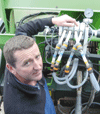
When planting potatoes, it has long been accepted that placing fertiliser in a tight band below and to the side of the mother tuber results in enhanced yields. Andy Collings takes a look at a new liquid fertiliser system that does just that
Cambridgeshire potato grower Ian Gilbert of Butcher’s Hill Farm, near Littleport, is no stranger to liquid fertiliser injection. He first tried a system over 15 years ago to capitalise on the benefits that could be achieved by placing fertiliser close to the mother tuber.
“Potato roots only occupy about a third of the cultivated area and when the crop is growing rapidly it may struggle to obtain sufficient nutrient from the immediate soil,” he explains. “Placing fertiliser – particularly phosphate which is pretty immobile – is, I believe, important.”
He comments that spinning granular fertiliser on to the surface just cannot be as effective and if it remains dry the nutrients can remain on the surface unused.
Investment
At the start of last year’s planting season Mr Gilbert bought a new two-row Dutch-built Miedema Structural belt planter and invested a further £6500 having a Chafer liquid injection system fitted to it.
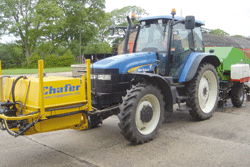
“With fertiliser injection tines fitted on to the planter’s openers, nutrients are placed 3in either side of and 2in below the potato tuber,” he explains. “Equal fertiliser rates are applied through each outlet so even the potatoes at the edge receive the required volume of nutrients.”
A speed related application control system means that a rate can be maintained irrespective of changes in planting speed. Colour coded restrictors enable liquid fertiliser rates to be pre-programmed from the in-cab TeeJet rate governor and an onboard warning system also alerts the operator should an outlet become blocked.
Chore
“Earlier systems we have used required us to vary application rates according to information provided by charts and alter operating pressures manually,” he says. “It was all a bit of a chore but we believed in doing a good job – growing potatoes is a specialist business and we could not afford to get the nutrition wrong, especially at the early stages of crop growth.”
Mr Gilbert opted to fit the New Holland TM155 planter tractor with a 1000-litre front mounted tank – it helps to balance the weight of the Miedema, especially when full.
“A larger tank would mean fewer fill ups,” says Mr Gilbert. “But, in practice we fill up each time we need to stop to re-fill the seed hopper. As a rule of thumb, 1t of potatoes requires about 1000-litres of fertiliser.”
One-man operation
He makes the point that the seed and fertiliser fill up is now a one-man operation which not only cuts down on labour requirements but actually reduces downtime.
The distribution system calls for the manifold to be split into four chambers with each supplying an injection tine with two bands of fertiliser placed either side of the potato seed tuber.
Logically, the liquid system suggests that nutrients are readily available and are therefore taken up by the plant more quickly. This reduces the dependence on the weather or soil moisture to activate the take-up of solid fertiliser.
Bonus
Mr Gilbert adds that, as a bonus, liquid fertilisers can also be formulated to suit the nutritional needs of individual fields.
“On the solid fertiliser system we employed in the past we used to get yellow patches on the outside rows and this almost certainly reduced yield,” he says. “On a two-row planter this can be serious so before purchasing the new machine we had to make sure all issues about accuracy and dose rate were covered.”
The change over to the new injection system has also offered some time saving – Mr Gilbert says he can plant his 120ha (300 acres) of potatoes at a rate of 8ha a day (20 acres a day), making for a three week, rather than four, planting season.
“The sooner the crop is in the ground the quicker it starts to grow and keeping the crop growing for as long as possible is the key to boosting output,” he insists. “And if the nutrients are in the right place to spoon-feed the growing plants then crop stress and other disorders can be reduced.”
He also makes the point that an added benefit of liquids is the huge reduction in waste packaging and the problem – and cost – of having to dispose of it.
Liquid Fertiliser for spuds
- No wastage – all fertiliser available to growing crop
- 25% quicker operation
- Reduction in waste disposal costs
- 1750-litres/ha of 7:10:12
- Benefit is in evenness of establishment and uniformity of harvested crop