

Contractor Comment: Horsch Pronto tests 724 to the max
 © JO Straughan
 Who’da thought it? Some of the hardest hours at JO Straughan this year have come not on the combine or forager, nor in tractors racing to get ground tilled and drilled.
Instead, they have been in the pickups.
The makeshift gritting team has been flat out over the past few weeks, regularly clocking double-digit overnight hours to cover 105 sites south to Newcastle and west to Hexham in occasionally treacherous black-ice conditions.
See also: Fendt unveils long-awaited Gen5 800-series Vario tractors
Business facts
JO Straughan & Co, Netherton Park Steads, Stannington, Morpeth, Northumberland
JO Straughan & Co has been offering a comprehensive range of agricultural, plant hire and haulage services to customers in Northumberland and the Scottish Borders since 1955.
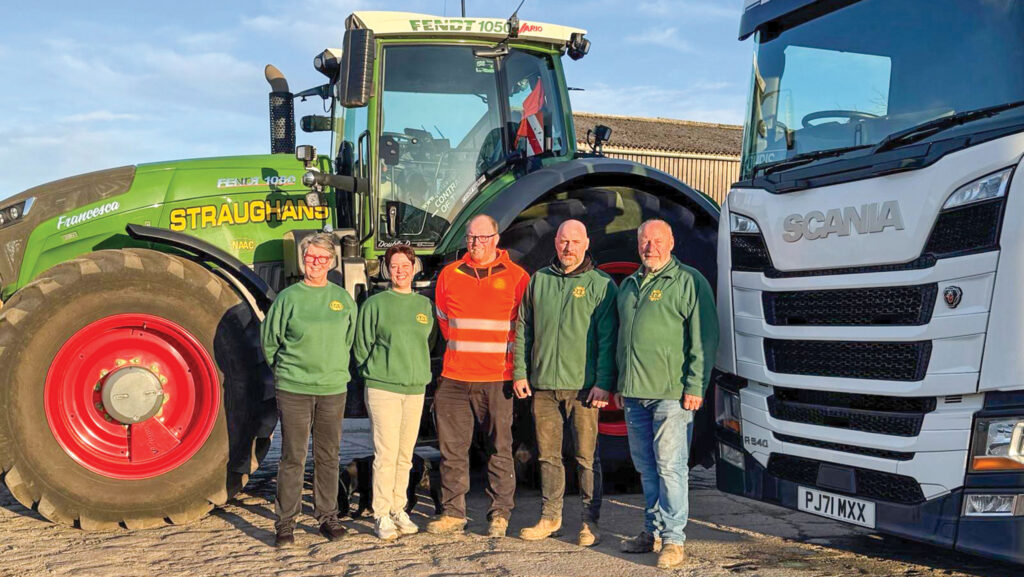
Owner Roger Dickinson runs the business alongside his wife Sandra, sons David and Stuart, and daughter-in-law, Debbie.
- Main services: Grass silage (2,500ha), combining (1,400ha), cultivating and drilling (3,400ha), square baling (45,000 bales)
- Other: 400ha contract farming (stubble-to-stubble arable contracts), treated biosolids spreading (55,000t), bulk haulage of straw (2,500t), grain (16,000t) and biomass wood pellets (10,000t), plant hire and machinery transport
- Staff: 11 full-time plus up to another three during the busy season
The Dickinson family © JO Straughan
This unexpected surge in demand – a trebling of last year’s site count – has necessitated the purchase of a third trailed spreader, which should carve three hours off a big night’s work.
To get the job done as efficiently as possible, Straughans is using an app designed for delivery drivers – Spoke – that imports address spreadsheets and maps out the best route for each outfit.
Aside from the extra work at an otherwise sleepy time of year, the recent cold snap should pull the leash on some very forward crops that, on current form, look capable of matching this year’s stellar harvest figures.
Wheat hit 12t/ha, barley 10t, beans 6t and rapeseed 5t in what was the earliest, easiest and one of the most bountiful summers in JO Straughan history.
“We only stopped combining for one day, and even the beans were cut at 14%,” says the firm’s chief, Roger Dickinson. “We’ve never done that before. They were like bullets coming into the tank.”
And there was only one combine breakdown of note – a steel hydraulic pipe, gradually fatigued by pulsing oil, burst on an elbow.
It has been replaced by a rubber hose – Roger’s standard course of action where steel pipe problems are concerned – and plans are afoot to fit an accumulator that will eliminate the pulsing.
Reliable weather gave the team the chance to demo a Claas Lexion 8700 in the last few wheat fields, complete with a 12m Convio header.
“The output compared to our 10.8m Vario header was unbelievable,” says Roger’s son Stuart.
“Everything goes in head-first and smoothly, and the combine was never overloaded, even when we were hitting 90t/hour. By comparison, our own 8700 was managing 70t/hour – albeit with a bit less horsepower.”
“The running costs of that header might be higher, but it certainly gave us something to think about.”
Terrano pending
© JO Straughan
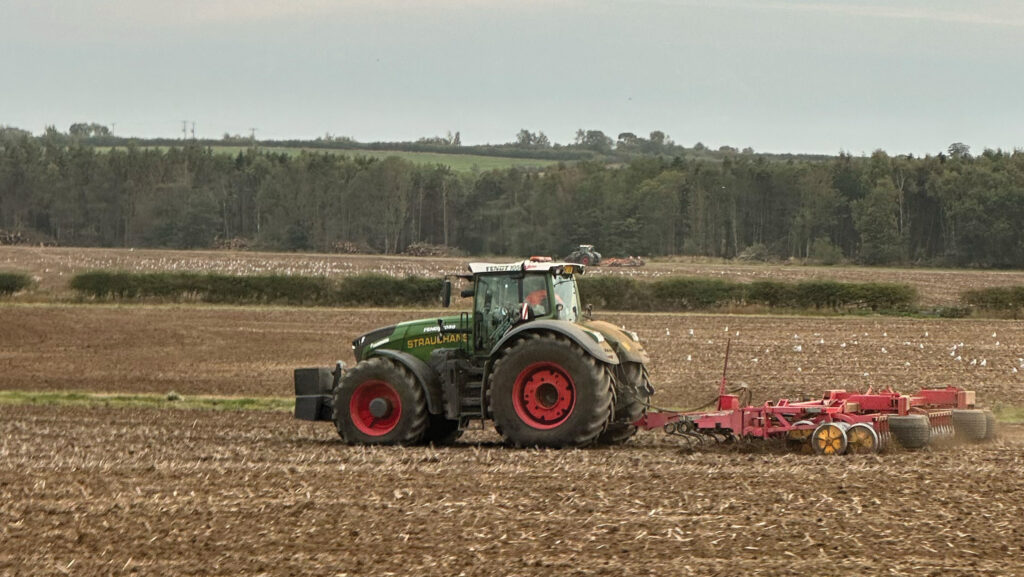
The Lexion wasn’t the only demonstrator to arrive at Netherton Park Steads in late summer, with Horsch bringing its tine-based 6m Terrano cultivator to the party.
And it looks set to be a permanent fixture, having been earmarked to replace an ageing 5m Simba SL.
Potential benefits of the upgrade include a 50% increase in forward speed, to about 12kph, an extra metre of working width, and better performance in heavy trash conditions thanks to well-spaced legs.
“It should be gold-plated looking at the price, but we can’t stand still – we have to invest,” says Roger.
“Fortunately, SLs are still in demand so should command a decent price – and rightly so, as they’re good machines.”
The Terrano will do all the primary cultivations, ploughing aside, followed by a pass with a Vaderstad Rexius Twin or Simba Unipress or, if conditions allow, the drill.
Given it wants at least 400hp on the front, it’ll be run on a Straughans favourite – the ever-reliable Fendt 1050.
And to add to its versatility, the Dickinsons plan to spec it with a Biodrill for establishing cover crops.
The remaining 4m SL will be fitted with a coulter bar and liquid starter fertiliser kit for putting in oilseed rape, once it’s been stripped from the departing 5m and modified to suit.
A new plough is also on the shopping list, with the five-furrow Lemken Juwel 7 having failed to pass muster.
Its fate was sealed when the main 4in turnover shaft snapped on the second-last bout of the season, and on the furthest job from home.
“We just power harrowed the remaining stubble and took a low loader and forklift to recover the plough,” says Stuart.
“But the reality is that the Juwel 7 isn’t a contracting tool; it’s not man enough to handle 240hp.”
Though the breakdown might have been the straw that broke the camel’s back, it’s the plough’s complexity that has proved as much of a sticking point.
“Some days it is perfect but it’s not very user-friendly – there are just too many adjustments,” he says.
“We’ve had Kvernelands before and they’re easier to set up, which is critical when you’ve got several different operators. There’s no place for electronics on a plough.”
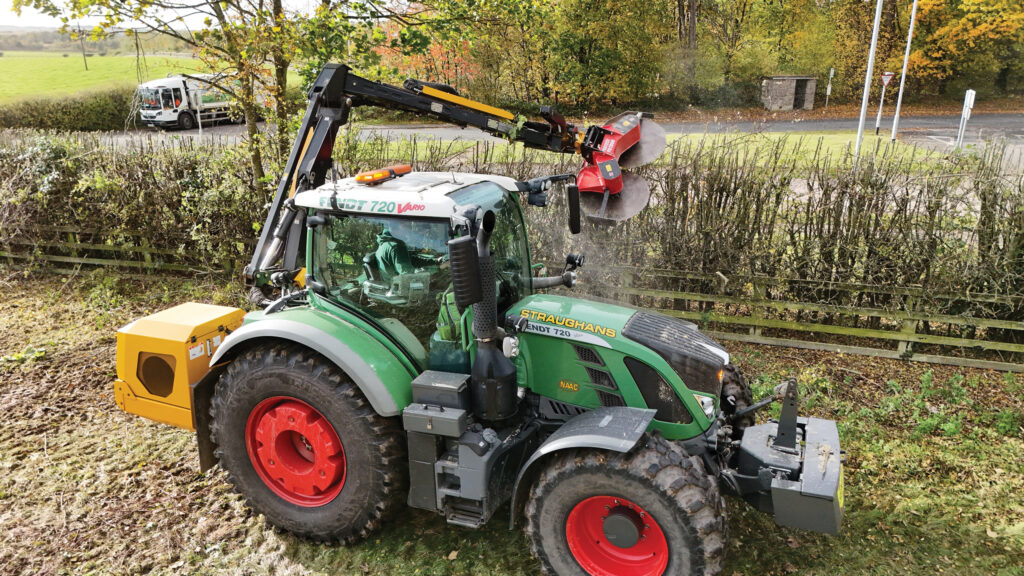
Two other mid-year investments came in the form of a halfpipe aggregates trailer to run alongside the bulk grain bodies, and a Protec PB 2000 twin disc cutter that has annihilated unkept hedges since its arrival.
The Dickinsons have also just done a deal for a full-spec Gen 5 Krone Big Pack 1290 VC to replace their non-chopping 2014-built model early next summer.
724 struggles
This year has proved a rough one for Stuart’s Fendt 724.
Now on 5,500 hours, a never-ending run of mechanical maladies will probably culminate in its demotion to lesser duties in 2026. A 728 could well fill its boots on the frontline.
“It has been pushed too hard for too long,” he says. “I need it to be well on top of drilling and mowing but, according to the telematics, it has been gasping at 100% engine load practically all day, every day.
“That won’t be a problem with the extra power and lower revving Agco engine of the 728.”
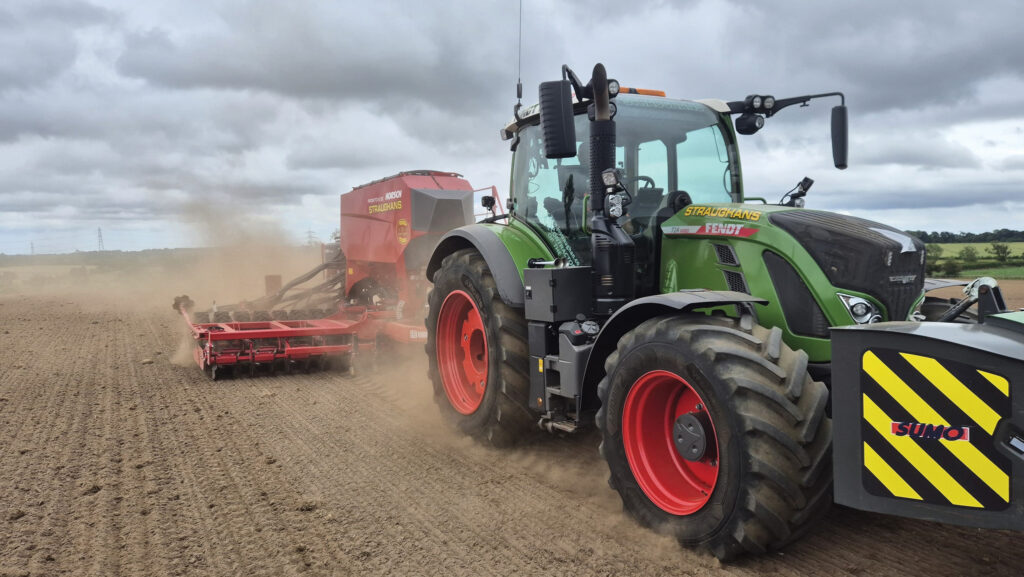
The new 6m Horsch Pronto drill was particularly unkind on the struggling 724 – at least once moisture had returned to the soil surface and wheelings needed pulling up.
“The 724 is comfy at 11kph but try and push on to 14kph and it’s a rough ride all day – especially given the final cultivations are done at an angle,” says Stuart.
“We had a 728 on demo for beans and it was perfect: it has that bit more weight and power, and bigger wheels, to keep the dog wagging the tail.”
Recent 724 troubles include having to replace the viscous fan, the spools haemorrhaging oil when parked overnight, and an AdBlue system fault. The NOx sensor was replaced in-house, but the problem turned out to be injector related.
“We had the bits in stock but it needed a laptop, so we couldn’t do anything with it.”
As a result, the tractor was parked up for seven hours on two separate days.
“Downtime, and the disruption it causes, has been the real killer – especially when I’m drilling in the middle of nowhere,” he says.
“It’s all well and good having an 8,000-hour warranty, but it doesn’t protect us from inconvenience and hold-ups.
“That’s where the dealer is critical and why we’re increasingly thinking about keeping things local. We could have a Massey Ferguson 8S from three miles away.”
So why not change?
“The 8S.305 is a really good tractor. It’s quiet, comfortable and offers tremendous visibility – it’s just a quality joystick and screen short of being perfect.
“The other catch is that it isn’t a great deal cheaper than a 728, and we’d comfortably make up that difference on resale.”
However, Massey may well get the nod when the 11,000-hour 939 is chopped in, less than a year since an engine transplant.
“The 9S is nimble like a 939 rather than a big heavy lump, which is handy when it’s used as an emergency stand-in at silage time, so it could be the way we go for baling and cultivations.”
Drills prove a hit… in easy conditions
Two new drills joined the fray for the autumn campaign, and both look to have proved their worth – albeit in incredibly forgiving conditions.
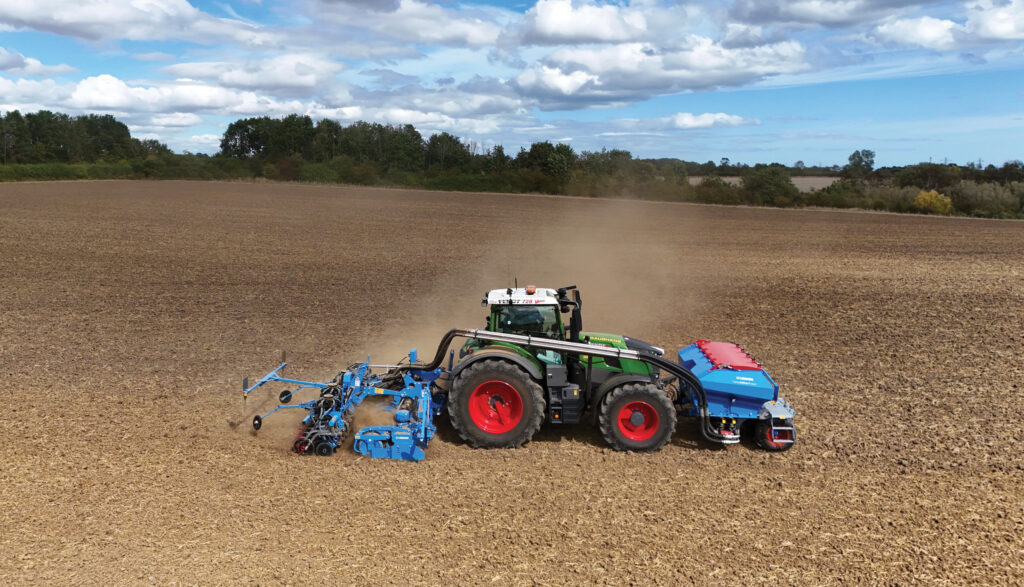
One was a Lemken power harrow toolbar and front hopper combination, which demonstrated merits beyond just the better weight balance that such an outfit affords.
“Part of the reason we bought it was to help us travel on challenging ground without a tonne of seed adding to the weight on the back,” says Roger. “It turned out we didn’t have that problem this year.”
But he has also been impressed by the new isobus-controlled hydraulic coulter bar that puts down far more pressure than the 12-year-old Solitair 9 it replaced.
“Visibility is better too, it’s easier to calibrate – as everything is done at the front tank – and it has the Zirkon 12 power harrow, which is a different animal to the old Zirkon 10.”
© JO Straughan
Though the front tank makes for a slightly an unwieldy looking outfit, according to Roger it’s no bigger than a front press, and easier to travel with thanks to a full set of cameras.
The Dickinson clan is similarly pleased with the new Pronto and, in particular, its split hopper and extra Biodrill that allows them to buy companion and cover crop seed as straights and meter them separately, saving money over bought-in mixes.
Stuart’s only grievances from its first 1,200ha are that stones occasionally wedge between the central frame and wing sections, gradually shredding the tyres and enveloping them in white smoke, and the lack of wheel scrapers – something the previous Vaderstad Rapid did have.
According to Horsch, this is combatted by increasing forward speed – if you’ve got the horsepower… A new 728 would see to that.
The other challenge is keeping it running straight, with the drill’s tendency to pull left accentuated by pushing the discs in deeper and working across slopes – even very gradual ones.
“It might only be a 3cm difference, but on 15cm spacings that inconsistency looks hellish until the crop has tillered.”
Technology headaches
The obvious solution is to fit a GPS receiver on the drill to ensure it runs bang on.
But the Dickinsons are loathe to invest in the stand-out candidate – from John Deere’s Greenstar stable.
“It would do exactly what we want. But our aim is to have the whole fleet running on the same software and feeding into one management platform,” says Stuart.
“We’re not going to run John Deere tractors – been there, done that – so it doesn’t make sense for us to make a huge investment to convert every machine to Greenstar.”
“Why spend a load more money on more kit from a third party when we’ve already paid for Fendt tractors and the associated technology?”
With Trimble now fully integrated into the Agco business, and the latter having emphasised its intention to focus on retrofit technology packages, hope could be on the horizon.
The biosolids spreading division offers a good example of what the team is lacking.
© JO Straughan
The fleet is typically made up of two hired-in Massey Ferguson 8S.265s and one of Straughans’ Fendt 724s.
They work as a trio, peeling off to spread in different fields before finishing in the one containing the stockpile.
“At that point, they need to be sharing boundaries and AB lines – one tractor can map the perimeter while the other two are being filled, but it needs to work on the Masseys and Fendts.”
This requires a system that will show where each has spread, irrespective of tractor brand.
“Traceability is critical – we need to show exactly what we’ve put on and where, so the systems need to talk.
“Fendt might be the best tractor out there, but the tech is eight years behind John Deere. We’re hoping Trimble might come up with something next year to store and share all the information from one place.”