Contractor Comment: Second Jaguar mops up late-season grass
 © James Andrews
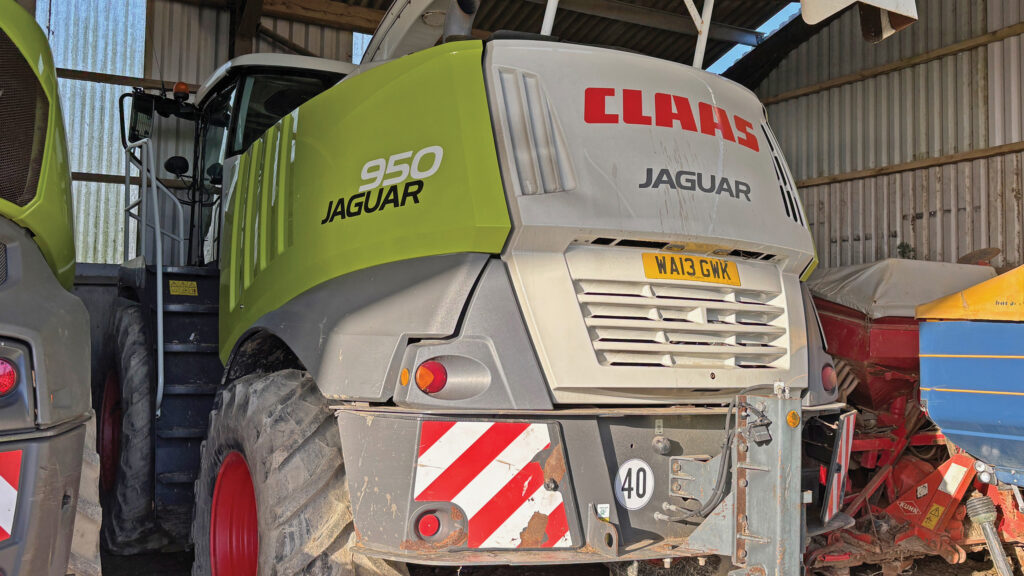
 The arrival of a second Claas Jaguar 950 forager couldn’t have come at a better time for Josh and Helen Collins, who found themselves facing a formidable autumn workload.
Just as they were gearing up to tackle 400ha of maize, parched pastures that had lain virtually dormant all summer received a late-season soaking and put on a growth spurt.
See also: Driver’s view: Contractor rates pre-production Claas Jaguar 1200
This added an unexpected 350ha of grass silage to the jobs list, all of which needed chopping before the heavens opened again.
Thankfully, the 2013 Jag turned up with barely a day to spare. “We’d been thinking about increasing our chopper output for a while, but kept going around in circles,” says Helen.
However, when a tidy 970 with just 1,000 hours on the clock came up for auction locally, upgrading their 2021 950 seemed like the sensible move.
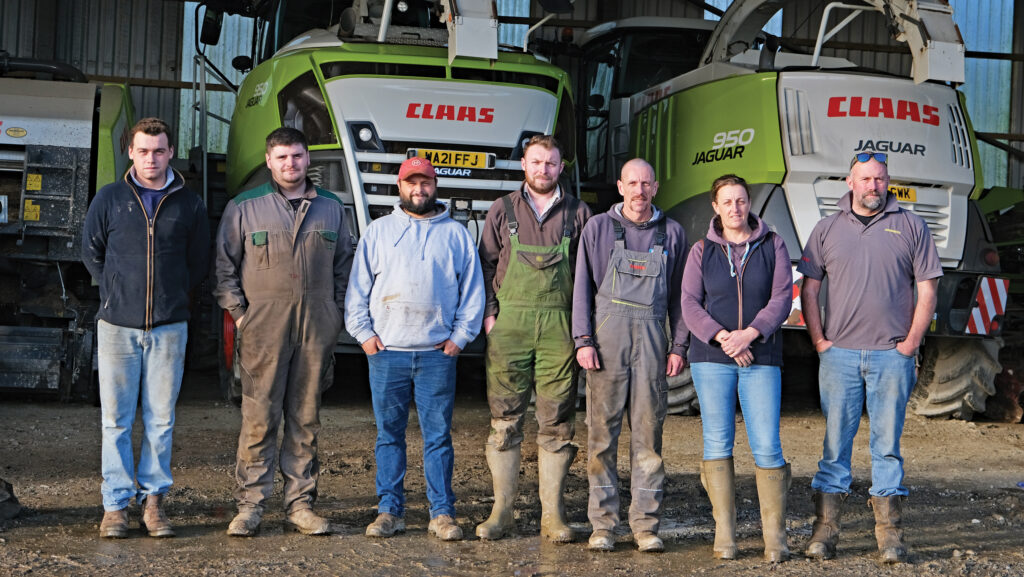
Helen and Josh Collins (right) and son Henry (left) with staff © James Andrews
Finance was arranged and they put in a couple of bids, but the £222,000 hammer price was too steep to justify.
“That’s when we changed tack and decided we’d be better off getting a second older one instead,” says Josh.
As well as offering more capacity than a sole larger machine, this setup would allow them to run with two gangs if needed, as well as providing a backup if the frontline forager broke down.
Business facts: JJ and HE Collins Agricultural Contractors, Tresillian, Cornwall
- Main services Grass, maize and wholecrop silage (3,000ha), ploughing and cultivation work (4,000ha), drilling (160ha), combining (400ha), round/square baling (20,000 bales), umbilical and tanker slurry spreading, muckspreading, hedgecutting
- Other Groundworks business and portable slurry bag hire
- Staff Josh, Helen and son Henry, plus nine full-time and one part-time employee, and extra seasonal help
Upping the budget
First on the shopping list was a 940 for sale with WM Bright at Honiton.
“It was rougher than we thought it would be, which made the tidy 13-plate 950 next to it look far more attractive – so, we upped the budget and bought it for £75,000,” says Josh.
Soon after it arrived, it was launched into the late September grass, leaving the original 950 to concentrate on maize.
This proved a sensible move, even though it meant drafting in extra drivers and trailers, as they were able to wrap up both crops before the weather broke at the end of October.
Despite its advancing years, the 2013 Jaguar romped through the grass just as well, if not better, than its younger sibling.
“We weren’t able to get them working side by side, but that V8 engine and the lack of emissions stuff might just give it the edge,” says Josh.
Another new arrival was a Horning corn cracker to replace the 2021 chopper’s worn-out Shredlage unit.
This was significantly cheaper than the original and, so far, has matched its performance.
The only breakdown of note during this campaign was a snapped gearbox shaft that put their 12-row Orbis maize header out of action for a couple of days.
Fortunately, it didn’t stop them, as Saltash contractor Roy Davey had already finished and kindly lent them his.
Bent spreader
© James Andrews
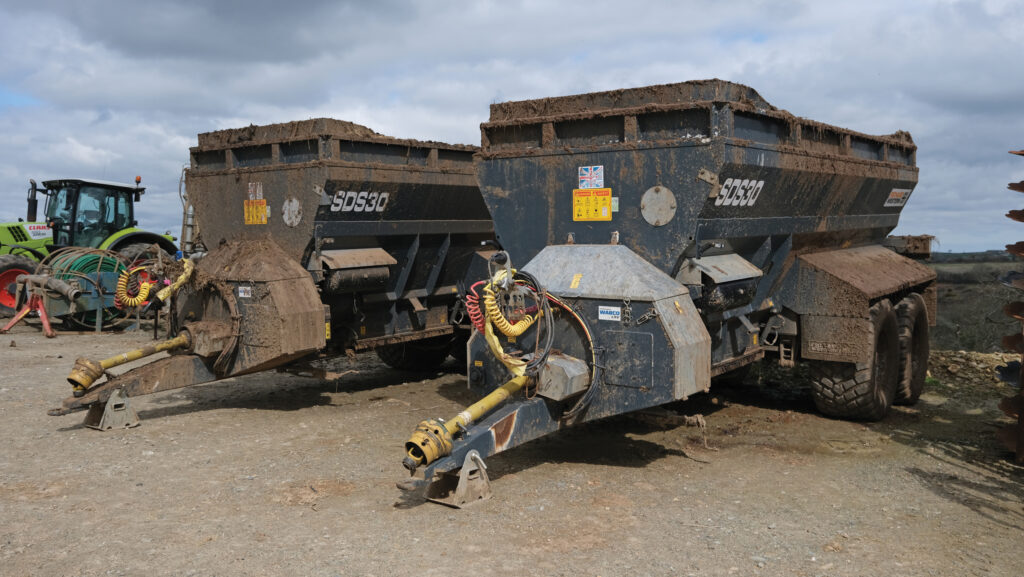
A second casualty this season was an 18-month-old Richard Western SDS 30 side-discharge muckspreader.
While working on steep, greasy stubble, it started to slide before suddenly finding grip; the weight of the contents slopping to one side was the final nudge it needed to topple over.
They righted it themselves, and it was still in usable condition, but the bodywork was bent well out of shape.
There were no quibbles from the insurance company, which paid out £30,000, and they were able to buy it back as salvage for £13,000.
The plan is to straighten it as best as they can and keep on using it.
“There’ll be a bit of redneck engineering involved – something like filling it with straw bales and using a loading shovel on each side to give it a bit of a tweak,” says Josh.
Tractor updates
As for the tractor fleet, there’s been no change to the prime movers since the arrival of another Axion 830 and Massey Ferguson 8730S.
Instead, the focus has been on more compact power, with a small-yet-gutsy Claas Arion 570 set to arrive soon.
Slotted into the same size chassis as their pair of 550s, it packs an extra 15hp and 33Nm of torque, giving a total of 180hp and 730Nm.
This puts it in the same ballpark as the six-cylinder Arion 630 it will be replacing.
Its main duties will be running tankers, hauling trailers and pulling a destoner, as well as jobs that are a bit clumsy with a six-cylinder.
“My only concern is the size of the fuel tank, as I already spend far too much time gallivanting around the county with the bowser,” says Helen.
Workshop project
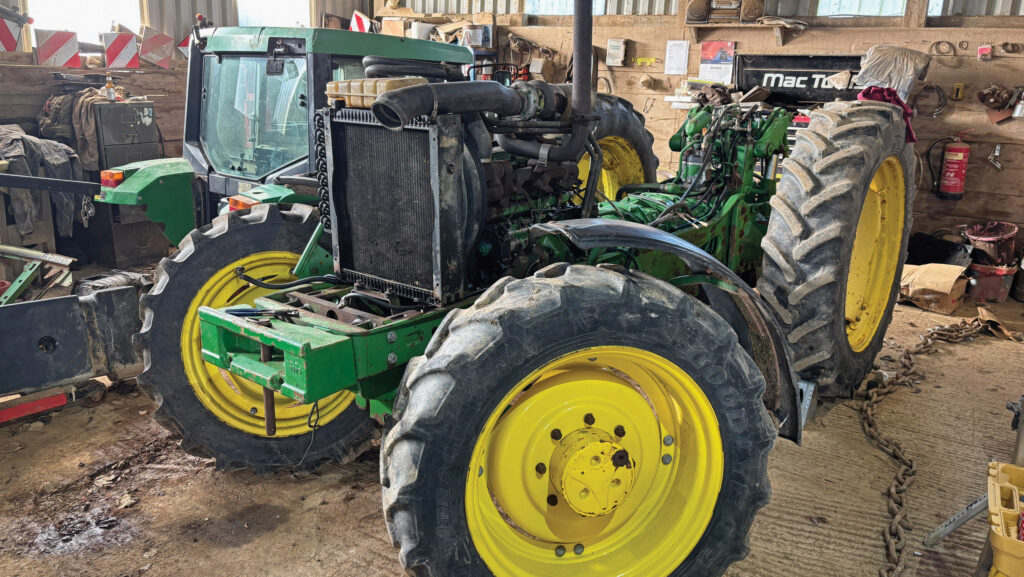
The John Deere 6200 in the workshop
Also new on the scene is a 32-year-old John Deere 6200 SynchroPlus that Josh picked up at a farm sale for £10,000.
Though tidy and mechanically sound, it was starting to show its 11,000 hours of work, with the odd leak and cosmetic blemish.
“We got it in the workshop and tilted the cab to replace a leaking oil pipe – then things escalated,” says Josh.
They ended up removing the cab completely to clean off decades’ worth of grease and dust – a job that took only a couple of hours – after which they decided to give it a thorough going over, as well as treating it to a chassis respray.
Once complete, the plan is to fit it with a loader and use it as a yard tractor for son Henry’s 70 cattle and Helen’s horses.
Taming rented land
Since our last visit, a significant amount of time has been dedicated to tidying up 32ha of land taken on as an 18-month council tenancy.
“When we drove around it, the thistles were as tall as the Discovery and hedges hadn’t been touched for years,” says Helen.
They set about taming the unruly vegetation with their JB Equipment tree shear and hedgecutter, before spraying off the weeds, ploughing and establishing winter wheat over the entire area.
“It was a lot of work if we have to hand it back at the end of the tenancy, but hopefully we’ll be able to extend it a bit longer,” she says.
Winter work
As the peak-season work has tailed off, the challenge has been keeping their nine full-time staff gainfully employed.
“We’ve just taken on two more full-timers, which will be invaluable in peak season. But it also means we’ve got to find stuff for them to do in the quiet months,” says Josh.
Machinery maintenance and repairs provide a virtually endless stream of work – though no income.
So the money has to come from jobs like fencing, hedgecutting, salt spreading and running the diggers.
The latter comes courtesy of Josh and Helen’s sideline Agri Dig enterprise, which is operated entirely in-house since they bought out their former business partner.
© James Andrews
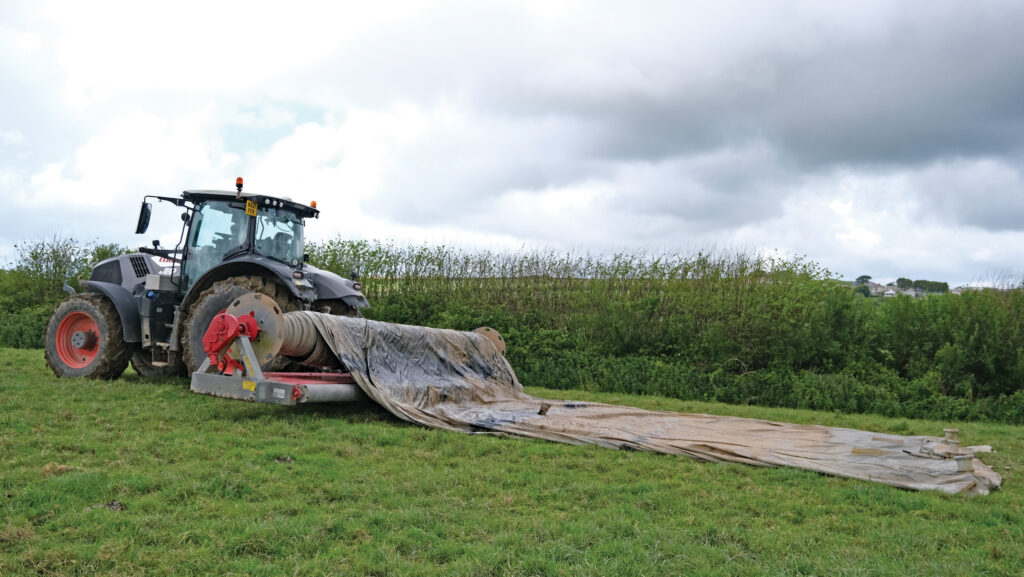
A pair of 13t Case machines – a CX30D and CX30E – are the frontline tools, carrying out everything from ditching to groundworks, as well as levelling sites for the temporary Albers Alligator slurry bags they hire out.
These five 350cu m vessels bring in a steady income – hire cost is about £500/week – from farms and other businesses that need some quick temporary storage.
Semi-permanent slurry bags
For those who need a longer-term fix, semi-permanent bags are available, which Josh and Helen are hoping to supply and install.
The largest of these can hold 2,500cu m in a completely sealed environment, so there’s no risk of precious storage space being taken up by rainwater.
They’re also quick to erect, with just a flat bare earth site required and no need to obtain planning permission.
“When we install them, we’ll dig in a sump so that slurry can be sucked straight into a tanker from the bottom of the bag,” says Josh.
“And the spoil from that will be used to create an earth bund around it, in the unlikely event that it gets a puncture.”
Bloating is avoided thanks to gas vents in the top, and there are gate valves that allow the contents to be agitated.
A 2,500cu m bag costs about £85,000 to supply and install, and they’ve already got a couple of serious enquiries.
Next on the shopping list
No more major purchases are planned over the winter months, apart from a couple of extra silage trailers.
“We won’t be getting anything fancy, but we need some extra capacity for when both foragers are running,” says Helen.
“Hopefully we’ll be able to find some dual-use root/silage Baileys at a decent price that we can hire out when we’re not using them.”