Contractor Comment: Staffs firm is fuelled up and ready for action
A familiar face from last year’s What’s In Your Shed? series, Matt Brewster returns as this year’s Midlands-based Contractor Comment contributor.
See also: Driver’s view: Tom Dirom’s Valtra Q285
Business data
Bickford Grange Farm, Penkridge, Stafford
- Farm size: 222ha (life tenancy), 415ha (short-term tenancies), 30ha (owned)
- Cropping: 284ha winter wheat, 40ha winter barley, 80ha winter oilseed rape, 80ha maize, 40ha spring beans. Remainder in grass
- Stock: 40 pedigree horned Hereford suckler cows and progeny
- Staff: Matt Brewster, plus six full-time operators. Seasonal casuals taken on for busy periods
- Contracting: Silaging (1,620ha grass, 364ha maize), combining (200ha), spraying (4,000ha), grass/cereal seeding (400ha), maize drilling (364ha), ploughing (300ha), round baling/wrapping (10,000 bales), big square baling (5,000 bales), muck/slurry spreading and umbilical work
How did you get into contracting?
My father, who sadly passed away three years ago, handed control of the 222ha tenanted home farm business on to me in 2008 when I was 21.
At the time we rented a further 50ha and owned another 30ha, and the main enterprises were arable, a suckler herd and a barley beef fattening operation.
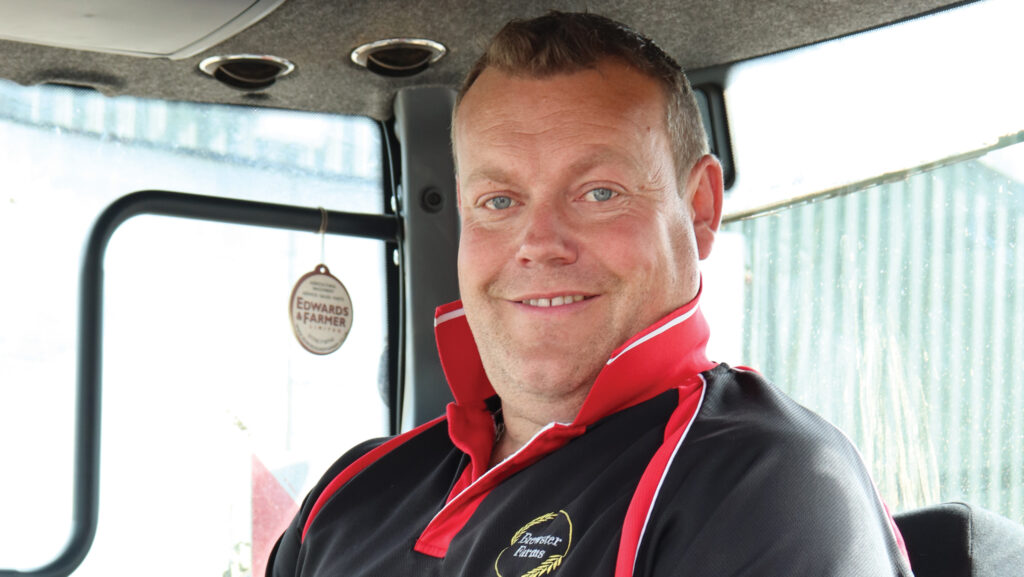
Matt Brewster started contracting in 2009 © Andrew Faulkner
Keen to make my mark, I took my first tentative steps into contracting the following year.
Though, to be fair, we pretty much fell into the job. We were – and still are – in a mixed farming area, with several livestock farms that increasingly couldn’t justify the kit to do their own relatively small patch of arable.
We already had the equipment so were asked to take on their drilling, spraying and combining.
Our grassland and muck/slurry enterprises started in much the same way.
In 2012 we switched from barley beef to grass-fed beef and wanted to keep the silaging job in-house, so invested in the equipment required to do our own work.
And, as with the arable operations, this very quickly led us into mowing, baling and wrapping, as well as muckspreading and slurry tanking, for other farms in the area.
The irony is that the contracting then grew so rapidly that we ended up pulling the plug on the 350-head bull beef unit just two years later. No regrets, though.
We were renting extra buildings for the cattle, the labour requirement was high and the margins very slim.
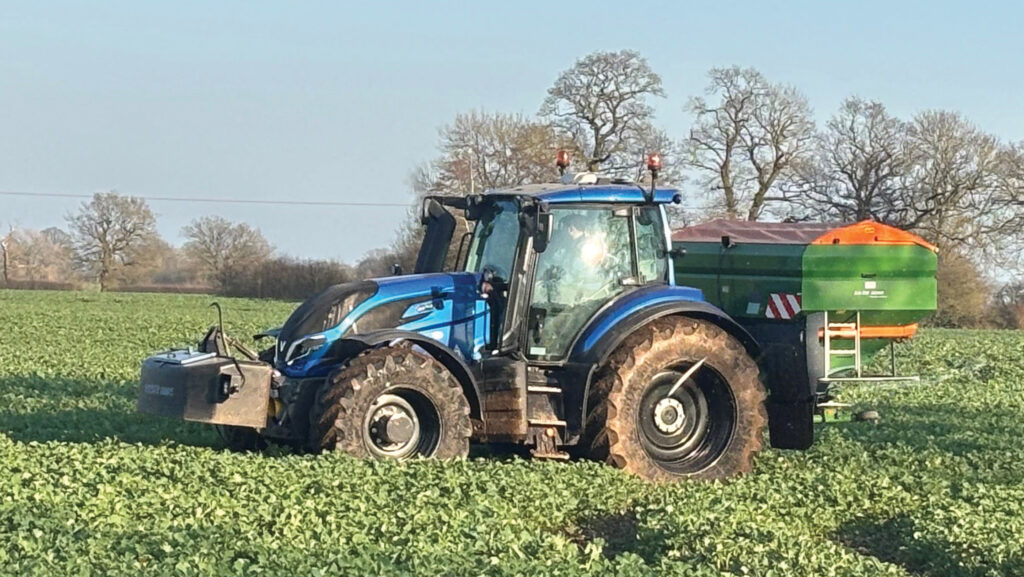
Fertiliser applications are all solid © Andrew Faulkner
Our next big contracting development came in 2023, when we bought our first forager – an 11-plate Claas Jaguar 850 – for £65,000 from another local contractor, who was packing up.
We were already helping him out with trailer and clamp work, so it was a logical next step. We effectively took on his foraging round.
The slurry umbilical system arrived in 2023, completing our overall contract offering.
Main services today?
Though the contracting business was built in the early days on combining and spraying, we now provide a complete arable and livestock service, specifically targeted at the smaller mixed farms within a 10-mile radius of our base.
Average field size is only about 6ha, the lanes are tight, and the kit, much of it second-hand, is chosen accordingly.
There’s no massive 1,000hp forager. No 12m drill. There’d be little point.
As a result, we’re neither the cheapest nor the fastest, but we aim to do a proper job. We’re farming ourselves, so we know what our customers are looking for. We adopt a farmer approach.
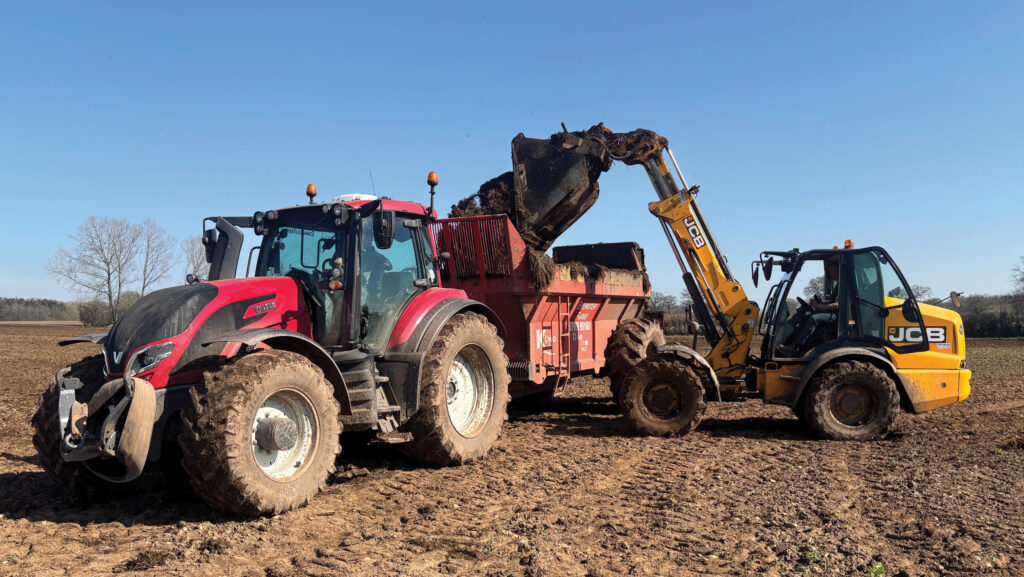
Muckspreading is carried out with a couple of 12t Ktwo 12 Duos © Andrew Faulkner
Indeed, for us, the contracting and farming dovetail neatly.
For example, some of the original contracting customers have ended up renting us their land rather than employing a contractor or contract farmer, because they like the stable rental income without having to fund the working capital.
This, in turn, has enabled us to increase our own farming operation to about 650ha over the past 18 years.
Similarly, the contracting gives us access to better equipment than we could otherwise justify, and we’re able to keep our staff more fully employed. Bottom line, it works.
Any forms of diversification?
Not really. My background is wholly agriculture. Which is why I’m reluctant to diversify into other less familiar sectors.
I’ve no interest in getting into groundworks, for example, where there’s already a huge amount of competition, a raft of extra regulation and doubtless additional insurance considerations.
And there’s also the hassle of switching to white diesel. I’d be way out of my comfort zone.
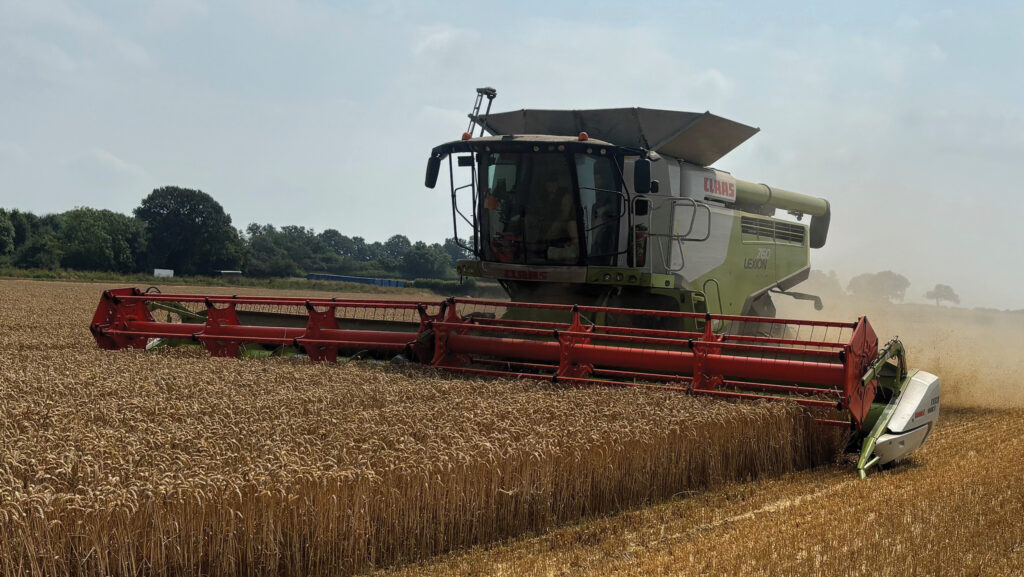
Combining kicked off the contracting operation in 2009 © Andrew Faulkner
My main recent diversification, assuming they qualify, is sheep.
Every October, about 2,500 ewes arrive from Shropshire, and we’re paid on a pence per head per week basis to look after them through until the beginning of March.
They start on grassland that has been cut for silage, before moving on to 60ha of stubble turnips in December, where they’re strip grazed through to the end of February.
The enterprise brings in about £35,000 during an otherwise relatively quiet time and keeps two people occupied for two days a week, largely on shifting the electric fencing.
We rotate the shepherding duties among the staff so everyone stays motivated.
Most profitable enterprise?
Spraying and combining, which, interestingly, are the two operations that first got us into contracting, and, in this area, still attract the least competition. Foragers, on the other hand, are two-a-penny.
Spraying is a particularly good earner, as we can cover up to 250ha in a decent day, and the associated costs of depreciation, fuel and wearing parts are relatively low.
At a rate of £12-15/ha, again we’re not the cheapest, but we don’t take on excessive work or travel much farther than 10 miles to maintain timeliness.
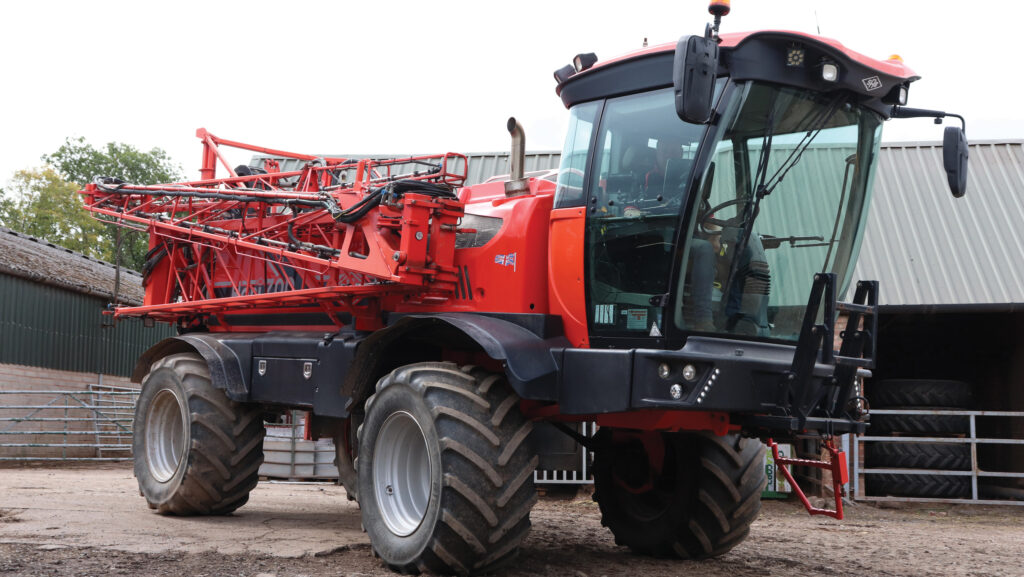
Spraying ranks as Brewster’s most profitable enterprise © Andrew Faulkner
At £110/ha excluding carting, the combining is some way off spraying in profitability, yet it still provides a reasonable return because of low machine depreciation; we aim to buy the harvester well at two to three years old and run it for another 10.
Plus, straw demand is high in this area and chopping is rare, which puts less strain on the combine. Even the rape straw is baled.
And the least profitable?
Hedgecutting… and none of the staff likes doing it. The main reason we don’t pack it in is that the money earned pays for the hedgecutting on our own land, which would otherwise cost us at least £20,000/year. Also, it keeps another person busy in the so-called quiet time.
What’s galling is that we can only charge £40/hour to remain competitive, whereas the rate needs to be £50 minimum.
Tractor deprecation is about £15/hour, fuel £15/hour, servicing £2.50/hour and insurance £2/hour. So you’re at £35/hour before adding the cost of the hedger and the man on the seat.
Biggest threats to your business?
As we head into foraging season, fuel price is my biggest worry on the contracting side. In April we bought diesel at £1.15/litre, compared with 62-63p/litre six months ago, which clearly has a massive impact when the forager is getting through 1,000 litres/day.
Rather than increase the foraging rate per hectare to customers, I’ve gone down the fuel surcharge route on anything over 70p.
So, effectively, on the daily 1,000 litres at £1,150, I’ll cover the £700 and the customer pays the balance of £450.
I haven’t yet calculated the effect of the oil price hike on servicing costs. Sod’s Law, it will settle to more sustainable levels in October, when the season’s over.
Difficulties with recruitment?
Staff recruitment is increasingly a challenge, and I’m very fortunate that the current team, many of whom have been with me for some time, are great.
When I do need extra full-timers, I tend to use social media such as Facebook or Instagram. My tip, though, is never to take a CV at face value.
Often the person who has just cobbled together a CV, on further investigation, is the best fit for the job, while those with an impressive, possibly AI-generated CV turn out to be wrong ‘uns.
It’s really important to do your own digging.
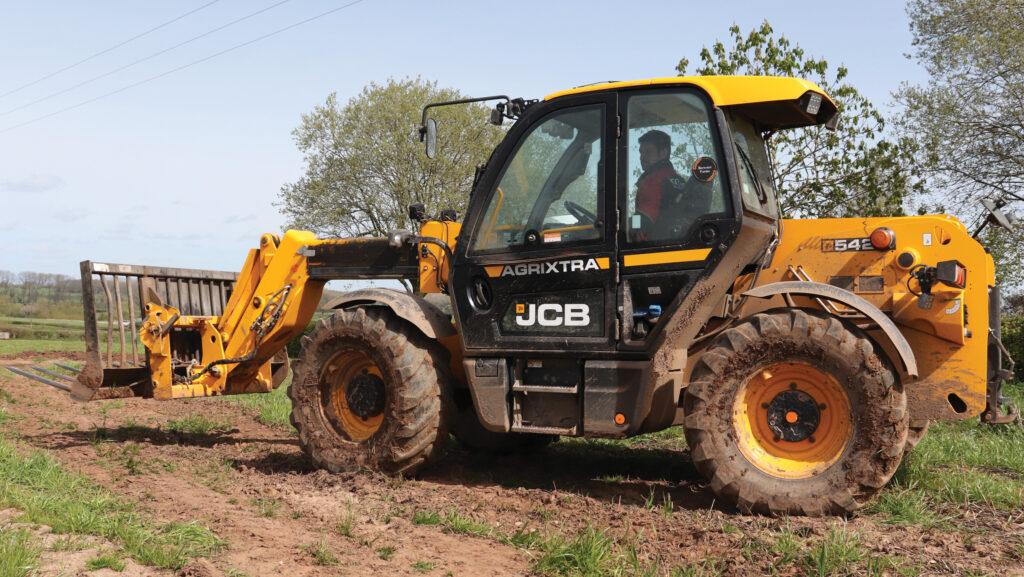
Telehandlers are bought new and kept for five years © Andrew Faulkner
The other issue is the difficulty in finding local accommodation, as the new renters’ legislation has seriously dented the supply of low cost, let housing.
For me, sourcing casual staff in the summer seems to be less of a problem. We have a number of people in the area seeking long-hour work but not wanting to commit to full-time.
What excites you about the season ahead?
Fingers crossed, the prospect of a decent harvest. All the crops are currently looking good and are proof that the old adage of ‘well sown, half grown’ still applies.
Everything was planted in favourable conditions last autumn, in stark contrast to the previous year, so, providing we receive the required amount of rain between now and July, we’re hoping for barn-filling yields. With costs as they are, we clearly need the extra income.
Any new machines?
Unfortunately, given the current climate, several of the machines on regular replacement cycles are up for change this year.
The aim is to swap in the tractors and handlers while still under warranty at a cost-to-change of £10-15/hour, so the tractors tend to go at 5,000 hours and three years of age, the handlers at 3,000 hours and three years.
For 2026, that means one of the Valtra T195s and the T215 are up for renewal, along with the JCB Loadall 542-70. However, depending on how harvest goes, we may stretch the TM pivot-steer replacement to 2027.
On the implement side, we’ve recently replaced the five-year-old McHale Fusion 3 baler wrapper with a new Fusion 4 and added a 5m wide Amazone KG5002-2 power harrow, complete with grass seeder, to the cultivation fleet.
Second-hand, we upgraded the 14-year-old 4m Vaderstad Rapid last year to a four-year-old 6m model. Warwickshire dealer Amtec gave us £15,000 for the trade-in, and we paid £45,000 for the 6m. I thought it was a good deal.
Also from Amtec, we’ve replaced a tired 16t Larrington trailer with an ex-hire two-year-old Richard Western with silage sides. At £21,000, the Western was about an £8,000 saving on new.
Recent major breakdowns?
Nothing too serious. That said, there’s always something niggly to fix, and we’re also heading into silage breakdown season, so something’s bound to go wrong.
To be fair, on the foraging side we’ve been pretty lucky… so far.
We bought the current forager, a 16-plate Claas Jaguar 860, for £110,000 in 2023 from Morris Corfield, and it’s been largely problem-free, thanks in the main to Corfields’ thorough annual service/inspection.
This year we’ve extended the Jaguar’s season with the purchase of a 14-year-old 5.2m Claas Disco 520 wholecrop header for £9,500 from a local contractor who’s retiring.
Given the extra 100ha of wholecrop workload, and that the forager is now 10 years old, we may swap it for a younger version in 2027.
Overwinter projects?
Just machine maintenance. The reality is that our supposedly quieter months of December, January and February aren’t that quiet.
There are the 2,500 sheep to move around; slurry carting from yard to lagoon keeps two tractors and tankers on the go; and there’s hedgecutting both here and for customers.
Factor in staff holidays, and it’s not so quiet, after all.
None of the winter jobs generate much of a margin, yet they do at least keep staff busy and the money coming in.
Totting up to 500 hours’ work at £60/hour, the tanking definitely pays better than the hedgecutting.
Current contractor frustrations?
Along with the worryingly high fuel and oil prices already mentioned, my main frustration is with the government and its lack of support for farming.
As just one example, farmers and contractors need some certainty over the future of SFI.
On the farm, we’ve just had our 2023 agreement extended by one year to 2027, and we suspect this is because Defra has no plans in place beyond this year’s SFI26.
Business data
Bickford Grange Farm, Penkridge, Stafford
- Farm size: 222ha (life tenancy), 415ha (short-term tenancies), 30ha (owned)
- Cropping: 284ha winter wheat, 40ha winter barley, 80ha winter oilseed rape, 80ha maize, 40ha spring beans. Remainder in grass
- Stock: 40 pedigree horned Hereford suckler cows and progeny
- Staff: Matt Brewster, plus six full-time operators. Seasonal casuals taken on for busy periods
- Contracting: Silaging (1,620ha grass, 364ha maize), combining (200ha), spraying (4,000ha), grass/cereal seeding (400ha), maize drilling (364ha), ploughing (300ha), round baling/wrapping (10,000 bales), big square baling (5,000 bales), muck/slurry spreading and umbilical work
Kit list
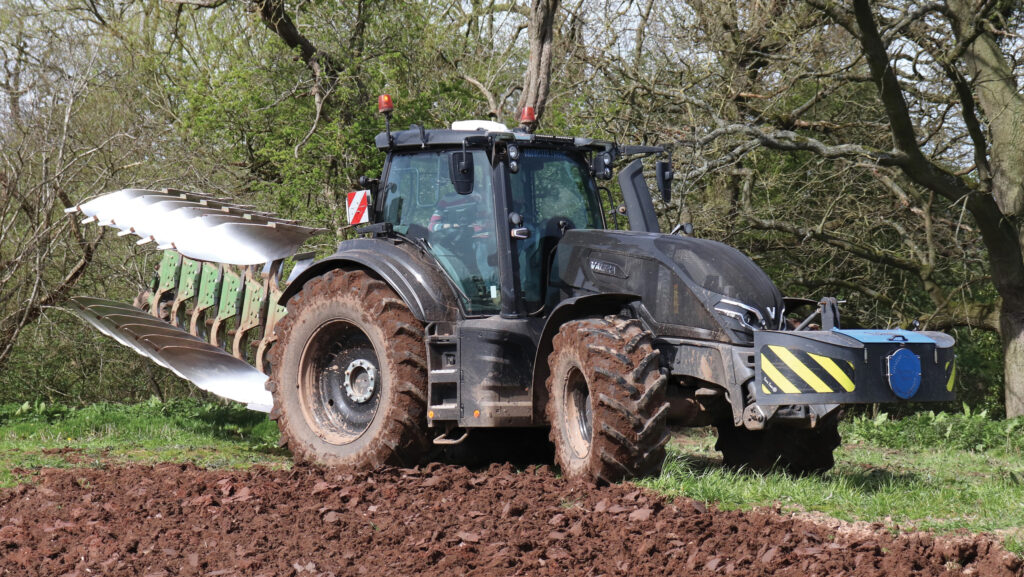
A 24-plate, 305hp Valtra Q305 heads up the Brewster Farms tractor fleet © Andrew Faulkner
- Tractors Valtra Q305, T235 x2, T215 and T195 x4; 1968 MF135
- Combine Claas Lexion 760TT with 10.7m header
- Forager Claas Jaguar 860 with grass pick-up, eight-row Orbis maize header and 5.2m Disco wholecrop header
- Handlers JCB 542-70 and TM320S
- Sprayer Sands Horizon 5500 (5,500-litre/36m)
- Spreader Amazone ZA-TS 4200
- Drills Horsch Pronto (4m), Horsch Xpress KR (4m), Vaderstad Rapid 600S (6m), Amazone power harrow combi (3m), Vaderstad Tempo (eight-row), Amazone KG 5002-2 power harrow with grass seeder (5m)
- Cultivators Horsch Terrano FX (4m), TerraTech Multi-Cut (3m), Vaderstad Carrier (6.5m), Weaving stubble rake (7m), six-furrow Amazone Cayros plough x2
- Grass Claas Liner 3600 four-rotor rake, Krone Swadro 880 two-rotor rake, Claas Volto 900 tedder, MF TD776 tedder, McHale front/rear butterfly mower (9.6m), McHale rear trailed/front mounted mower (6.4m), McHale Fusion 4 round baler/wrapper, MF 2270 big square baler (120x90cm)
- Muck and slurry 12t Ktwo 1200 Duo rear-discharge spreader x2, 12m Mastek dribble bar, 17,500-litre Conor tanker with 8m dribble bar
- Trailers 18t Richard Western x3, 18t Kane, 18t Larrington