On test: Battery powered pruning saws – which is best?
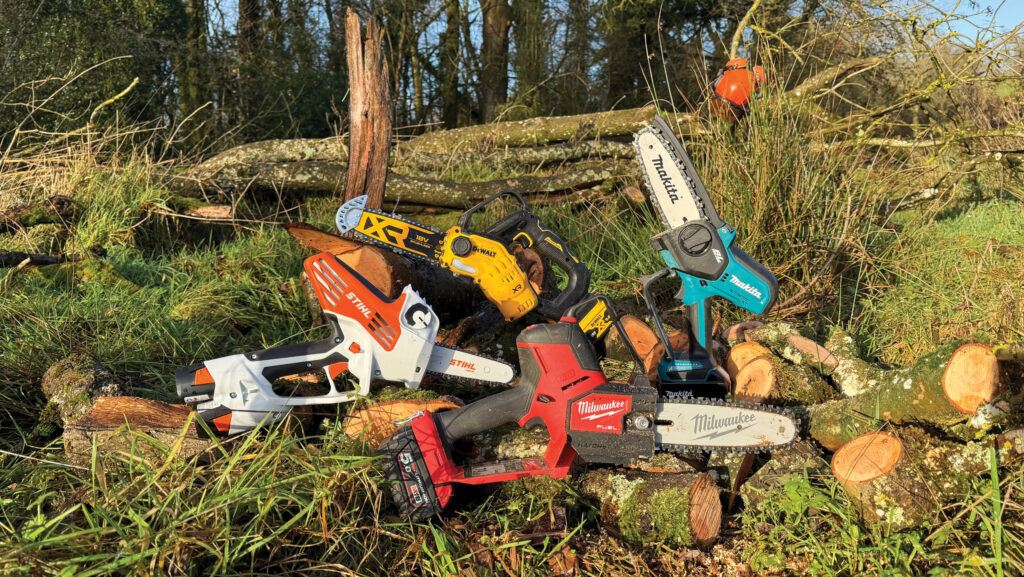 © MAG/Oliver Mark
 A relatively new breed of compact, battery powered chainsaws promises to make light work of pesky branches that clatter combine cabs, whack wing mirrors and unseat sprayer nozzles.
Avoiding the faff of returning to the crime scene with a petrol-powered machine, these mini “pruning” tools are primed for retribution at the drop of a hat.
See also: On test: Five top-spec electric chainsaws compared
That’s because they offer the unmatched convenience of running off a standard powertool battery and, just as importantly, are small enough to sling in a pickup footwell or behind a tractor seat in readiness.
Sound good but look too small? Reserve judgement. Their diminutive size belies surprising timber-tearing performance.
Topple hulking hardwoods they will not, but several of them will happily carve through limbs and logs as wide as their 15-20cm bars, and all will breeze through brush and tame unruly shrubs and trees.
This makes them a potentially handy companion for an ear-piercing petrol: smaller, lighter, cleaner and quieter, and free of the faff involved in sourcing and prepping two-stroke fuel.
They’re a good bit cheaper too, especially if your workshop is already teeming with kit – and the associated batteries – from one of the contenders featured here.
For this reason, we’ve selected three of our test group based on their popularity among the farming fraternity.
This gives Milwaukee, Makita and DeWalt diehards the option of buying just the bare tool, which knocks a healthy chunk off the cost of a full tool-battery-charger package.
Stihl is the obvious outlier, included purely because of its arboricultural pedigree.
And there are plenty of other models out there, predominantly at the more domestic end of the scale – from Husqvarna and Bosch to Worx and Greenworks.
How we tested them
As with previous chainsaw tests, we assembled a pile of uniform wood to assess each machine’s merits.
This included timing cuts through a 120mm diameter branch, as well as pushing them to their limits in a range of timber sizes and densities.
The results give a reasonable idea of their work capacity when flogged hard – and how they shape up against one another.
Regarding prices, we’ve trawled the web for the best online deals (ex VAT) from reputable distributors. They vary wildly, so it pays to shop around.
All can be purchased as a kit including a battery and charger, or as a bare tool to be paired with existing batteries.
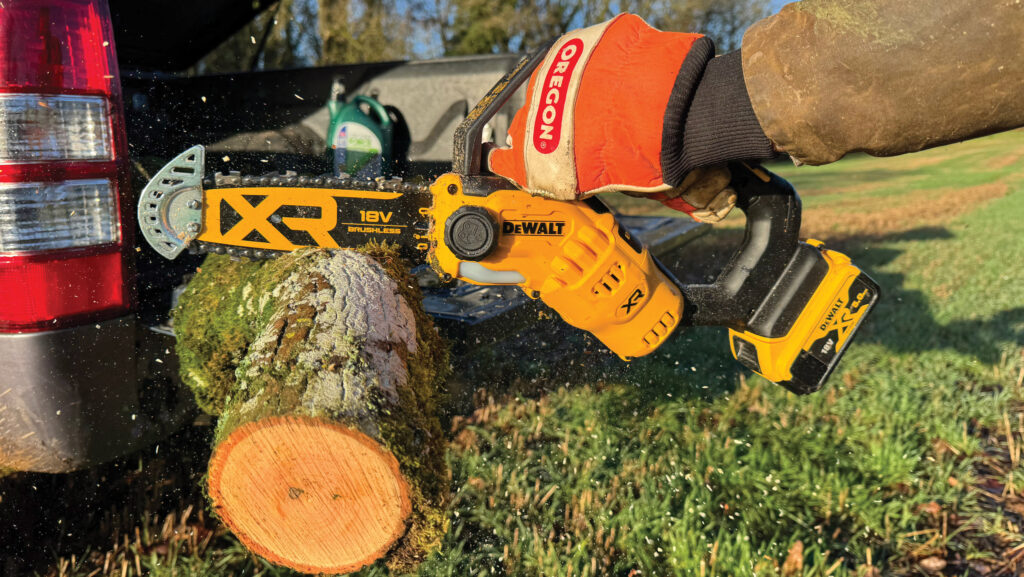
DeWalt DCMPS520
© MAG/Oliver Mark
DeWalt DCMPS520
- Official bar length 20cm
- Useable bar length 15.5cm
- Chain DT20693; 34 drive links
- Chain gauge/pitch 1.1mm/9.5mm
- Max chain speed 8.6m/sec
- Chain oil tank 55ml
- Quoted noise (no load) 92dBa
- Battery pack as tested 18V, 5Ah XR
- Weight with battery 2.7kg
- Bare tool price £135.82
- Bundle price £158.33 (one 5Ah battery)
Best for: Cutting speed on small branches
Verdict: A handful of loose change is all that separates powerhouses DeWalt and Milwaukee in the mini saw game, and there are plenty of similarities between their respective tools.
They are bigger, heavier and more powerful than those from Stihl and Makita, which makes them the most versatile for tasks that stray beyond just pruning and brush clearance.
But red beats yellow in almost every department – albeit generally by a small margin.
The DeWalt’s biggest weakness is ergonomics: iffy weight balance, poorly positioned handgrips and a downright awkward safety lock.
However, it trumps the competition for chain speed. This is most noticeable in small diameter cuts, which it whips through before the motor has a chance to bog down.
Start carving through girthier timber and the saw will occasionally cut out, as power – rather than speed – becomes the prevalent factor in performance.
As for spec, we liked the captive drive sprocket nut; less so the curious addition of an integrated tip guard.
This is primarily designed to reduce kickbacks during upcuts and, to a degree, protect the chain from dirt ingress when cutting low.
However, it restricts the useable bar length to about 15cm and is difficult to remove without a specialist tool – which doesn’t come in the kit.
DeWalt’s offering is decent when assessed in isolation, but comes up short against Milwaukee’s Hatchet.
Likes and gripes
Likes
- Relatively cheap
- Rapid chain speed
- Captive nut on sprocket cover
- Decent bar size
Gripes
- Poor weight balance
- Awkward handgrip and safety switch
- Tip guard can get in the way
- Chain slower to hit top speed than the rest
Test results
Average cutting speed 6.75sec
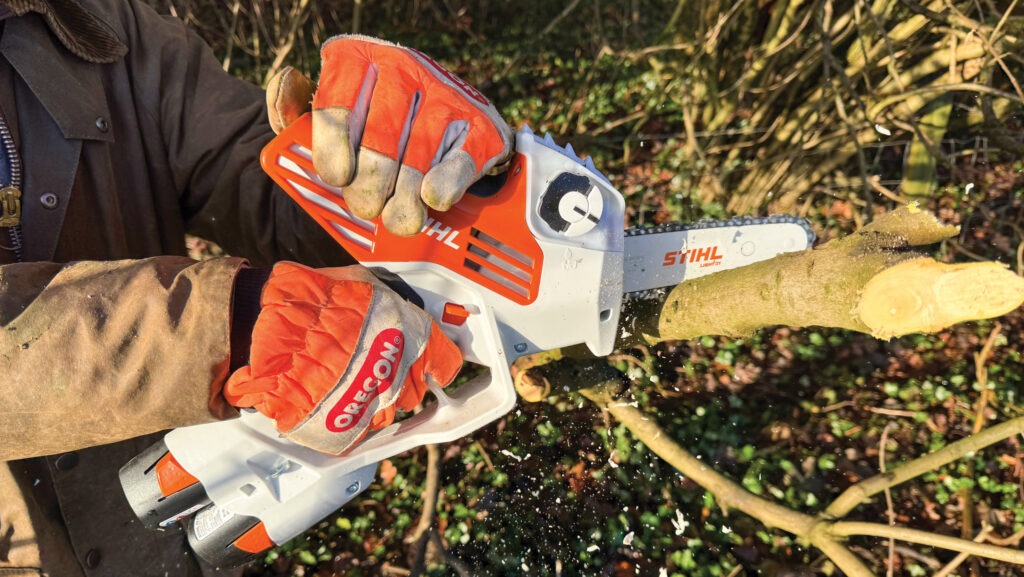
Stihl GTA 40
© MAG/Oliver Mark
Stihl GTA 40
- Bar length 15cm
- Useable bar length 14cm
- Chain Picco Micro 3 (PM3); 38 drive links
- Chain gauge/pitch 1.1mm/6.35mm
- Max chain speed 8m/sec
- Chain oil tank 110ml
- Quoted noise (no load) 90dBa
- Battery pack as tested 10.8V, 2.6Ah AS 2 batteries x2
- Weight with battery 2kg
- Bare tool price £187.49
- Bundle price £290.83 (two AS 2 batteries)
Best for: Precise pruning
Verdict: What it lacks in brawn the GTA 40 makes up for with near-perfect weight balance and blisteringly quick severing of small-diameter branches.
Much of this performance can be credited to its ultra-efficient Picco Micro 3 chain, which zips through timber without spitting out bucketloads of woodchips.
This makes it ideal for rapid clearance of brash, taming unruly hedges, and light trimming high in the tree canopy.
Yet it falters when thrust into tougher work. Not only is the bar the shortest in the test group, it also lacks the power to confidently drive itself through thicker material.
Pushing it too hard in these conditions will cause it to cut out, so it needs to be guided through by a patient hand.
In truth, this saw is more a companion for the professional arborist than the casual lopist.
It’s well made, nice to hold and proficient at the job it’s designed to do. But there’s a price to pay for this quality, and it isn’t as versatile as some of the other tools featured in this test.
Other considerations are that it lacks a proper hand guard – though this does make it easier to slot into tight spaces – and it runs on a pair of batteries that many farms are unlikely to have lying around.
That said, these AS2 packs are compact, lightweight and deliver a surprising number of cuts to a charge.
Likes and gripes
Likes
- Precise trigger control
- Skinny chain zips through small branches
- Very well balanced
- Lightweight batteries
Gripes
- Bogs down on larger cuts
- Shortest bar
- Expensive
- Powerpacks not compatible with a combi drill
Test results
Average cutting speed 9.18sec
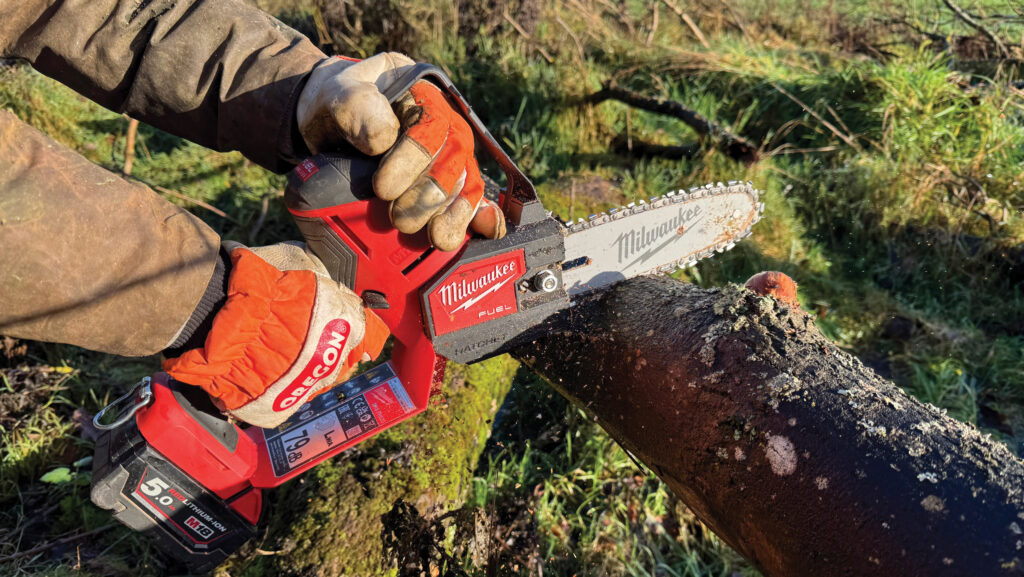
Milwaukee M18 Fuel Hatchet
© MAG/Oliver Mark
Milwaukee M18 Fuel Hatchet
- Bar length 20cm
- Useable bar length 18.7cm
- Chain 33 drive links
- Chain gauge/pitch 1.1mm/9.5mm
- Max chain speed 5m/sec
- Chain oil tank 77ml
- Quoted noise (no load) 89dBa
- Battery pack as tested 18V, 5Ah M18
- Weight with battery 3kg
- Bare tool price £143
- Bundle price £229.99 (one 5Ah battery)
Best for: Power
Verdict No other saw in this test came close to matching the Hatchet’s ability to chew through woody material.
Despite having a slower chain speed than some of its rivals, the unrelenting power of its torquey motor gave it the fastest cutting times by a comfortable margin.
It didn’t bog down or cut out either, even when an unfair amount of pressure was exerted on the bar. As a result, we ended up using it on chunky branches that would typically be reserved for “proper” chainsaws.
It coped well, too – the only downside of sustained sawing in the big stuff was accelerated draining of the 5Ah battery. Having said that, larger packs can be used for those wanting to regularly tackle this sort of work.
Other perks include a decent weight balance, study build quality and a handy chain adjustment tool that slots into the frame.
Our only real gripes were the lack of a captive nut on the sprocket cover, its relatively heavy weight and expensive chains – not that these are likely to need replacing very often.
Likes and gripes
Likes
- Unrelenting power
- Biggest useable bar
- Robust
- Neat hand guard
Gripes
- No captive nut on sprocket cover
- Heaviest model on test
- Replacement chains expensive
Test results
Average cutting speed 4.15sec
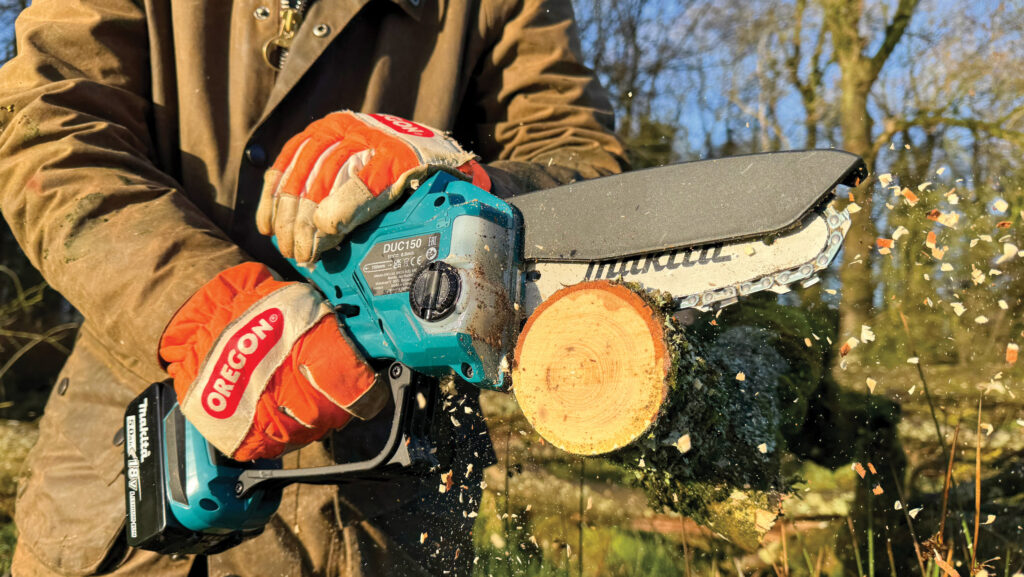
Makita DUC150
© MAG/Oliver Mark
Makita DUC150
- Bar length 15cm
- Useable bar length 15.5cm
- Chain 80 TXL; 32 drive links
- Chain gauge/pitch 1.1mm/8.25mm
- Max chain speed 8m/sec
- Chain oil tank 55ml
- Quoted noise (no load) 87dBa
- Battery pack as tested 18V, 5Ah
- Weight with battery 2kg
- Bare tool price £129.12
- Bundle price £216.62 (with 5Ah battery)
Best for: Nothing in particular
Verdict: The diddy Makita is more gardener-grade than the rest, with hedge trimmer-like acoustics the first indication of its modest power output.
It simply won’t entertain big bough butchery, and applying more downward pressure as a means of encouragement is counterproductive, as it’ll immediately throw in the towel.
Instead, it’s far more comfortable on light-duty work, and its compact, lightweight design makes it a doddle to handle – even when held at a stretch.
The limited power also has one notable upside, in that it can’t be pushed hard on jobs it’s not really designed for and, therefore, the battery lasts for yonks.
It’s also dead simple, with tool-free automatic tensioning of the chain and a simple on/off trigger with no proportional control.
Unlike the rest, it comes with a sprung top chain guard, which is good from a safety perspective but rules out upcuts.
So, a perfectly fine back-up saw if you’re already geared up with Makita batteries. If not, we reckon DeWalt and Milwaukee offer slightly better value for money.
Likes and gripes
Likes
- Lightweight
- Comfortable to operate
- Handy size
- Long battery life
Gripes
- Short of power
- Chain top guard prevents upcuts
- No proportional trigger control
- Designed for domestic use
Test results
Average cutting speed: 11.15sec
Farmers Weekly verdict
These minis might not match a buzzing two-stroke or a big electric saw for speed or cutting capacity, but they’re remarkably handy.
As well as being lighter, cheaper and easier to operate than a full-sizer, they take very little maintenance.
For starters, the shorter loop of chain requires half the sharpening of an 18in bar and, with big cuts through gnarly material unlikely to be on the agenda, they won’t go blunt as quickly.
Nor are they as prone to contamination, as they’ll typically be operating well clear of the ground, and are perfectly comfortable to hold at height for a sustained period.
So, unless you’re hacking away at a huge fallen tree, these machines should be up to the task.
This is especially true of the Milwaukee and DeWalt with their longer bars and powerful motors.
The Makita is a little more domestic spec and the Stihl a specialist pruning tool that is perfectly designed for that job. As a result, both are less versatile and best paired with a big saw.
As for which one to buy? The simple answer is to stick with your current powertool brand. If you’re starting from scratch and not yet committed, the powerful Milwaukee gets our vote.