Front loader makes Protech Evo220B an all-in-one fencing tool
 © Chris Merrett
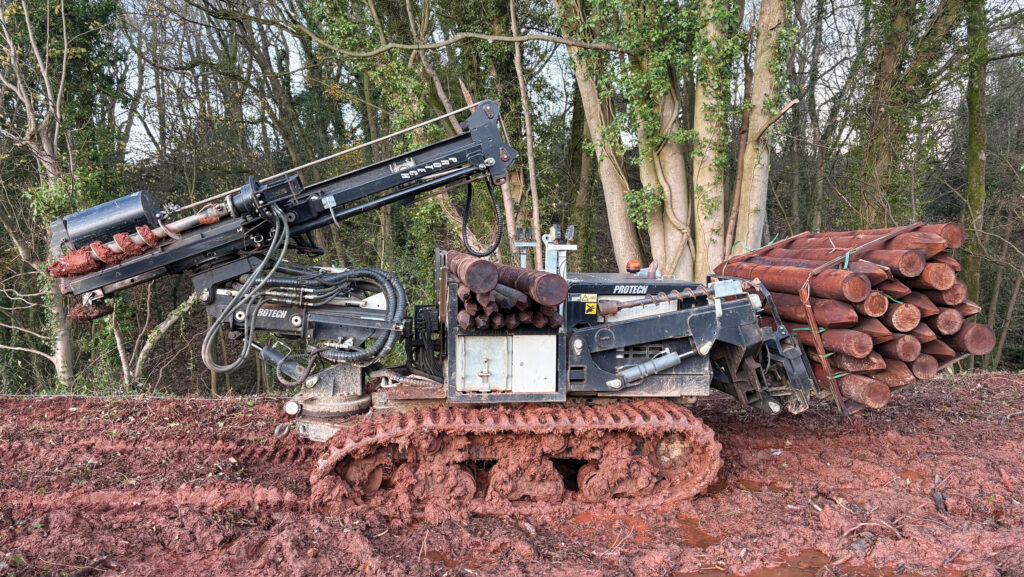
 Splurging close to six figures on a machine to pound wooden posts into the ground might seem extravagant but, when it’s geared up to supersede several vehicles in a single fleet, the numbers start to stack up.
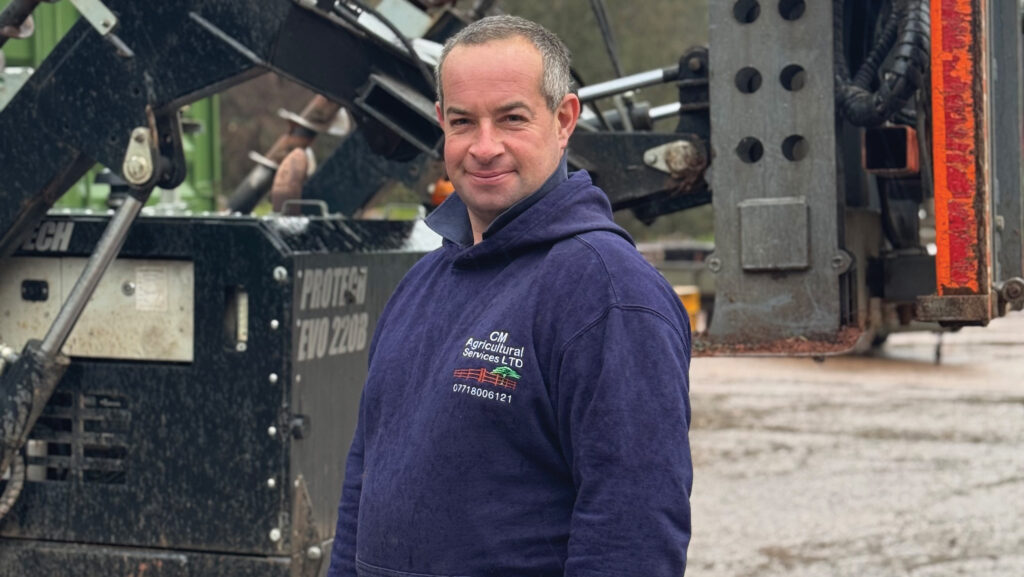
Contractor Chris Merrett is one of more than 50 fencing aficionados to have streamlined their business by ditching a tractor, basher and telehandler for a multipurpose Protech Evo220B.
See also: Handy tools and equipment to ease farm fencing jobs
Obvious attractions of this pricey rig include extendable tracks to help it float over sodden ground and a remote-control system to conduct manoeuvres from afar.
But its undoubted party piece is the versatile loader attachment up front.
Chris Merrett © Oliver Mark
This novelty allows owners to lift timber from lorries and trundle it to site, ready for the machine’s rear-end knocker to administer the thwacks required to have posts standing straight and true.
And that’s not all. Thanks to the Bobcat-style carriage – or Euro 8 brackets on newer models – the standard pallet tines can be switched for any one of umpteen other implements.
For Chris, this includes a bucket to grade ground, a hydraulically powered flail for prepping fence lines, and a Bushpig wire net unroller and tensioner.
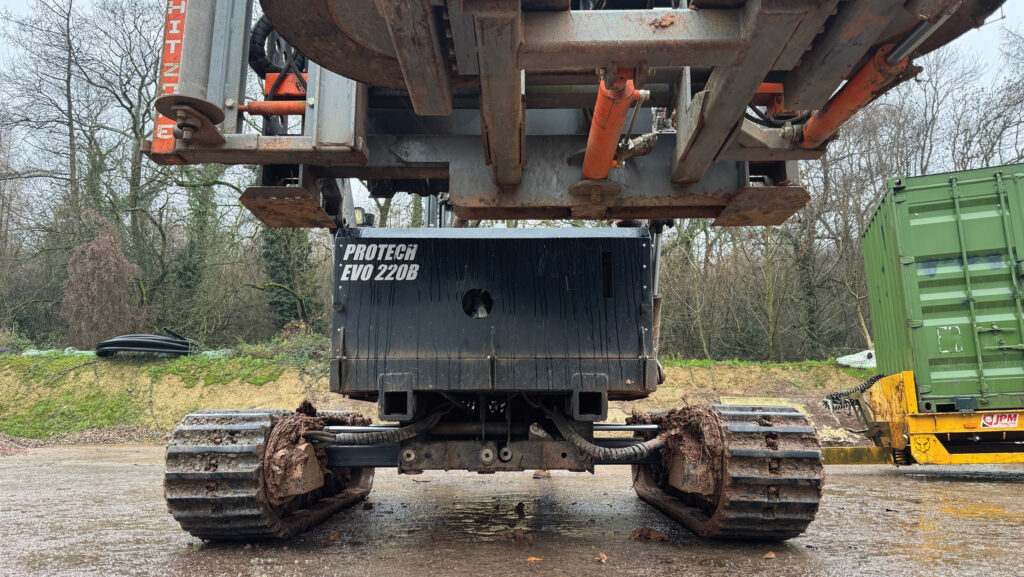
Protech Evo220B
- Engine 48hp Yanmar
- Tracks Hydraulically extendable, 450mm wide
- Weight 4.8t
- Hammer 450kg
- Slew 220deg
- Max post size 16ft (4.9m)
- List price as new £102,690
Fleet rationalisation
The Evo is now his sole frontline machine, having ousted the extra loader that previously necessitated the double handling of posts from lorry to field.
This alone has justified the £80,000 investment four years ago, since which it has clocked 1,900 largely trouble-free hours.
The most recent of these have come on a mammoth 15-mile job reinstating net-and-barb stock fencing at Chris’s base near Newent, Gloucestershire.
Prior to its arrival, he’d run a tractor-mounted knocker and, before that, one of Protech’s first self-propelleds – an MS600.
© Oliver Mark
“I’ve always liked Protech kit, as the company is on my doorstep and it’s brilliant for parts and customer service,” says Chris.
“And I was sold on the idea of having a front loader. We’re a two-man team, so the fewer machines we have to get involved in a job, the better.”
Given it was only the third Evo220B to roll off the maker’s Gloucestershire production line, Chris opted to keep the spec relatively lean by avoiding any unproven – and, to a degree, unnecessary – features.
The loader, mounted in place of the standard front post rack, is the obvious exception.
With his clutch of aforementioned attachments, it means the Evo can turn its tracklaying undercarriage to almost any fencing-related task.
That said, it’s clearly no match for a telehandler in terms of lift capacity and reach, with a 600kg pack of rails about its limit and wagon unloads an occasional challenge.
“It does what I need it to,” says Chris. “Extra reach would be handy but, in reality, there would be too many sacrifices – more metal means more weight, complexity and cost.”
High-capacity knocker
Thanks to its earth-shaking 450kg hammer, generously proportioned telescopic mast and optional boom lift system, the rear knocker has the capacity to wallop in hulking giraffe-spec 16ft telegraph poles.
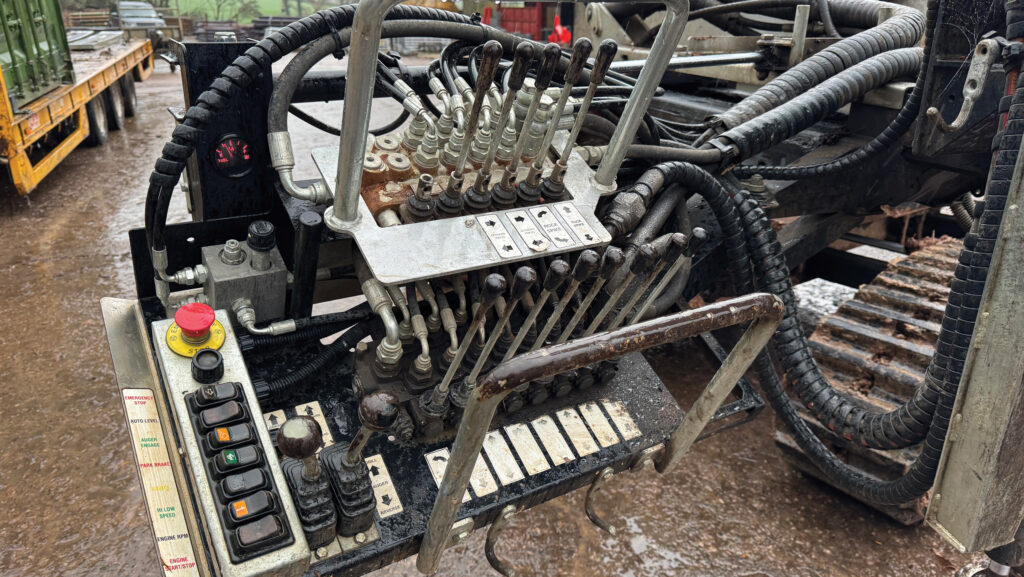
With these functions, plus a mind-boggling combination of boom back- and side-shift, mast angle adjustment, tractor unit steering and front loader lift/lower, controlling the machine is an art of its own.
This can be done on a lever-laden bank, itself coupled to a hydraulic ram that allows it to be positioned post-side.
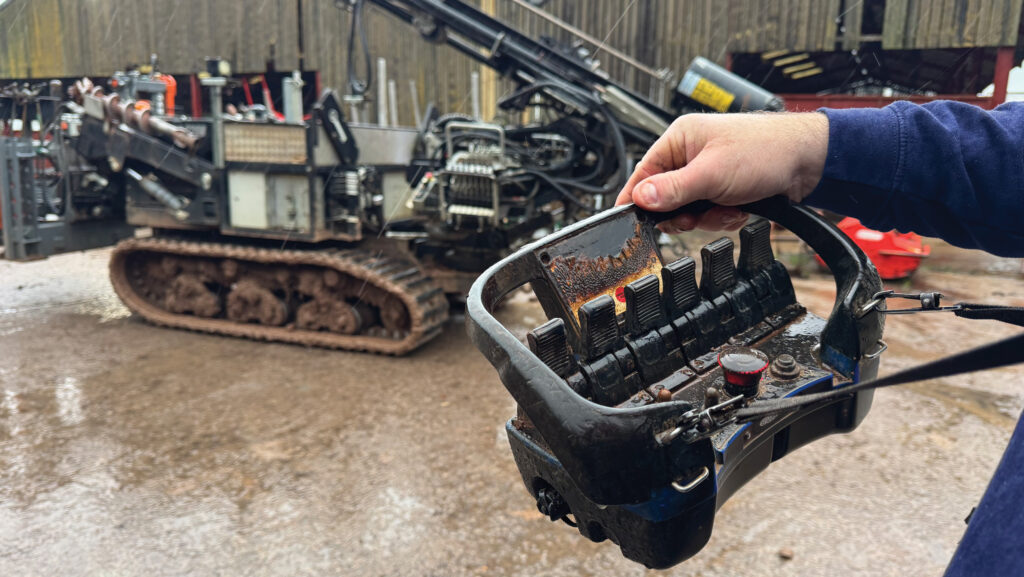
Many of the controls are also duplicated on a chunky handheld remote, including those for engine revs, the loader and the hydraulic netter attachment.
© Oliver Mark
“It means I can walk alongside it, placing the fence posts the correct distance apart, and even pull the net a bit tighter from 200m away,” says Chris.
Also on board is a central gantry that adds to the Evo’s timber-carrying capacity, and several lockable storage cupboards and drawers.
One of these houses a dock for the remote-control battery, there’s a USB for phone charging and waterproof stashes for staple guns and other tools.
In fact, the only thing it’s missing is a bank of sockets to charge powertool batteries. “It was an optional extra and, in hindsight, would have been handy, as I’m often in the middle of nowhere.”
Go-anywhere tractor unit
Another area in which this machine betters a tractor-knocker combination is in its ability to access inhospitable areas.
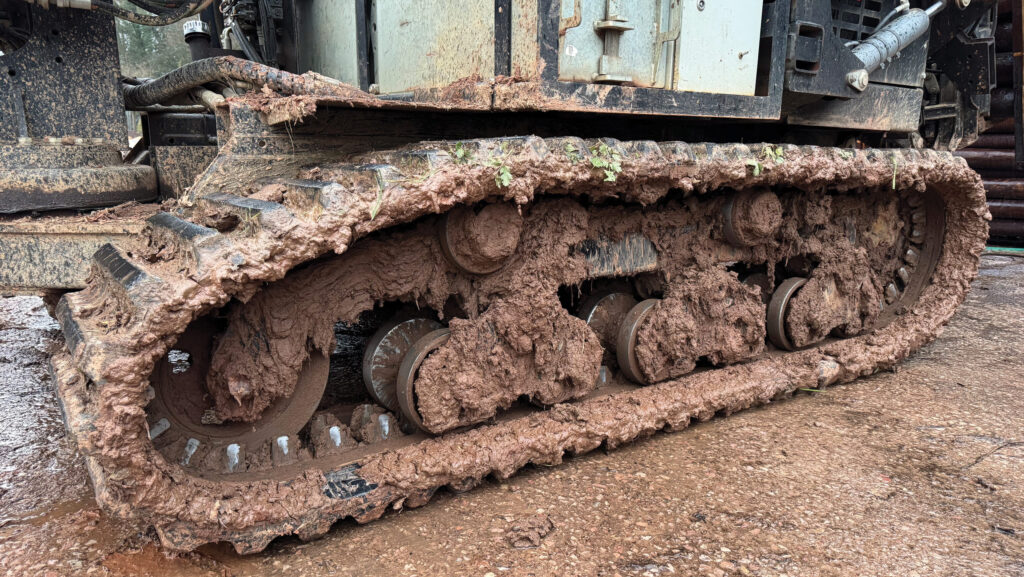
Key to this is its low centre of gravity and pair of weight-spreading tracks – a combination enhanced by pushing the latter outwards by 50cm each side.
Though this is effective enough, Chris is toying with the idea of upgrading from 450mm to 500mm rubber belts on his next machine.
This would give extra stability and float, albeit at the expense of transport width on his Unimog-towed low-loader.
Nonetheless, the 4.8t pond skater can get over – and extract itself from – some seriously hostile terrain, such that Chris has only been stuck once.
© Oliver Mark
“It’s amazing where it’ll go, it’s much safer than a tractor, and there’s always the backup of the rear winch; I’m never short of trees to attach it to.”
However, loading up the Bushpig netter with two 500m rolls of wire saddles the Evo with another 750kg, accentuated by its out-front position.
“Even when I push the knocker backwards as far as possible, it can nosedive down the field in bad conditions,” he says.
The other challenge is accessing tight corners, though the 220deg of slew helps – and a tractor wouldn’t necessarily fare any better.
Reliable powertrain
Puttering away to power all the hydraulics services is a dependable 48hp Yanmar diesel. This is rarely strained, given Chris typically runs it at a preset 1,550rpm.
A tea coaster-sized screen on the side shows the performance stats that, when driving, rarely exceed 35-40% engine load and 2.4 litre/hour.
Once static and simply employed to pummel posts, consumption is far lower. As a result, a tank of diesel usually lasts about three days and, better still, there’s no AdBlue aggro to worry about.
Despite the powertrain’s relatively easy life, Chris religiously services it at 500 hours. “I probably do more than necessary, but it’s my frontline tool, out six days a week, and I want to look after it.”
© Oliver Mark
Problems thus far have mainly been limited to fatiguing pulley ropes and bursts on the spaghetti of hydraulic pipes.
To save the faff and cost of the latter, the longest lengths of pipework have been split into sections by fitting intermediate blocks.
Track units occasionally give trouble, too. This is par for the course, given they operate in sloppy, sandy and bearing-busting mud for a fair chunk of the year.
So far, he’s replaced one rear idler and, just recently, a central idler – at a cost of £220.
Based on its solid reliability record, Chris expects to extract another two years of service from his current machine.
Second-hand values are a distinct unknown.
“I haven’t seen any Evo220Bs come up for sale, but I’d like to think it’ll be worth £50,000. On that basis, £30,000 depreciation in six years is good going, especially given the work it’s done.”
So, money well spent, after all…
CM Agricultural Services
Contractor Chris Merrett started his business 15 years ago and now installs up to 40 miles of agricultural and equine fencing annually, as well as tree shearing and clearing.
Creosoted posts, sourced from McVeigh Parker’s Stourport depot, account for 80% of his materials, with tanalised timber making up the rest.
McVeigh’s galvanised Clipex system seldom gets a look in, with most customers unconvinced of the metal’s aesthetics – irrespective of its potential longevity.
As for wire, Chris opts for Black Max, imported from New Zealand.
“The barbs are sharper than Tornado’s, so it’s not particularly nice to work with but cattle respect it, and it can also handle being slightly overstrained without snapping,” he says.