Monitoring equipment options to ease grain store management
Clambering over heaps of grain armed with temperature probes and sampling spears can be a relentless chore for anyone storing crops over time.
But there is another way. A raft of high-tech tools are available to help farmers and store managers monitor conditions more easily – and spend less time tipping barley out of their boots.
At the top end, this includes automated setups with multiple connected sensors that continuously beam live data to a cloud-based server, while those on more modest budgets can plump for lower-tech systems and standalone devices that don’t break the bank.
See also: What’s in your grain store? Tackling pests before harvest
To save yet more cash, the technically minded can assemble their own time-saving equipment using cheap components purchased online.
Another helping hand comes in the form of the Farming Equipment and Technology Fund (FETF), which could cover as much as 40% of the purchase cost of some equipment – the application window for the current scheme closes at midday on 28 April 2026.
Here, Farmers Weekly has lined up a few pieces of kit that span the broad spectrum of features and cost.
Barn Owl Wireless
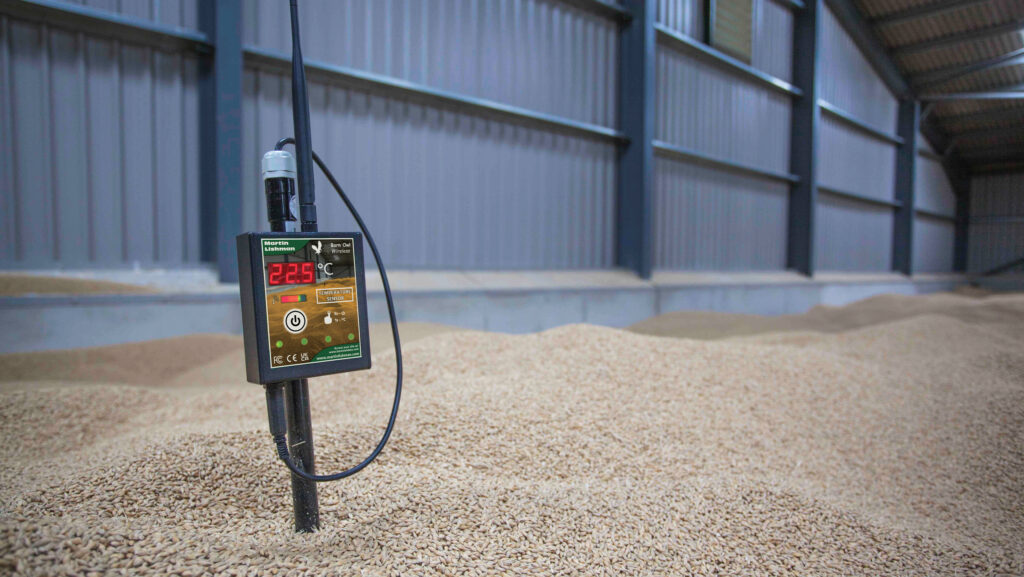
Barn Owl Wireless feeds information into Martin Lishman’s new web app © Barn Owl
Having been treated to a new web app last year, the Barn Owl Wireless monitoring and control system from Martin Lishman is claimed to be far more user friendly.
Information is now easier to interpret, with neater graphics and a nifty bird’s eye view of the store that clearly highlights any hotspots, rather than simply serving up a list of probe readings.
There’s also the ability to set custom alerts, giving users the opportunity to decide the point at which they’re warned of any changes in conditions.
Another perk is that the app will automatically change its layout depending on the type of device it’s being viewed on so that it is equally easy to operate on a phone, tablet or computer.
Like before, the hardware is of a modular design, meaning farms are able to adapt the setup to suit their specific needs and budget.
This can start with a small group of temperature probes and gradually build to a fully loaded assembly offering automatic control of ventilation systems.
At its heart is the wireless “gateway” device that allows all parts of the system to talk to one another and transfer data to the server.
An array of sensors can be connected and operated through this, such as temperature and moisture measurers for flat stores and silos, as well as devices for monitoring ambient air temperature, humidity and carbon dioxide.
Also in development is a wireless probe that gives moisture and temperature readings, and the carbon dioxide level, in the heap.
The latter could give early warning of any biological activity, allowing store managers to act before the problem worsens.
Then there are the fan controllers, which will trigger ventilation to kick in as soon as certain parameters are met.
These can switch motors on individually so energy isn’t wasted trying to cool an area of the store that doesn’t need it.
Static controllers need to be hardwired and can operate up to 12 fans, while mobile ones – that are movable and don’t require the services of an electrician – can handle five each.
In addition to monitoring flat-floored grain sheds, the Barn Owl Wireless system is available with configurations to suit silos, potato stores, compost heaps and other bulk-stored goods.
Prices for an entry-level setup, including six wireless temperature probes and a gateway for storing and wirelessly transferring information, start at about £3,000.
Adding fan control ups the starting price to about £4,800.
These figures include a one-year subscription to the firm’s “connectivity plan”, which covers the wireless internet connection, server access and updates. The ongoing cost for this is £525/year.
For those seeking automated ventilation control on a more modest budget, Martin Lishman offers a Temperature Differential Controller.
This has a wired connection to fans and will switch them on whenever the crop temperature is 5deg more than the ambient air temperature.
Prices for static versions start at £460, though these need to be wired in professionally, with portable plug-and-play kits available from £1,700.
CroverPro robot
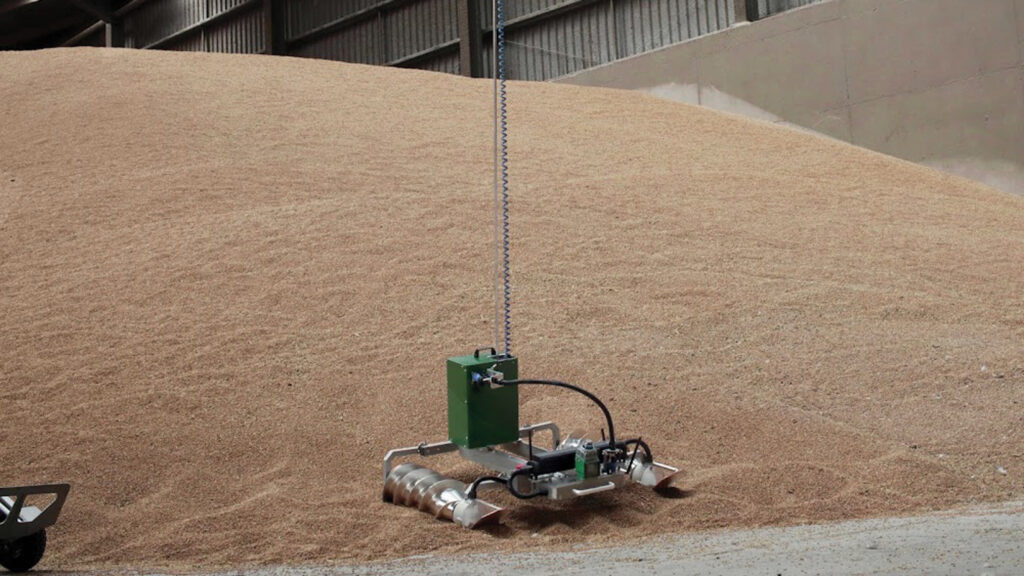
CroverPro robot armed with a sensing module © CroverPro
Rather than using static probes to monitor grain temperature, moisture content and carbon dioxide level, the Crover robotic platform travels over the heap, taking readings as it goes.
These are carried out at depths of up to 1.5m, giving a decent picture of what’s going on throughout the store.
For buyers who upgrade to the Pro version, an additional crop sampling module is included too, which can collect up to 9 litres without anyone having to set foot in the grain.
The current iteration of the battery-powered tool – cable-powered ones are also available – is driven over the heap using a remote joystick controller, with a live camera feed helping guide the way.
However, a software update planned for later in the year will allow it to operate in a fully autonomous manner.
All the collected data is beamed to a cloud server, which can be viewed by downloading the firm’s web app.
As an added bonus, the twin augers propelling the rig will stir grain on the surface, helping to aerate it and prevent a crust forming.
The CroverPro system, complete with grain sensing and sampling module, is priced at £24,000.
Grain Fan Assist Wireless
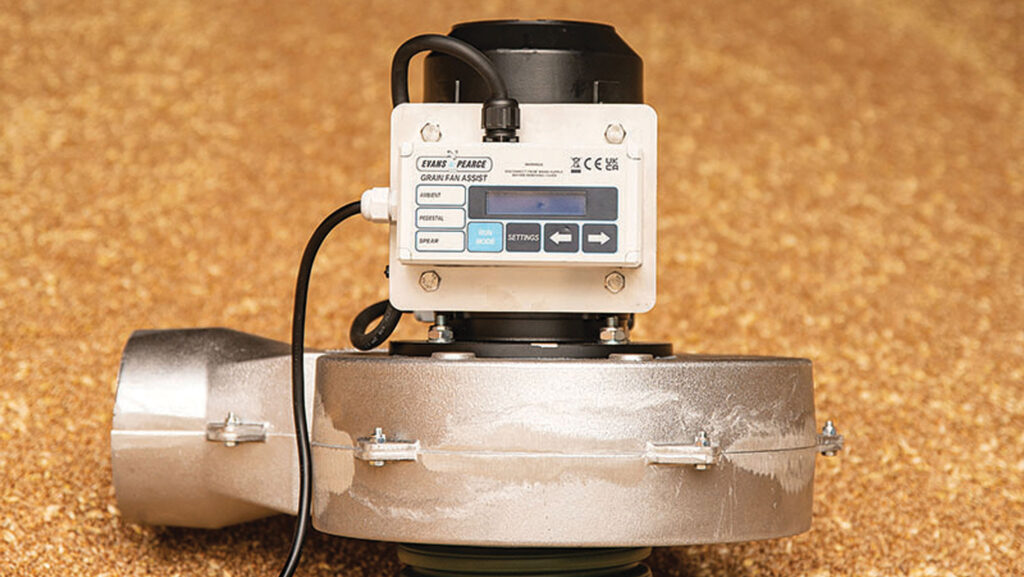
Grain Fan Assist triggers ventilation automatically © Evans and Pearce
Dorset outfit Evans and Pearce offers a simple kit for switching grain store ventilation on and off automatically.
The Grain Fan Assist Wireless works on a temperature differential, meaning fans will only be triggered to start when the ambient air is cooler than the grain in the heap.
They will then switch off once the two equalise, helping to reduce energy costs by as much as 40%.
Communication between system components is wireless, meaning no additional data cables are required, and they work without the need for a mobile SIM card or broadband connection.
The equipment is modular too, so buyers can start small and scale up over time. At the simpler end of the spectrum there are individual on-fan controllers, with twin-fan units and multi-hubs also available.
Readings for ambient air, ambient relative humidity and crop temperature are transmitted to each controller from a 2m probe inserted into the heap.
Multiple units can operate from a single one of these probes, which are priced at about £160.
As for the controllers, individual versions for single-phase fans can be purchased for about £330 apiece, with twin setups coming in at £415.
MiniTemp Blue
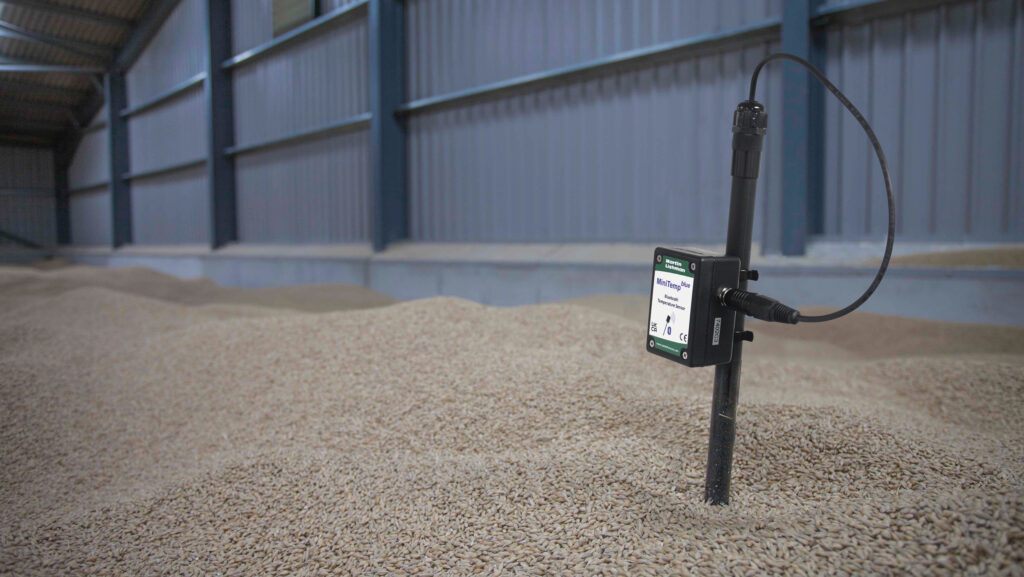
Up to six months’ worth of data can be logged © MiniTemp Blue
If you’re after a simple tool for keeping tabs on temperatures without climbing the heap then the £263 MiniTemp Blue from Martin Lishman should fit the bill.
This battery-powered device mounts to 2m or 3m static temperature probes inserted into the grain and transmits readings over Bluetooth to a smartphone or tablet, avoiding the need to use a separate reader.
The only caveat is that the operator needs to have a clear line of sight to the sensor for the connection to establish.
There’s also sufficient internal memory for it to automatically log up to six months’ worth of temperature data which can be downloaded for longer-term record keeping.
Information from the device is viewed in the firm’s ML Sensing app, which can be found in the Apple App Store and Google Play Store.
AgroLog Wireless Sensor Spear
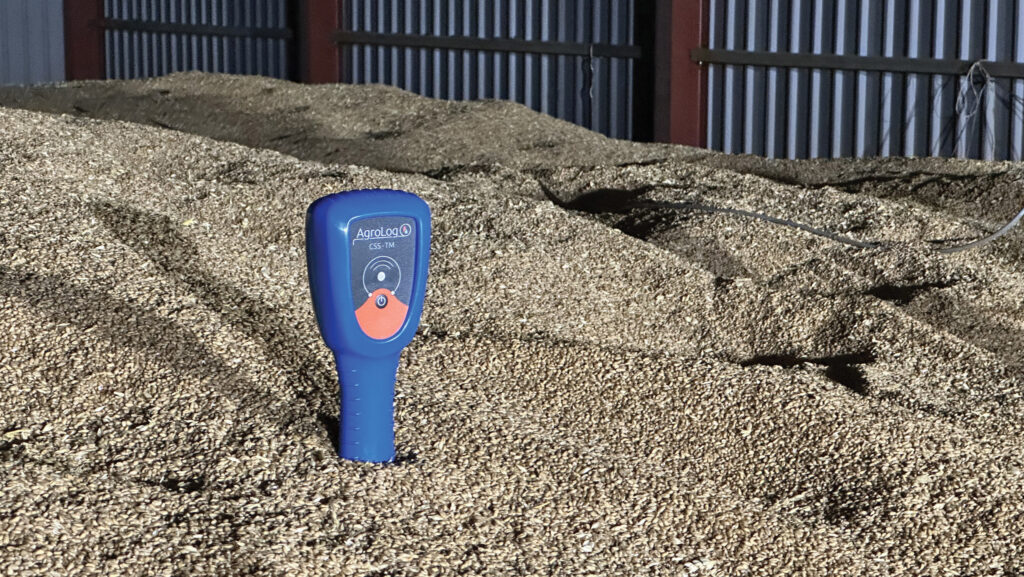
Portable AgroLog spear keeps tabs on temperature and moisture in grain and ambient air © AgroLog
Armed with an array of measuring devices, the portable AgroLog Wireless Sensor Spear can detect temperature and moisture levels in both grain and ambient air.
These readings are then beamed to a server via a built-in wireless internet connection, allowing users to view them in an app.
The spear will work as a standalone unit, or users can install several and view the information from each alongside one another.
Thanks to built-in GPS, it’s possible to view the location of each device on a map, making it easy to see which building they are currently located in. In its standard setup, readings are taken once an hour and sent to the app.
However, users can also get it to produce live data, and set thresholds for temperature and moisture levels which, if met, will ping a notification.
Battery life is approximately two years and it’s IP65 rated to protect against dust and moisture ingress.
AgroLog Wireless Sensor Spears can be picked up for about £300 each, though they require an annual subscription which is currently £180/device.
Farmex/Spitfire wireless store monitoring and control
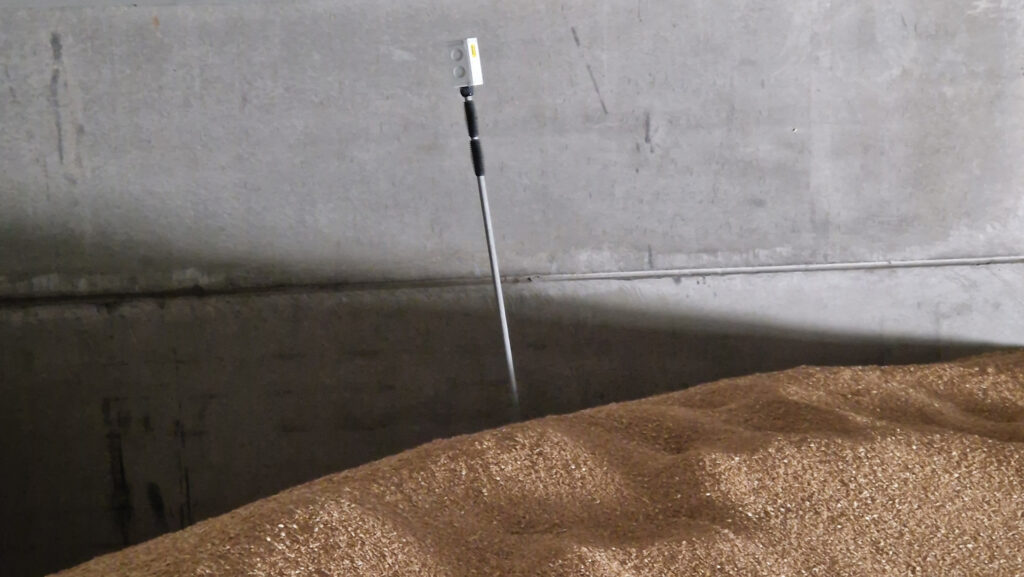
Farmex’s lance-type sensor © Farmex
It might be best known for pig housing ventilation systems, but Reading- based specialist Farmex has recently added grain stores to its repertoire.
By using multiple remote lance-type sensors, topped with Bluetooth relays, to monitor temperature and humidity, the firm’s installations create an accurate picture of what’s going on both in the heap and the wider grain store.
Information is then sent to a server via a reliable 4G wireless connection from Spitfire Network Services, allowing farmers to view it off-site.
This means it doesn’t have to rely on internet connections, or require cabling to be laid around the yard.
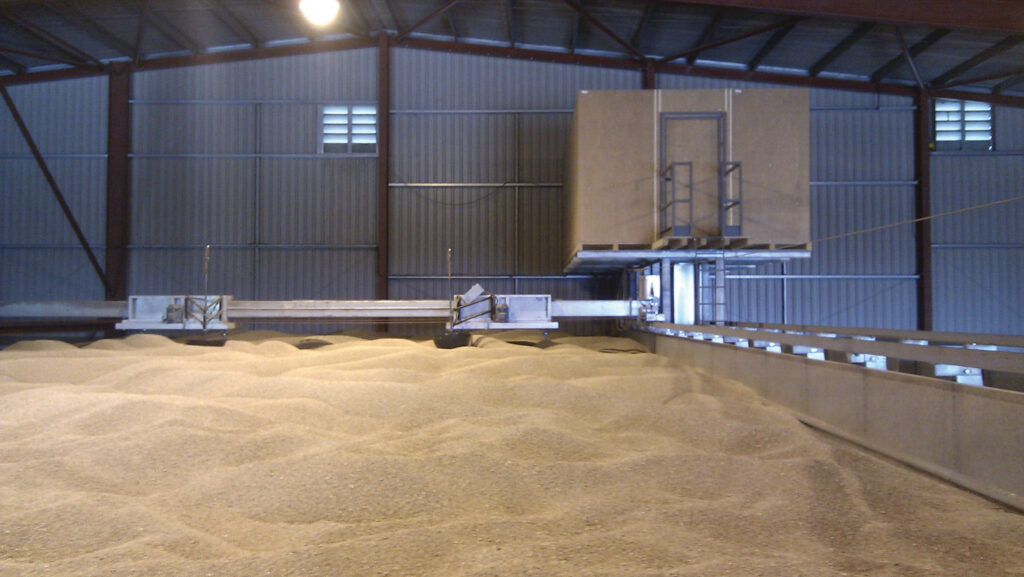
Information is transferred via a Wireless Spitfire connection © Farmex
DIY approach
Fed up with waiting three or four minutes for his handheld moisture probe to settle on a reading, Fife farmer John Hutcheson went in search of a solution.
Having already got a portable readout device, he figured that he could buy multiple probes, leave them in the heap and then quickly get the information by plugging his reader into each one.
Off-the-shelf units were priced at about £42 apiece, which would soon mount up if he bought one for each of his testing points.
To save some cash, he did a bit of research and worked out that he could make them himself.
Sifting through documents that came with his readout device, he realised that the key component was a thermistor with a particular characteristic – essentially, the way resistance changes with temperature.
After carrying out a few tests, he confirmed which type was required and ordered a batch online.
To make the probes, he soldered the thermistor onto one end of a length of wire and a 6.35mm audio jack onto the other, ready for the measurement device to plug into.
This assembly was then slotted into a length of 20mm electrical conduit, with regular cable glands and push-fit caps sealing off the ends to prevent grain getting inside.
The parts to make a single probe cost £5 and it takes him 10 minutes to put together, so it was easy to justify making a large number.
With his single portable unit, it took the best part of a day to get round all of the farm’s stores, so having static units always at grain temperature has saved a huge amount of time.