Driver’s view: William Heslip’s New Holland T7.300
 © TB Drone Media
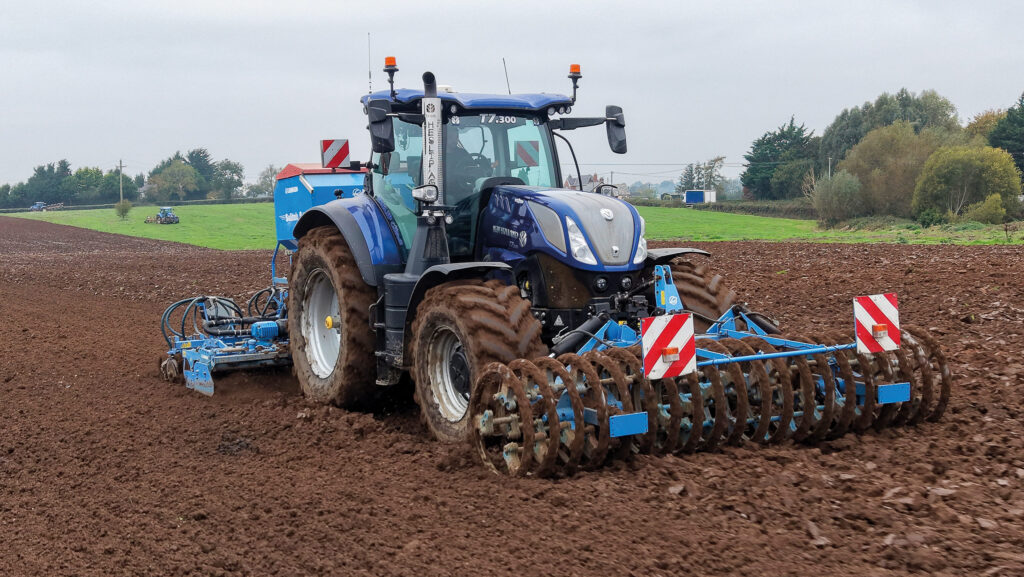
 A new cab was the stand-out improvement on New Holland’s “long-wheelbase” T7s when they were introduced at the Sima show in Paris three years ago.
There are five Auto Command models in all, offering boosted outputs that range from the T7.230’s 225hp to the 300hp of the flagship T7.300 seen here.
See also: Driver’s view: Sisto family’s 7-year-old New Holland T7.210
Following a successful demo, William, Dean and Roger Heslip nabbed the first one to land in Northern Ireland.
It operates alongside a handful of other T7s at RB Heslip Agri Contracts – a 210, two 225s and a 245 – as well as a TM130 and Claas Xerion 3800.
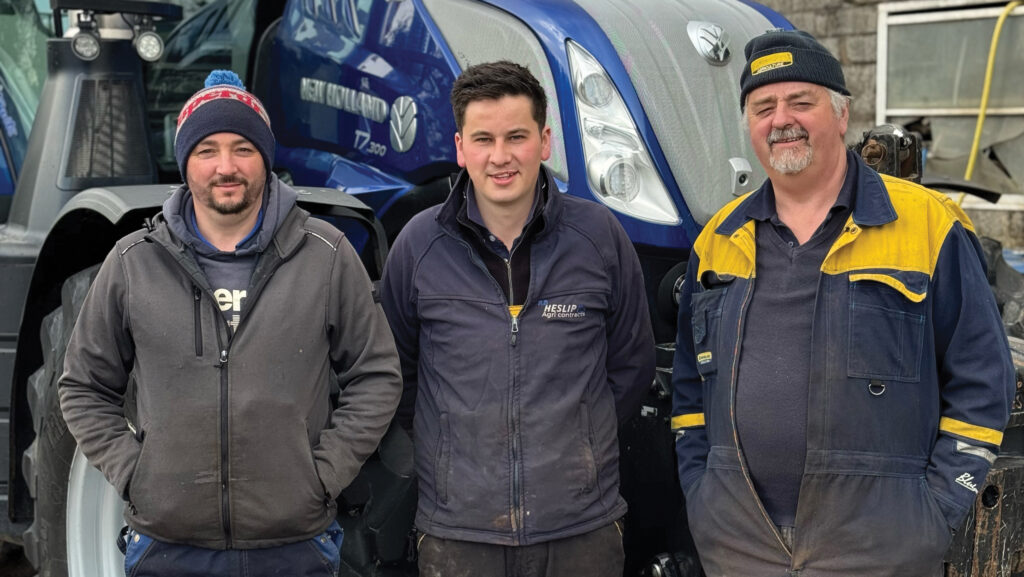
Dean, Roger and William Heslip © MAG/Oliver Mark
William Heslip’s New Holland T7.300
- Year 2024
- Hours 2,000
- Engine 6.7-litre, six-cylinder FPT
- Max power 280hp (boosts to 300hp)
- Transmission Auto Command CVT
- Hydraulics 210 litres/min
- Lift capacity 10,463kg
- Price (quoted for new model in 2024) £225,000
Why a New Holland T7.300?
We’d had the best of our 12-year-old T7.270 and it was time for a change.
Another 270 was on the cards, but we had a demo of the T7.300 at the back end of 2023 and, after a bit of late-season subsoiling, we were sold.
The power was impressive, and the comfort levels were unbelievable compared to the other tractors we have.
Our dealer, Kennedys, couldn’t supply a new one, so we took the 300-hour demonstrator.
We also priced up a Case, which worked out more expensive, there was a 12-month wait for a Fendt 728, and the local John Deere dealer sold its demo 6R 250 before we got to try it.
© MAG/Mark Oliver
What extras did you opt for?
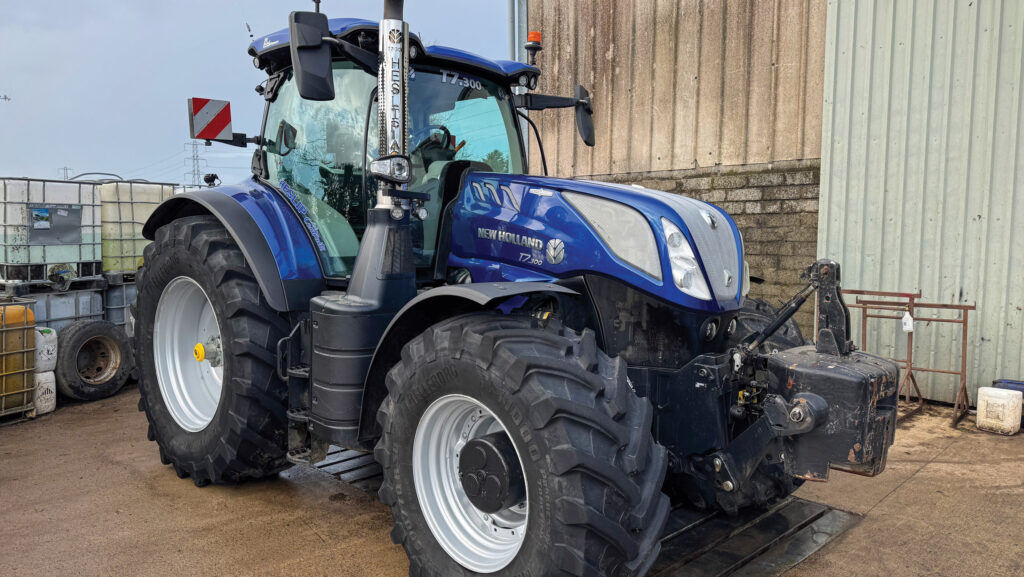
Every conceivable extra was already fitted. It’s got RTK guidance, five rear and two front spools, hydraulic stabilisers for the rear arms, and a front linkage and pto.
There’s also a full LED light package, which is fantastic, and a central locking system.
We wouldn’t be without many of these features now. The only exceptions are probably the subwoofer in the cab and the powered extending mirrors, which we’ve never moved.
The rear-facing camera could also be added to that list, but the one on the nose is handy for hooking on the front mower.
Plus, we could always rig up some more wireless cameras; at the minute, we run the one on the back of the baler through a separate display.
The only “extra” was a three-year/3,000-hour warranty. We do all the servicing in-house, but with the cost of the high-grade oils and backend filters – one of them is about £120 – it’s by no means cheap.
How has it performed?
The old T7.270 was remapped to put out 295hp and was seriously torquey, but this 300 easily matches it.
We don’t need any more power – there’s a limit to how fast you can pull the Lemken Solitair and big baler.
It also runs a set of triple mowers alongside the Xerion. Fuel consumption is about 7.5 litres/ha, which is on a par with the 270.
But it’s so much nicer to drive. The suspension is brilliant – we’d always pick it over the Xerion – the cab is roomier and it has far more storage space.
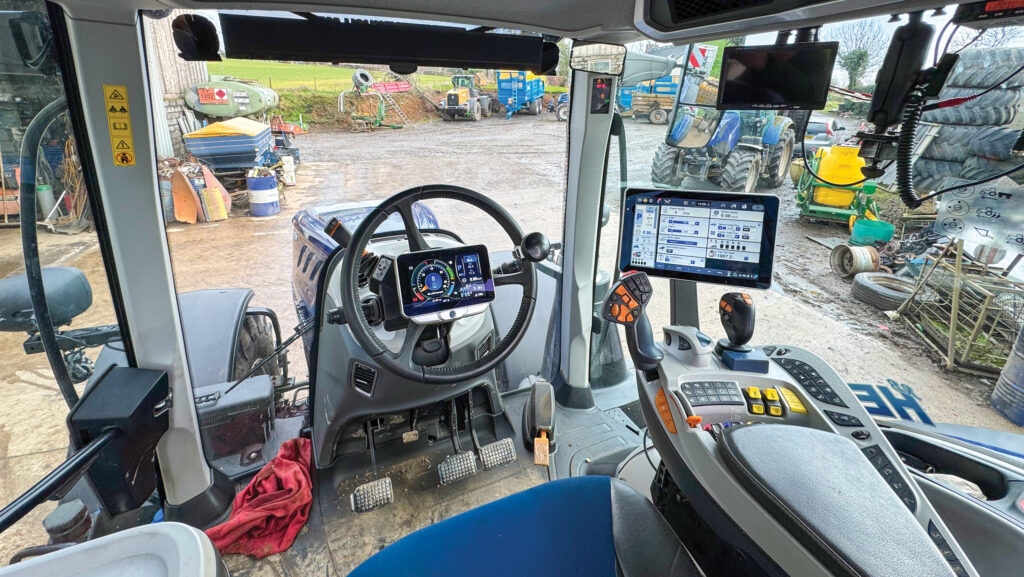
The screen is a massive improvement, too. As well as having loads more settings, which took a bit of getting used to, the display can now show isobus and guidance together.
© MAG/Oliver Mark
What could be improved?
Bar the odd oil leak, a few other niggles, and plenty of software updates, it has been trouble-free.
However, despite New Holland’s efforts, those updates haven’t yet got the screen waking up quicker on start-up.
It’s not a problem if we’re running straight off down the road, but it feels like forever when we’re waiting to change an implement.
While they’re at it, they could add an option to view the guidance map on the steering wheel screen.
Ironically, I wanted rid of that screen when we first got the tractor, as I used to steer by spinning the wheel spokes with my fingers.
After hurting myself one too many times, I enquired about moving it, but a new steering column and loom was going to cost £2,500. Now I’m used to it, I quite like it.
I would fit a bigger toolbox and a sunroof if I could, though. Opening the back window is a non-starter, so the only circulation comes from the air conditioning.
The other thing we’d change is the size of the diesel tank. It’s got more capacity than the 270, but not enough to get us through a long day, which often means making a fuel run at 7pm.
And it has a fair thirst for AdBlue. Thankfully, the emissions system has behaved so far, but it’ll be getting deleted if it starts to play up.
Likes and gripes
Likes
- Comfortable ride
- Screen shows isobus and guidance simultaneously
- Fuel efficient
- Useful front camera
Gripes
- Small fuel tank
- Thirsty for AdBlue
- Screen slow to wake up
- Tiny toolbox