First impressions: Fresh Fendt 832 puts power to the ground
 © Nick Fone
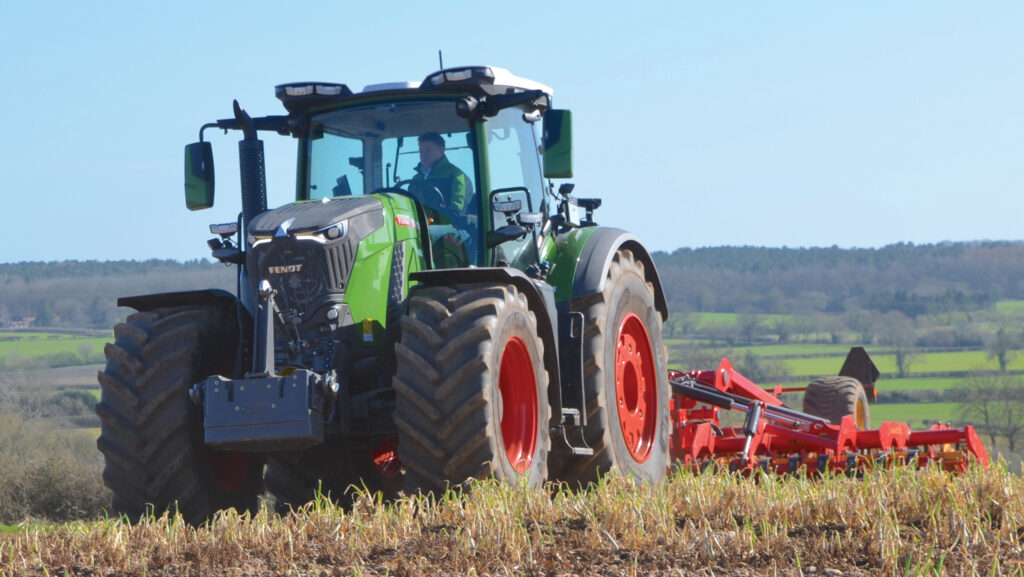
 Fendt has finally cut all ties with engine manufacturer Deutz. Its new 800-series is the latest to get a heart transplant from sister company Agco Power, and with it comes a slicker single-range transmission.
While tractor makers regularly trot out the “new from the ground up” spiel, for once it rings largely true, with the models sharing hardly any common componentry with their predecessors.
These have been out of production for almost two years.
See also: Driver’s view: Lee Henzell’s Fendt 728 Vario
Fendt 832 Vario Profi+
- Engine 8-litre, six-cyl Agco Power
- Max power 343hp@1,700rpm
- Max torque 1,680Nm@1,300rpm
- Transmission Single-range, 60kph stepless TA250 VarioDrive
- Hydraulics 165-litre/min@205bar (220- and 385-litre/min options)
- Spool valves Two front, six rear
- Lift capacity 5.3t front, 11.6t rear
- Unballasted weight 9.9t
- Max payload 7.6t
- Base list price £356,351
- Price as tested (Profi+ spec) £433,221
Although they plug an obvious gap in the line-up between the 700s and 900s, the company is at pains to point out that they’re not direct replacements for the previous generation.
The three models are rated at 260hp, 290hp and 320hp, so there’s effectively a 15% hike in output and they weigh almost half a tonne more.
For that reason, Fendt suggests likely buyers will be folk that have previously run lower powered 900s; traditional 828 owners will probably opt for the less bulky 728.
And while we’re on the subject, we’d better address the proverbial elephant in the closet – the engine issues that dogged those old 800s.
The exhaust gas recirculation (EGR) system on the 6.1-litre Deutz motor employed previously often caused premature wear in the cylinder bores that resulted in a full engine overhaul or replacement block for many an 828.
Fendt reportedly looked after owners of those tractors well and a revised EGR system was fitted as a recall item. Sadly, however, that single, major issue tarnished the reputation of the range.
© Nick Fone
Agco Power
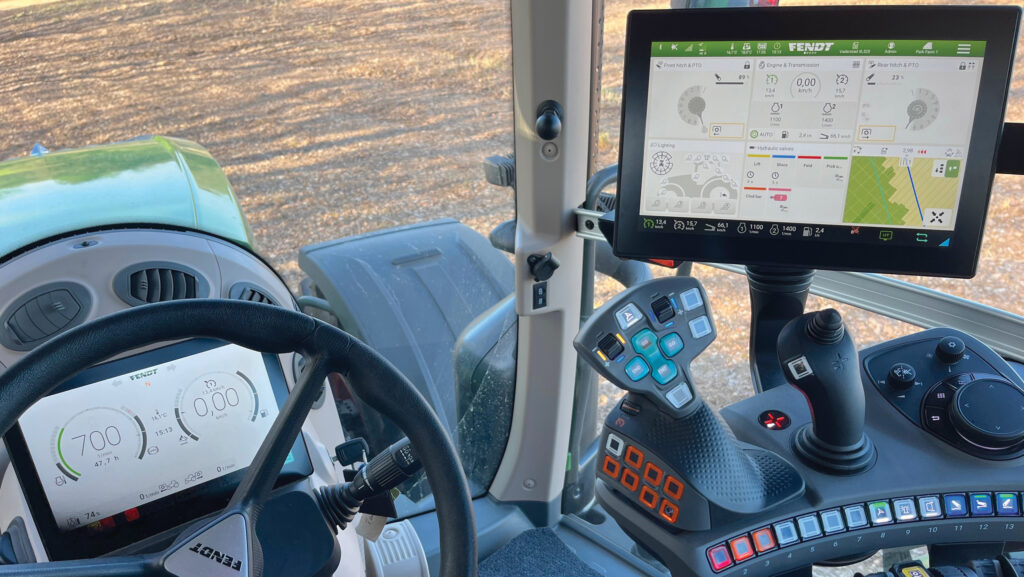
No surprises, then, that the new 800s come with a totally different power plant. Built by Agco Power, the 8-litre Core80 is derived from Sisu motors of old and, as such, has a strong pedigree.
Its introduction will come as welcome news for many, especially anyone that’s run a Valtra, Massey or even a JCB Fastrac powered by a long-legged, torquey Sisu six-pot.
While effectively the same design as the 7.5-litre engine fitted to the latest 700-series, it has a bigger crankshaft, larger oil pan, and its pistons are made from steel rather than aluminium. It’s devoid of any form of EGR, relying instead on AdBlue exhaust after-treatment and a particulate filter to ensure it limbos under the low bar for emission regs.
There are apparently 25% fewer components within the system, but it does mean the tractors will guzzle more AdBlue – the cost of which is offset by the associated reduction in diesel use, according to Fendt. It says this improved frugality is mainly down to the engine’s ability to develop maximum power and torque at much lower revs.
While the old 828’s 287hp Deutz motor topped out at 2,100rpm and delivered 1,217Nm at 1,450rpm, the new bottom-of-the-range 826 generates 283hp at 1,700rpm and coughs up an impressive 1,450Nm of torque at 1,300rpm.
Bringing those two peaks closer together in the rev range could potentially have a big impact on performance, whether in out-and-out muscle or sparrow-like thirst. It also means the trio can reach their top speed of 60kph at 1,450rpm.
All these numbers might excite the more stat-hungry lab rats, but most impressive is what these new machines can do while running at revs that would normally see a tractor pronounced medically dead. Plus, they’ll reach a respectable 40kph at a whisker over tick-over and seemingly do so with very little fuss or snorting.
The switch to the Finnish-made motor also brings a modest power boost function. Dubbed “dynamic performance”, this kicks in to counteract parasitic losses from auxiliaries such as the hydraulically driven cooling fan, air compressor or air conditioning, rather than purely extending the tractor’s maximum output.
Put simply, it’ll generate up to 23hp extra solely to maintain performance while the energy-sapping leaches are sucking up essential gee gees. Apparently, this means the number on the bonnet is what the operator will see at the shaft.
© Nick Fone
Single-range CVT
The second major change comes with the transmission. Having led the field with stepless CVTs back in the 1990s, Fendt’s Vario boxes have historically had two working ranges. With the latest incarnation that’s all changed.
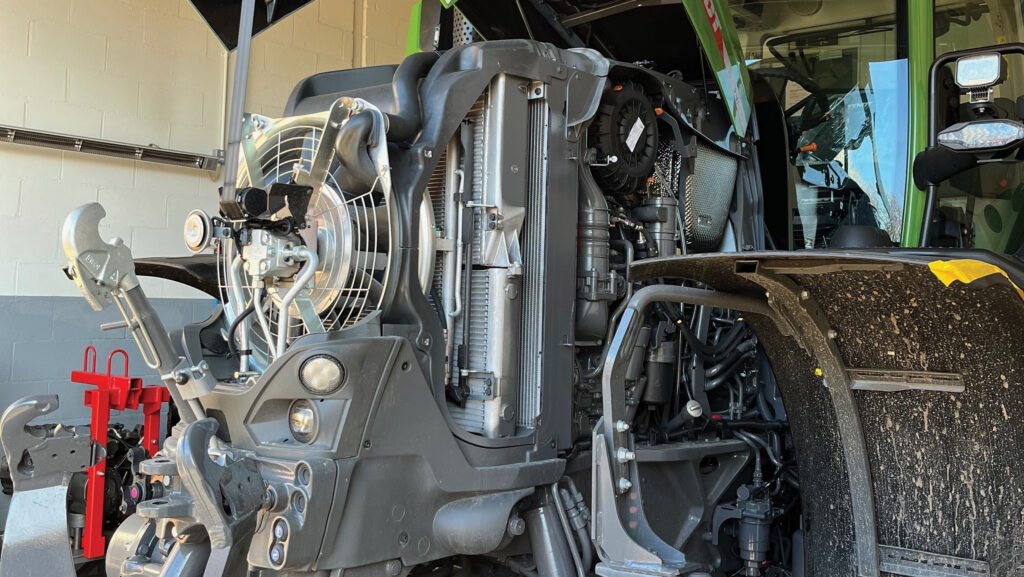
The TA250 VarioDrive employs a pair of hydro swash-plate motors to power the front and rear axles independently – a setup the Bavarian manufacturer reckons has added an element of intelligence to traction control.
Sensors detect when the front wheels begin to slip and then bias drive to the rear accordingly. Likewise, if the backend rubber starts to scrabble, more effort is sent to the front beam. Consequently, there’s no longer a four-wheel drive selector switch on the armrest.
Building on the same concept as Kubota’s Bi-Speed turn system, which ups the pace to the front axle to haul the nose round quicker, this Fendt arrangement can proportionally vary the speed of the front wheels according to the steering angle.
The result is that despite being 50mm longer than their predecessors, new generation 800s will pull themselves round in a 10% smaller arc.
There’s still a clutch pack in the front axle driveline, which disengages drive above 20kph – a factor that gains the tractor around 20hp thanks to the reduction in drag.
The new transmission’s ability to set the 10t tractor off from a standstill to 60kph in a single range is down to the extra oomph generated by having a second hydrostat motor.
Fendt says it means the full torque can be applied to the wheels throughout the entire speed range. While in theory this means getting up to a fair lick when loaded should require less effort, slowing down can be a different story.
The Deutz motor of old had an exhaust brake – a facility the new Agco Power unit lacks. Instead, Fendt ramps up engine loading by engaging the auxiliary hydraulics, as well as winding the vanes on the variable geometry turbo wide open to mimic the “jake-brake” effect.
© Nick Fone
In the field
Coupled to 5.25m Vaderstad Carrier, we gave the flagship 832 a run out on some abandoned spring onions. Starting speed was a steady 8-9kph with the discs set to cut down to 75mm-100mm but, after breezing along at sub-1,000rpm, it quickly became apparent that this wouldn’t be any test for the range-topper.
The heavily rutted veg ground meant we could only dial up the pace to 13kph, which saw the revs climb to a modest 1,280rpm.
It might sound clichéd, but this latest generation of Fendt requires a very different driving style. Gone is the need for heaps of right boot and the associated roar one might previously have expected.
Thanks to the change in transmission there’s no longer that trademark Fendt whine, either. Plus, without a need to shift ranges, there’s no opportunity for unscrupulous operators to put the driveline under unnecessary strain.
And having the same size hydro motors propelling both front and back wheels up to speed theoretically means power and torque are distributed equally.
FW verdict
It’s fair to say that Fendt has answered its critics with a completely new engine and gearbox for the 800-series. But is it too late?
Have traditional 828 customers wandered off to the likes of Deere and CNH, fed up with the reliability issues that plagued it? The company says not.
Many 828 purchasers have migrated to lighter-framed 728s and the new line-up is apparently more likely to appeal to 900-series customers of old. Yet the current base 933 wades in with less power than the new 832 and top-end 700s now reach right up beyond 300hp, so it doesn’t exactly fill a gaping hole.
Those that opt for a demo will find a far quieter, smoother machine with more low-end grunt than ever before, delivered at much lower revs. But that all comes at a cost, with the base list price starting at £356,351.
Three ranges compared |
|||
| With some fairly significant overlaps between ranges, perhaps pricing will help to un-muddy the water when it comes to choosing a model | |||
| Model | Max Power | Weight | Base list price |
| 728 | 303hp | 9.6t | £307,493 |
| 826 | 283hp | 9.9t | £326,633 |
| 832 | 343hp | 9.9t | £356,351 |
| 933 | 326hp | 11.3t | £370,933 |