What’s in Your Shed? visits a fledgling contracting business
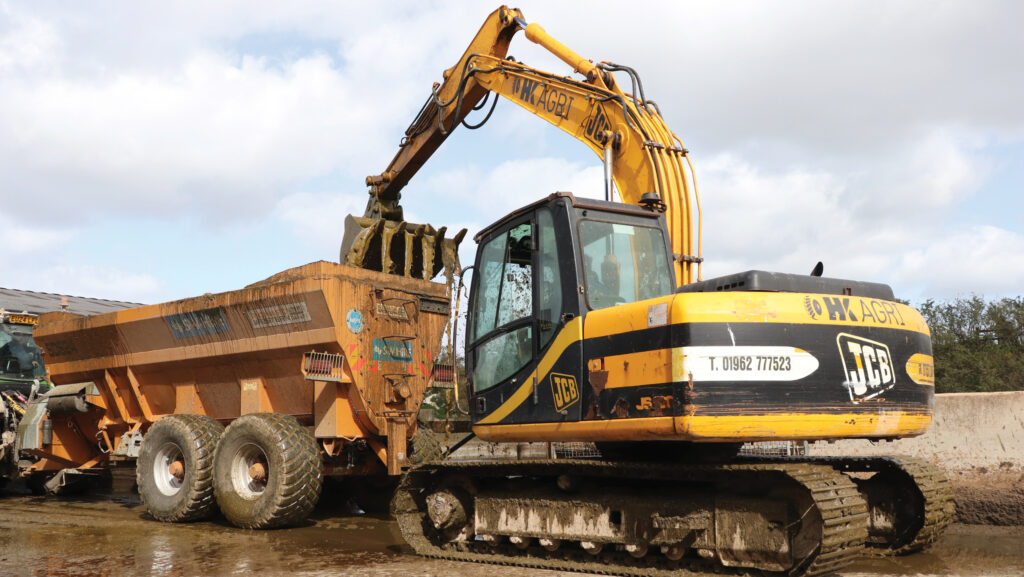 HK’s 24-year-old, 13t JCB JS130 © Andrew Faulkner
 In the latest in our What’s in your Shed? series, we visit Harry Kennedy’s fledgling Hants-based contracting operation, HK Agri.
The business relies on second-hand kit bought for sensible money and maintained/repaired largely in-house.
See also: On test: RS Agri targets muckspreader market with new Atlas
How did you get started?
Even though my family has no history in farming, the irony is that my business is now a real family affair and totally reliant on them.
My father, John, is an electrical engineer and a massive help in the workshop; my brother, Todd, works for me part-time; and my sister, Alex, is an accountant and does the books.
On top of that, I’m based in my brother-in-law Charlie Cheyney’s yard, and the Cheyney dairy/arable farm provides me with about 25% of my work. Along with my fiancé, Rebecca Sutcliffe, they’ve all been hugely supportive.
Looking back, the closest I came to having an agricultural background was courtesy of my godfather Peter Middleton and his wife, Sue, who ran a small flock of sheep; those Middleton sheep accounted for plenty of after-school hours.
Next, aged 16, I did a two-year apprenticeship on a 500-cow dairy farm before heading off to South Island, New Zealand, for a winter stint with Woodley’s Contracting. It was at Woodley’s that I caught the contracting bug.
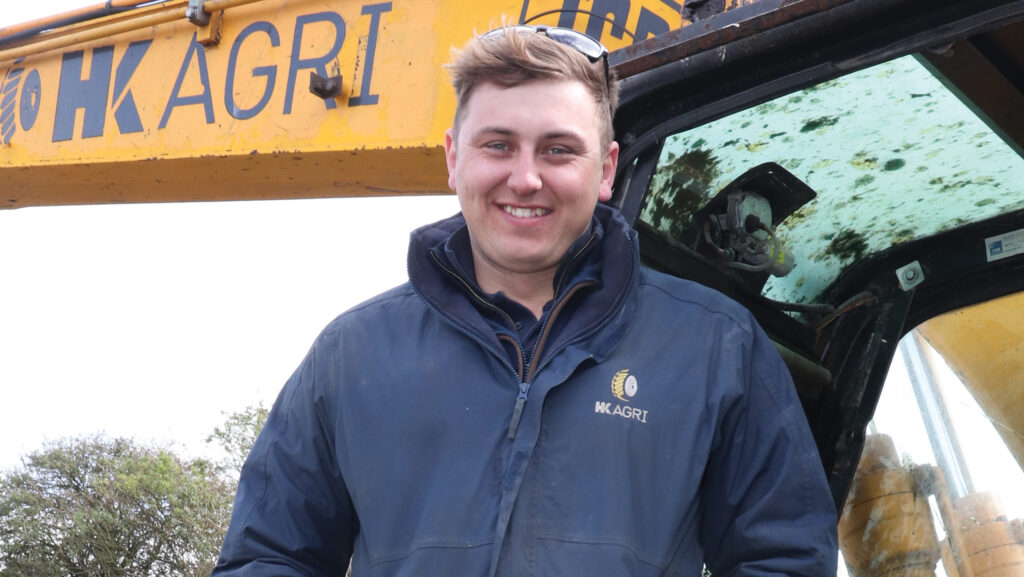
Harry Kennedy © Andrew Faulkner
When I arrived back from NZ in 2017, I started to fill out the UCAS forms to study agriculture at college, but got about halfway through the paperwork and thought… why?
I was already bored, so the prospect of another three years with my head in a book wasn’t appealing. I wanted to learn on the job. So that’s what I did.
Initially I took on my parents’ small-scale, small-bale hay equipment, quickly expanding into offering hay and general paddock maintenance to a growing customer base.
Business facts
- Main services Hay (600-700 bales), haylage (200 bales) and straw (9,000 bales), grass seeding, muckspreading, slurry spreading, and man plus tractor
- Other Groundworks and haulage
- Staff Harry Kennedy, plus one full-time (Rob Hutchison) and one part-time (Todd Kennedy). Up to six other staff taken on during busy periods
This work funded my first “proper” tractor, a 2007-plate MF 6480, and the subsequent move into more mainstream farming tasks, including a basic man plus tractor service.
Next purchase was the 2002 JCB JS130 13t digger for groundworks as well as muck loading jobs. And completing the business’s diversification, the Scania truck arrived in 2022.
Which, enterprise-wise, pretty much brings us up to today, even though there have been several other kit additions along the way.
From day one, my philosophy has stayed the same – to identify an opportunity and then spend as little as possible on the necessary used equipment to get a foot in the door, without compromising on the quality of service we provide.
I’ll only upgrade the kit once I’ve secured the work to justify the investment. That’s the theory, at least.
How brand loyal are you?
For tractors, I’ll probably stick with John Deere and JCB.
I like the products, they hold their money reasonably well and, for the most part, these brands haven’t let me down. Also, we’ve got used to working on them.
As a small example, a hub bearing on our previous 3185 Fastrac front axle went in the field in 2021, but we were able to jack it up and change the bearing and brake disc ourselves without losing too much time and at minimal cost.
Favourite dealer?
As mentioned, we’re looking to minimise costs so use £100-£120/hour main dealer workshops as little as possible.
My one full-time member of staff, Rob Hutchison, is good on maintenance and repairs, while brother Todd is a qualified ag engineer. Add in my father, and we’re capable of most jobs.
For parts and back-up when we need it, Hunt Forest is excellent, as are Crawfords, JH Milnes and Big Bale Company.
Favourite piece of kit?
Fingers crossed, it’s going to be the 2019 John Deere L1534 six-string baler that we’ve got coming for this harvest.
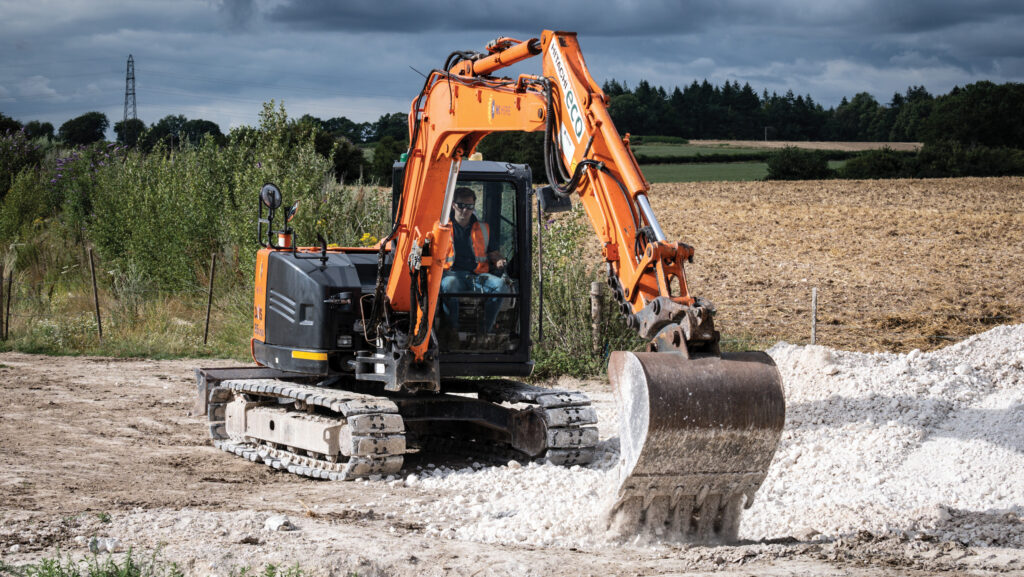
The eight-year-old Hitachi ZX85 USB © Rebecca Sutcliffe
For now, though, I’ll go with our 8.5t Hitachi ZX85 USB digger. It’s a handy size, comfortable to operate despite its small cab, and has been pretty reliable since it arrived here in 2024.
We paid £27,000 for it from Dorset dealer RJ and KD MacLean as a six-year-old with 2,900 hours. In the 800 hours clocked with us, we’ve replaced the fan belt, and that’s it.
And your least favourite?
It’s probably the 18-year-old Scania truck. In hindsight, I should have waited and bought something a bit newer, but I was keen to get into haulage and got stung as a result.
We’ve spent a lot of money on it (see “punchiest repair bill”) and, even so, it’s still showing its age. Every six- or eight-week inspection at Botley Commercials, something needs doing.
I’m currently investigating extra haulage work. When this comes in, I’ll upgrade to a more comfortable and reliable tag-axle unit.
Latest purchase?
The aforementioned 19,000-bale Deere six-stringer that will be coming from Claas Western to cope with the additional 6,000 straw bales we’ll be making this harvest.
I’m told the L1534 is a solid, “plodding” baler. Which is fine. I’d have liked another MF, but for the same age and bale count we’d have had to pay another £25,000 to £30,000 on top of the Deere’s price of £42,000.
Oldest machine still at work?
Based on age rather than hours, it’s the 24-year-old JCB JS130, which was bought for £9,000 as a non-runner off Facebook Marketplace in 2019.
After a bit of investigation, all it needed was a new set of injectors – £500 plus our labour – and since then it’s just had the odd hydraulic hose. It’s parked outside but starts on the button every time, without fail.
How long do you keep your kit?
No hard-and-fast rule. It’s either when we take on some extra work, or a particular machine becomes problematic. A typical example of the latter would be the original MF 6480 (see “worst tractor”).
Next on your wish list?
A JCB TM320 pivot-steer telehandler would be handy for straw shifting in the summer, and it would also be well suited to the smaller muck jobs where it’s tricky to justify hauling in the 13t digger. Clamp work is a possibility, too.
I’m on the lookout for a 2019-20 TM with about 8,000 hours. The budget is up to £40,000.
Most embarrassing mistake?
When working a harvest job for another contractor, before setting up HK Agri, I turned too tight with a 20t grain trailer and put it in a ditch.
Luckily the trailer stayed upright, but I still had to shovel about 10t before we could pull it out.
The worst thing for the rest of the harvest team was that the boss had bought Domino’s pizzas for us on the night in question, and, solely down to my mishap, these were cold by the time we got to them. I wasn’t popular.
Punchiest repair bill?
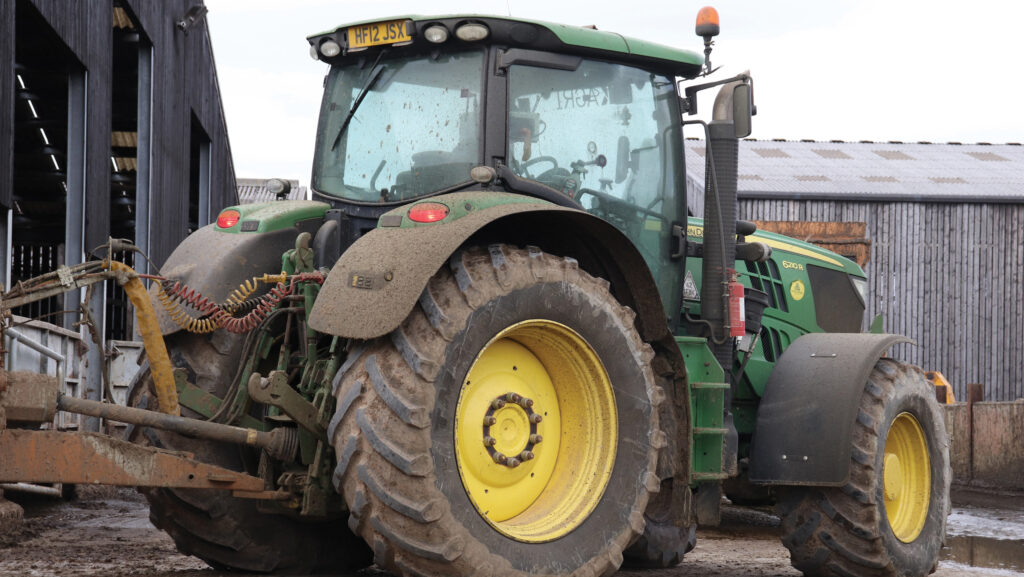
This 14-year-old John Deere 6120R has clocked 15,005 hours © Andrew Faulkner
This would have been an £11,500 invoice to sort a turbo fault on the 6210R, soon after it arrived from Hunts back in 2020.
The fault proved a nightmare for Hunts’ workshop to diagnose, and we ended up with a new turbo, wiring harness and ECU, along with an £8,500 labour bill.
Tim Hunt has a longstanding reputation for helping young people entering the industry, and this certainly proved to be the case for us.
Under no obligation, he agreed to waive the labour charge if we settled the parts element, making a huge difference to our business.
Hunts were fantastic for us back then, and I’ve been a big fan ever since.
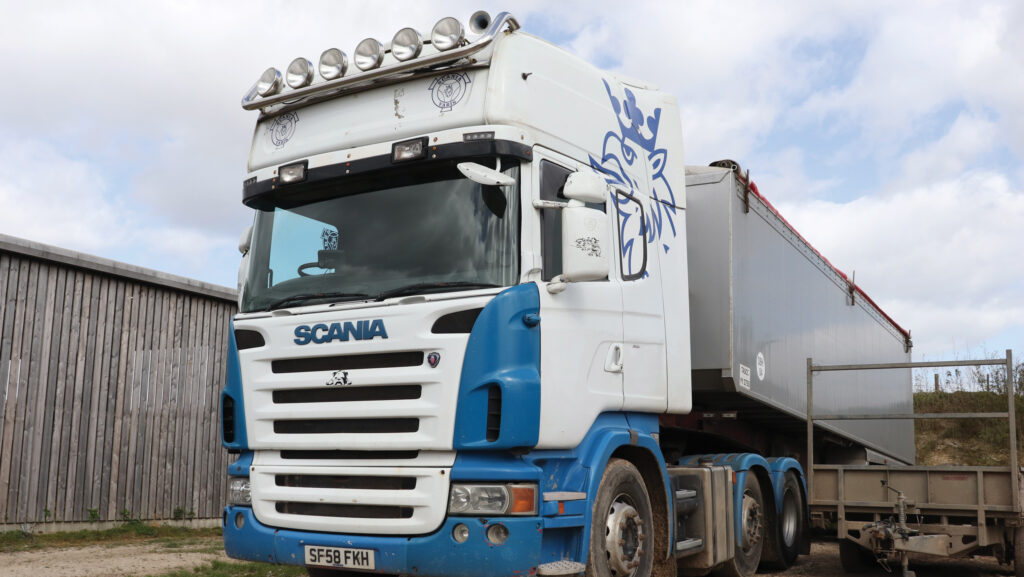
HK’s Scania R480 switches between hauling grain, stone, straw and plant © Andrew Faulkner
Ultimately much worse was the Scania’s engine failure on the M4. Rescued back to base, we replaced the block, piston rings and liners and had to have the head skimmed and valves reseated.
Some of the replacement valves were too thin with hairline cracks, so they lasted no time at all. Head off again. The final bill was well over £10,000, excluding our labour.
Most expensive spare part?
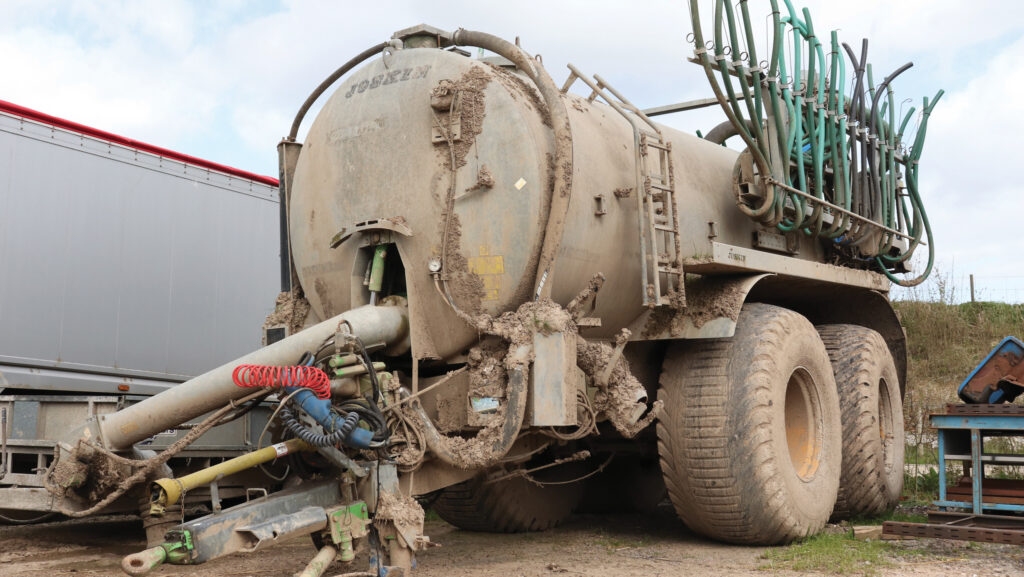
The 14,000-litre Joskin tanker discharges its load through a 12m dribble bar © Andrew Faulkner
The 10 macerator blades on the 14,000-litre Joskin slurry tanker are only relatively small discs, yet they’re priced at £1,200 for the set plus £200 for the nuts and bolts. That’s painfully expensive, even if it is hardened steel.
Dairy farms around here mainly bed their cows on machine-unfriendly sand, so we tend to wear out one or two sets of blades per season. Not ideal.
Best invention?
We’re fixers rather than inventors, though Dad has knocked up a couple of novel solutions to get us out of a hole – a potentiometer bracket for the 13t digger that allowed us to fit a non-genuine potentiometer (£50) rather than the JCB original (£450), a new seal for the self-loading arm on the Joskin slurry tanker… and so the list goes on.
What couldn’t you live without in the workshop?
Dad. That’s the short answer. He’s the first person we call if we’re scratching our heads, and he invariably comes up with a fix.
On the tools front, I love the MIG welder – or “hot metal glue gun”, as we tend to call it. We can patch up most things with it.
Favourite and least favourite jobs?
Favourite is baling when it’s going well; least favourite is baling when it’s going badly – inexplicably dropping strings, for example.
A particular dislike is having to crawl under the low-slung, twin-axle MF four-stringer to re-twine it on a hot, dusty day.
Another grim job is fishing unsavoury items – cow hoof blocks and worse – out of the macerator when slurry tanking.
What’s your everyday transport?
Current daily transport is an 18-plate Amarok double-cab that I picked up from VW Basingstoke for £23,000 about 18 months ago. At the time it had 42,000 miles on the clock, and I’ve added another 26,000.
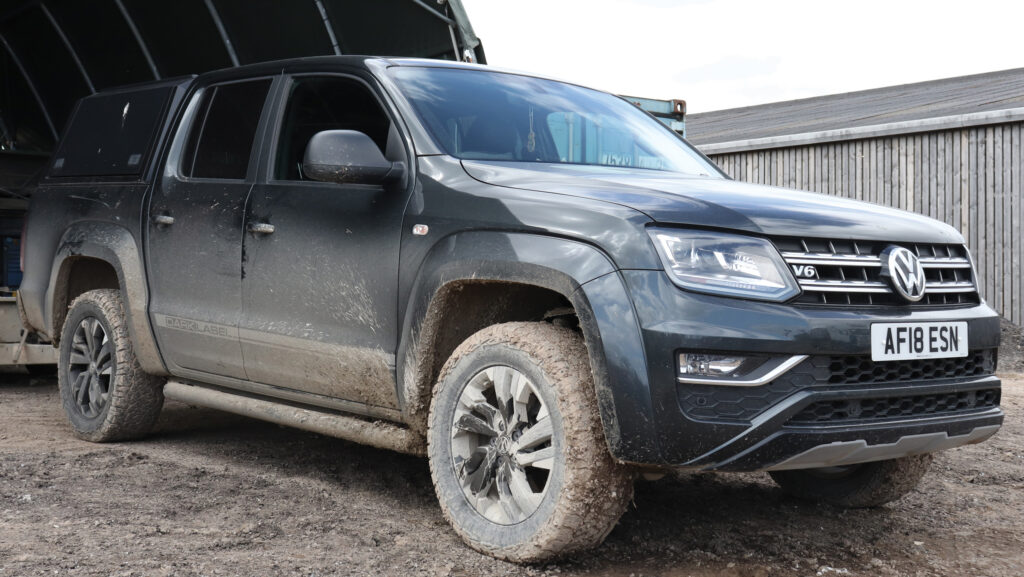
Harry Kennedy’s daily drive is a 68,000-mile, eight-year-old VW Amarok © Andrew Faulkner
What made the Amarok especially attractive was its £3,000 Smartcap canopy, which was included in the overall price. I’ve since added a second set of drawers and a dog cage, bought off Facebook Marketplace.
Best tractor you’ve had?
It’s probably the current JD 6210R, which, despite its unfortunate start with us, has only suffered the odd sensor issue in the past 7,000 hours.
We bought the 2012-plate tractor from Hunts in 2020 with 8,100 hours for £48,000, and it’s now on 15,005 hours.
Rob likes driving it, and I’m only thinking of changing it as I’m getting nervous about the AutoPowr transmission. They say it’ll do 20,000 hours plus, but I’m not convinced.
In fact, we like the 6210R so much that we’re currently considering its newer equivalent – an 18-plate 6215R in RJ & KD McLean’s yard at £50,000. They’re quoting £20,000 to change, which is tempting.
And the worst?
That was my first tractor, a Massey 6480. We only had it for 18 months before trading it for the 6210R. In that time it had a new main driveshaft and the brakes went, costing us about £5,000.
We actually sold it for £22,000, which was £4,000 more than we paid for it. However, that’s only because it went with an almost new MX front loader.
Biggest bargain?
It’s the same as our oldest machine, the JCB JS130. We paid £9,000 for it six years ago as a non-runner, and it’s still probably worth around £8,000.
But its not the comfiest digger to use. Everything’s getting a little tired, and there’s no air con.
I have to keep the windows shut to avoid being splattered in muck, so its a bit of a hot box in summer, despite the hefty investment in a 12V fan from Argos.
Best and worst pieces of technology?
No surprises on the best. It’s GPS, though I also love the info-packed flow meter system on the Mastek umbilical setup. The isobus facility on the new Deere baler should be good, too.
Worst? That’s my iPhone. I’m convinced Apple build quality is heading the wrong way. I’ve only had the current phone for 18 months, its EE coverage is dire and the battery is already knackered.
Kit list
- Tractors JCB Fastrac 4220 (2017) and John Deere 6210R (2012) with MX U414 front loader
- Excavators 13t JCB JS130, 8.5t Hitachi ZX85 USB and Hitachi ZX17U
- Balers John Deere L1534 six-string (120x90cm), MF 187 six-string (80x90cm), MF 185 four-string (80x90cm), Welger AP 630 conventional
- Muck and slurry 14,000-litre Joskin Komfort tanker with 12m dribble bar, Mastek umbilical system with 12m boom and 1,600m of pipe
- Other 2.5m Browns harrow with Stocks seeder, flat roller, 3m Kuhn VKM280 topper, five-furrow Dowdeswell plough and JPM 19 TLL low-loader
- Haulage Scania R480 mid-lift 6×2 tractor unit with bulker and plant trailers