What’s in Your Shed? visits a Surrey straw and forage contractor
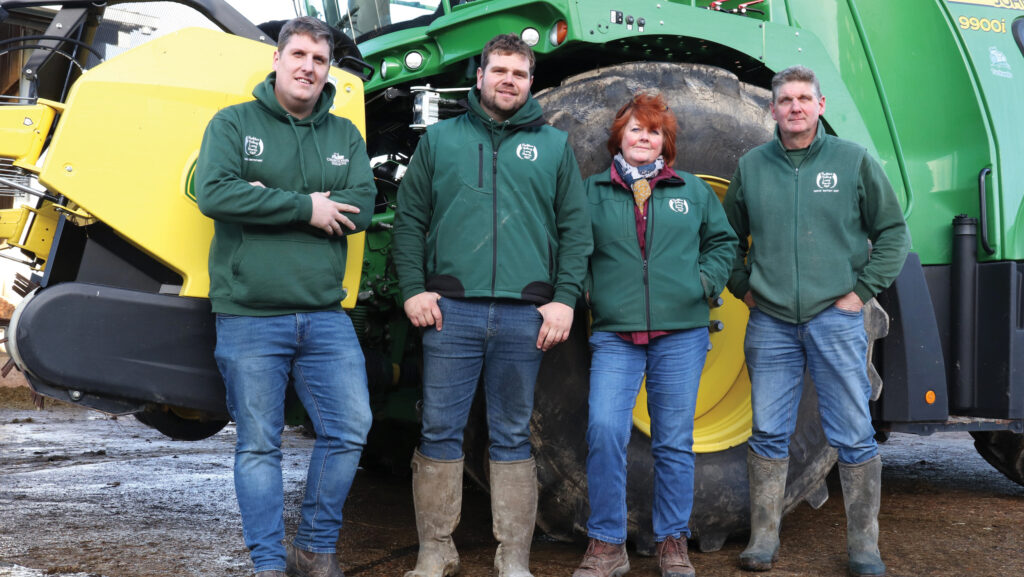 Right to left: Nick Fuller, partner Babs, Ollie, Nick's son and Miles, Nick's son-in-law – the Church Farm Services management team © Andrew Faulkner
 Straw and forage contractor Church Farm Services operates both within and beyond the M25 ring.
Farmers Weekly ambles around the Surrey-based firm’s machinery sheds, guided by proprietor Nick Fuller, son Ollie and son-in-law Miles.
See also: John Deere tops 1,000hp with flagship F9 forage harvester
Business facts
- Farm size: 658ha tenanted, 22ha (owned)
- Cropping: 60ha maize, 60ha lucerne and 25ha of cover crop. Remainder in grass
- Stock: 280 English Longhorn cattle and 30 Wiltshire Horn sheep
- Staff: Nick Fuller, Babs Kingsley-Monks, Ollie Fuller, Miles Brown and four full-time operators; three employed in livery yards
- Contracting: Silaging (1,600ha grass, 1,200ha maize and 120-160ha wholecrop), baling (20,000 straw bales, 15,000 hay/haylage and lucerne bales), grass seeding, muckspreading and slurry tanking
- Other enterprises: Three full, assisted and DIY livery yards along with a horse manure collection service
How did you get started?
Nick: My family have been farming around the Halliloo Valley since 1896, so, in reality, I was only ever going to go farming, or something close to it.
Originally, we were tenants but went on to buy a 50ha dairy farm. Then in the 1950s we took on more local tenanted land.
The dairy farm was subsequently sold in the 1980s, the cows going and the ground becoming Woldingham Golf Club.
The remaining arable land was put into set-aside, and my focus switched to building up a fencing enterprise.
I returned to the family farm full-time in 2003. Since then we’ve grown the business to about 680ha, owning 22ha and the remainder on tenancies, some as small as 5ha. Most of the ground is under grass.
© Church Farm Services
We’re based within the M25 on the edge of London, so many of our 18 landlords have a large house with 5-10ha around it that they need taken care of.
This land is predominantly free-draining chalky loam on rolling and often steep hills, particularly suited to the out-wintering of our English Longhorn cattle.
We started with just a couple of cows in 2009, and the Halliloo Valley herd now numbers 280.
Horses also play a big part in the business. My partner, Babs, runs our three livery yards, and we supply straw, hay and haylage to these and other equine customers.
On top of that, we have a horse manure clearing business, where we collect the barely soiled straw from livery yards and bring it back to the home farm.
We then reuse it as low-cost bedding for the cattle, which, in the process, increases its nutrient value to us as a fertiliser.
© Church Farm Services
Ollie: I came back home in 2013 after studying at Plumpton College and working in New Zealand. That was when we really started to grow the contracting business.
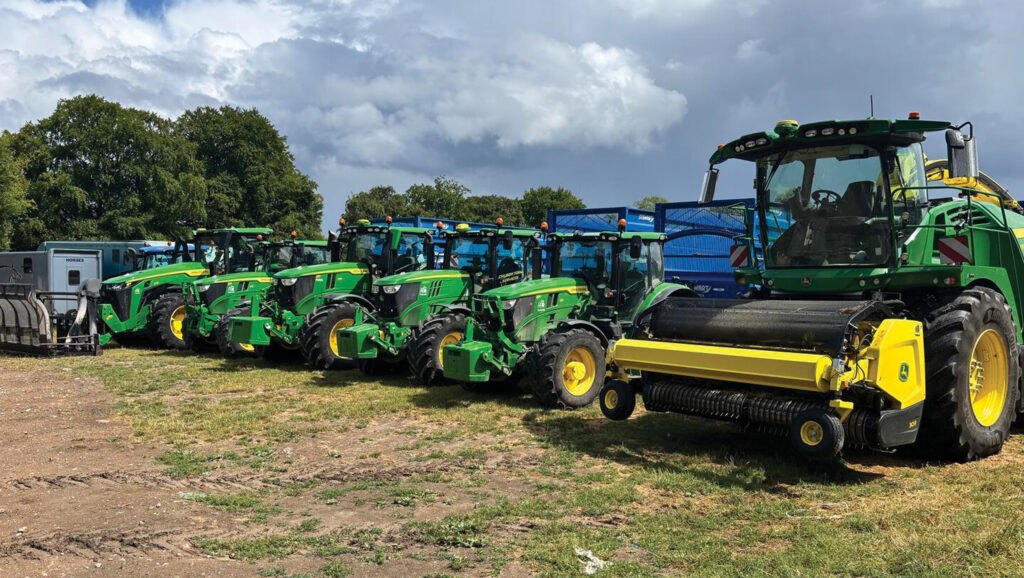
The big change was in 2016 when we bought our first self-propelled forager, a five-year-old John Deere 7450i, complete with an eight-row Kemper maize header.
An opportunity had cropped up following the retirement of a foraging contractor at nearby Turners Hill, so, despite the scary £100,000 investment, we went for it.
And that’s been our philosophy ever since. If we see a chance that stacks up, we go for it.
As a result, the foraging business has steadily increased to 1,600ha of grass and 1,200ha of maize for dairy/beef farmers and anaerobic digestion (AD) plants across the South East, while the baling operation has enjoyed a similar rate of growth over the same period.
How brand loyal are you?
Ollie: On the main items of foragers, tractors, handlers and balers, we’ve pretty much stuck exclusively to John Deere, JCB and Krone.
We like the product, we know the product, so why change?
Favourite dealer?
Nick: No surprises with our top dealers, as they’re the suppliers of our three main brands – Tuckwells for Deere (Framfield or Stockbury depots) and Haynes for JCB and Krone (Horsham or Uckfield).
Both are excellent for service and back-up. Which is just as well, because some of the Deere stuff, in particular, hasn’t been problem-free. More on that later.
Favourite piece of kit?
Ollie: It’s a toss-up between the forager and the Krone balers. The 970hp 9900i is just a joy to operate, supremely comfortable, and it does a top job of chopping.
Clearing 60ha of maize in a day is hugely satisfying, and it never ceases to amaze how it manages to feed 300t/hour of material through a 2mm corn cracker.
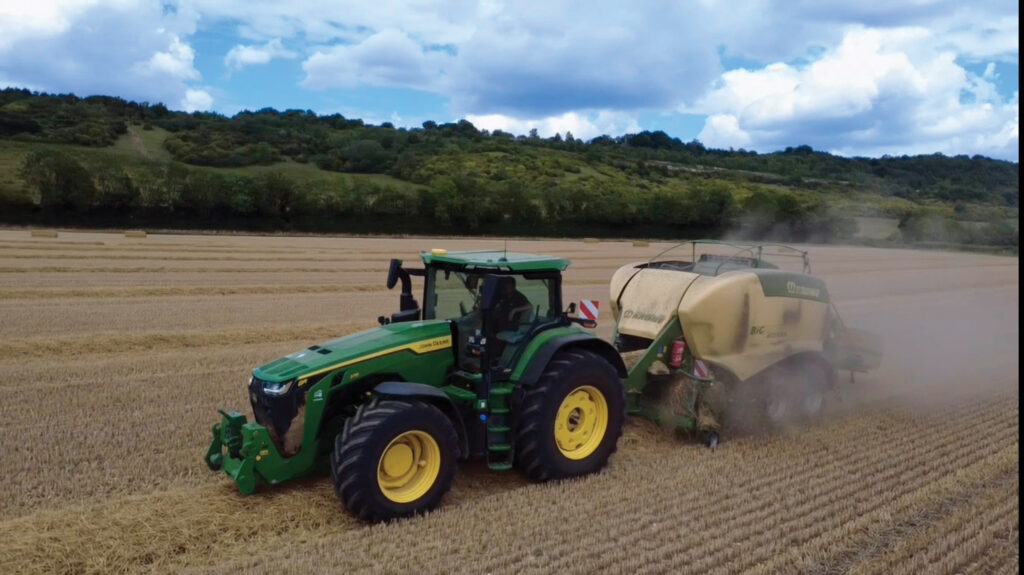
The Krone BigPack 1290 HDP eight-string big baler has been a similar game-changer, enabling us to bale up to 30% more straw in a day than the six-stringer.
Again, it’s great to use and, for the most part, doesn’t go wrong.
And your least favourite?
Ollie: Our old Dowdeswell six-furrow mounted plough heads up my “least favourite” list. Whatever I try – and I’ve tried most things – I can’t get it to match up.
In contrast, the seven-furrow Kverneland on-land/in-furrow LO85 is much easier to set up and does a better job. Using it on-land with auto steering is a neat feature, too.
Latest purchase?
Ollie: We’ve got two new JD 6R 215s on order for this year to replace a 22-plate 6195R and 23-plate 6R 155.
Both the outgoing models are AutoQuad semi-powershifts, whereas the new ones will be AutoPowr CVTs.
Main reason for the power upgrade is that the current 6R 155 struggles with the Transtacker bale chaser: it’s fine on the flat but quickly runs out of steam on our slopes, some of which are challenging.
Other jobs for the 215s will be tanking, mowing, raking, trailer work and also occasionally baling with the six-string 1290.
Oldest machine still at work?
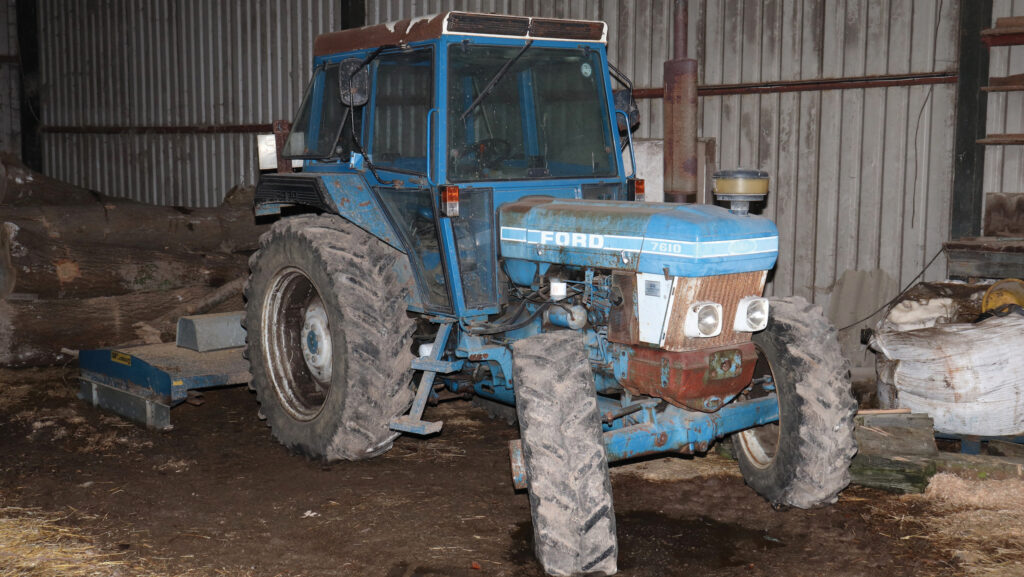
Nick: In what the others consider a moment of madness, I paid £11,000 for a 1983, 5,000-hour Ford 7610 a couple of years ago.
© Andrew Faulkner
Despite being more than 40 years old, it’s still in reasonable condition and will be even better when I get the chance to sort it.
Having grown up around Fords, I’ve long hankered after owning another 7810 or 7610. So, it’s an itch scratched.
Ultimately, the plan is to use the 7610 for topping and some bale wrapping. That’s my justification anyway.
How long do you keep your machines?
Ollie: We’ll try to move on tractors, the forager and handlers before their warranty expires, because we’ve been caught out in the past.
The new 6R 215s, for example, have been bought with 7,500-hour/five-year warranty packages.
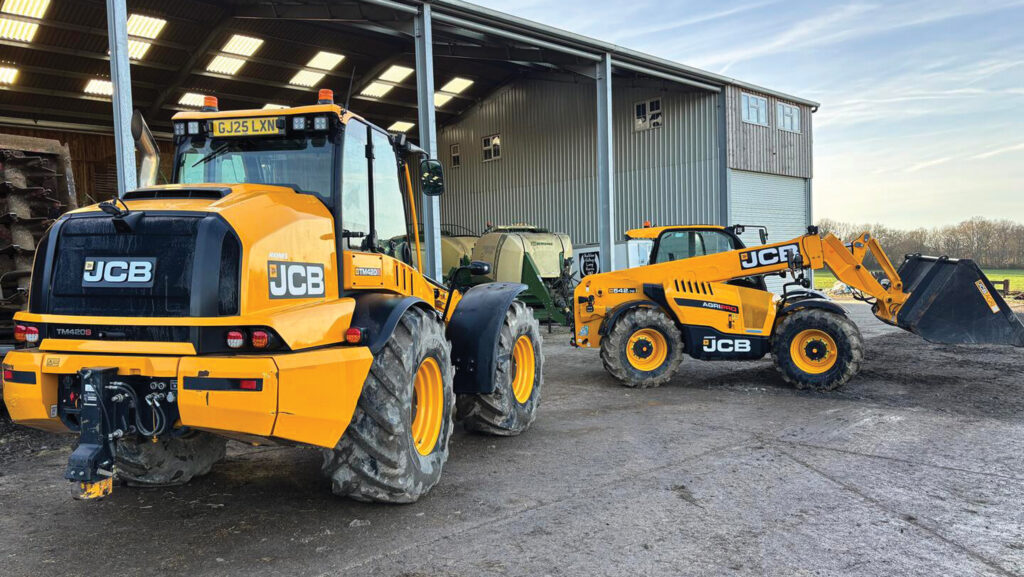
The JCB handlers are warrantied for 5,000 hours and changed after three years, whereas we’ve arguably taken a riskier approach with the balers and just gone with the standard 12 months.
The Krone extended warranty looked expensive and, more importantly, a long list of items wasn’t covered.
© Church Farm Services
On the forager, we’ve adopted a different approach again. Similar to Krone, extending the standard warranty would have been pricey, at about £10,000/year.
We couldn’t justify the cost, so instead went with Deere’s Dura Line wearing part option – a selection of higher wear resistant components – covering the bits from the drum right through the machine to the end of the spout.
This is guaranteed for five years or 3,000 engine hours. The forager is, in effect, one big wearing part.
We plan to run the current machine for no more than five years, so, fingers crossed, the expensive driveline bits should hold together until then.
Next on your wish list?
Ollie: Boring, perhaps, but we’d like a 6m flat roll. With the cattle outwintered, rolling the grassland in the spring to remove any poaching is an important operation.
Most embarrassing mistake?
Ollie: By some margin, for me it was touching an overhead power line in 2022 with the forager spout when opening up a customer’s maize field.
The power line broke, glanced the following tractor/trailer on the way down and was left sparking on the ground.
The farmer phoned the electricity provider which, to be fair, switched off the power very quickly, removing any immediate danger. It was extremely scary.
The local residents weren’t too happy either, as you can imagine, and we had to put in an insurance claim to cover the resulting bill.
Still, nobody was injured… or worse. Even the forager escaped with just a new spout flap motor and an ECU. It was a massive lesson learnt, though.
Biggest repair bill?
Ollie: Our first step into big tractors wasn’t a happy one. Back in 2019 we bought a five-year-old/5,000-hour 8360R through Tuckwells with no warranty. Never again.
It had been on PowerGard up till we bought it, so we thought we’d be safe. Big mistake.
The tractor was fine for the first year, but in the second year it had to be dragged off the silage clamp for a £10,000-£12,000 transmission rebuild.
Worse still, the engine also had to be rebuilt a couple of months later, down to faulty piston liners. Another £10,000-£12,000 bill.
Most overpriced spare part?
Ollie: Everything on the forager costs a fortune, which is why we went for the Dura Line warranty mentioned earlier.
About £4,000 for a shear bar seems excessive, and even the grinding stones – we’ll get through four of these in a season – are £150 a pop.
Nick: I have a real issue with replacement pto guards, which are criminally expensive.
Some are £500-£600 for a piece of plastic, albeit a very important piece of plastic. That’s an exorbitant price. Manufacturers, in my view, are taking the mick.
Best invention?
Nick: Though no longer in use, the stand-out item was a home-built, trailer-mounted bale wrapper for towing behind a conventional baler when making small bale haylage.
It worked well enough but was slow… and then big bale haylage came along.
What couldn’t you live without in the workshop?
Nick: We’ve got two Kemppi mig welders, as we’re constantly making stuff.
Our family has always been that way inclined, dating back to my father, whose mantra was, “if we can’t afford to buy one, I’ll build one”.
He’d always wanted to own a Unimog, so, after receiving the customary negative from his father, he ended up converting a two-wheel drive lorry to four-wheel-drive for hauling trailers.
His last conversion was also capable of taking a sprayer. Thinking back, much of my childhood was spent on the set of Scrapheap Challenge – or its equivalent at the time.
Favourite and least favourite jobs?
Nick: I love buckraking. It’s immensely satisfying, squeezing the maximum amount of material into a properly compacted clamp with neatly shaped sides and shoulders.
We use a 3m buck rake on the front of the 8R 370 with a 4.4t compactor roller on the back, as we reckon this is more efficient than a wheeled loader.
We can still shove up an 18t load with three pushes, but you move up and down the clamp much faster.
What’s your everyday farm transport?
Ollie: I’m in a 2023 Toyota Hilux double-cab, bought new for ULEZ reasons.
One of our farms is in the low emissions zone, and I got fed up with having to pay £12.50 for every visit.
© Andrew Faulkner
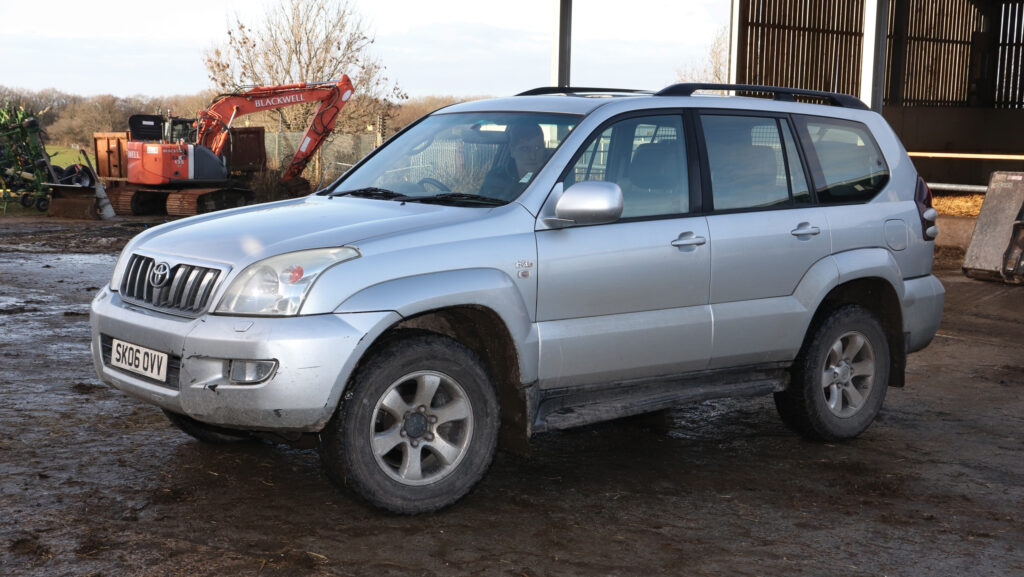
Nick: I recently “upgraded” from a 14-year-old Hilux to an even older Land Cruiser Colorado seven-seater. We paid £2,500 for it, with 200,000 miles on the clock.
The seven seats come in handy for ferrying the silage gang around, and the vehicle was very tidy for its age… until its offside rear had an argument with a straining post.
Best tractor you’ve had?
Ollie: I was particularly fond of our first AutoPowr tractor, a 6215R, which we bought new in 2018 and sold in 2021.
It was so much nicer to drive than the previous DirectDrive semi-powershift 6210R.
We never got on with DirectDrive, which was jerky when cold and also had a nasty habit of refusing to downshift and then stalling.
And the worst?
Ollie: Most memorable “Friday afternoon” tractor was a 7R 350, bought new in 2023 and, thankfully, with us for less than 12 months. Tuckwells even had a wiring issue with it when carrying out the PDI.
Post delivery, the tale of woe continued. The plug on the back of the engine came out; the rear linkage’s top knuckles would catch on the mudguard plastic; the turbo and hydraulic back-up pump both went within a month; two front diffs failed, this time within weeks.
And it goes on. The engine would cut out and be reluctant to restart, the air con packed up and there was a problem with the seat.
The warranty cost for Deere must have been eye watering. What isn’t accounted for, however, is the downtime cost, which was horrendous.
To be fair, Deere supplied a stand-in tractor, and they also came up with a cracking deal for its replacement, the current 8R 370, which we love.
Biggest bargain?
© Andrew Faulkner
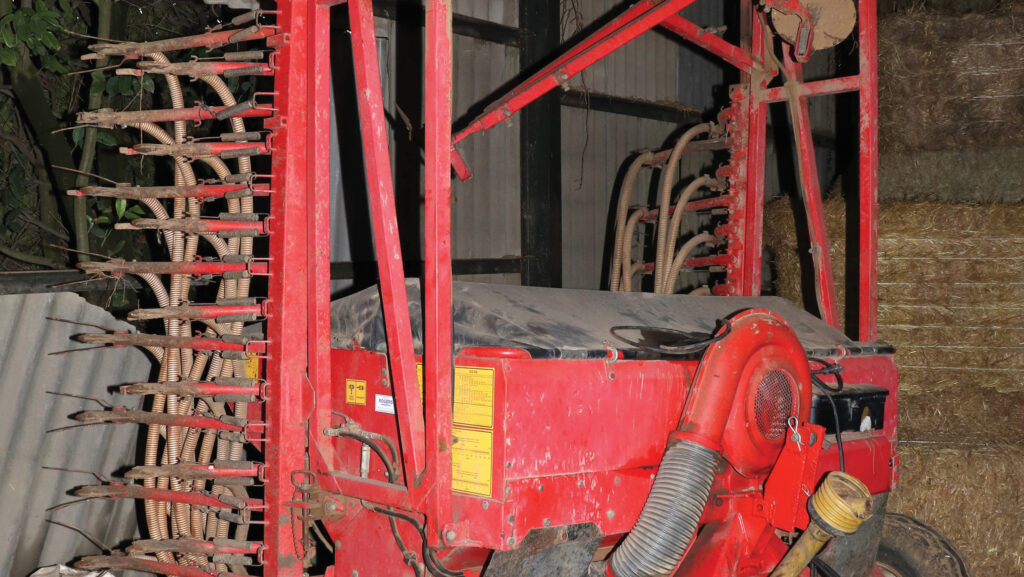
Nick: We spent £1,500 on an ageing 6m Massey Ferguson 510 mounted seed drill, spotted on Facebook Marketplace, and it has already paid for itself many times over.
The 510s struggle to establish cereals evenly at depth, but for our main purpose, reseeding grass, they’re excellent.
Best and worst technology?
Ollie: Both our farming and AD customers are big fans of the forager’s HarvestLab sensor for recording yield and quality information, to the extent it can be a key attraction when tendering for work.
We’ve even got customers who base their future cropping decisions on the data we provide.
Worst? For us, isobus is a love/hate thing. When it works, it’s great. But often the tractors take an age to identify an implement; sometimes they don’t find it at all. The system just needs to be more reliable.
Kit list
- Tractors: John Deere 8R370, 6195R, 6R 155 x2, New Holland T7.225 (hired) and 1983 Ford 7610
- Forager: John Deere 9900i with 30R grass pick-up, 12-row Kemper maize and 6m Domai wholecrop headers
- Handlers: JCB 542-70 and TM420S
- Balers: Krone Big Pack 890XC four-string, 1290HDP six-string and 1290HDP eight-string
- Grass kit: 9.5m JD butterfly mower (F310 front/R950R rear), Krone Swadro TC1370 four-rotor rake, TC 930 two-rotor rake, Krone Vendro 820 tedder x2, McHale 998 bale wrapper and Spearhead topper
- Drill: 6m Massey Ferguson 510
- Other kit: Bailey flat-bed trailers x5, Stewart 18t GX18-23 silage trailers x4, NC 314 dump trailer, Slurry Kat 4500G slurry tanker with boom, Ktwo Evo 1600 rear-discharge muckspreader, Transtacker 4100 bale chaser and Protech P400 Pro post driver