

Sea eagle funding uncertainty threatens lambing, NFUS warns
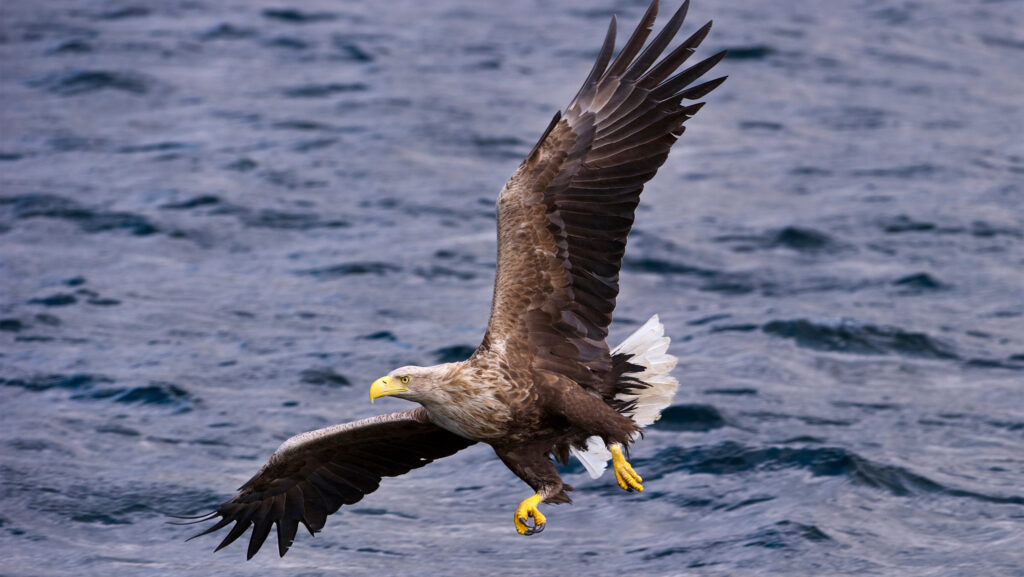 © Adobe Stock
 NFU Scotland has warned hill farmers and crofters cannot plan for the coming lambing season unless the Scottish government urgently commits to future funding for the Sea Eagle Management Scheme.
With hill tups already out in the fields, the union says uncertainty over funding is undermining animal welfare, business planning and the viability of fragile upland communities.
Speaking at an NFU Scotland (NFUS) press briefing in Edinburgh this week, vice-president Duncan Macalister said clarity was needed now.
See also: More support for Scottish farms affected by sea eagle predation
“You cannot get shepherds and extra resources just at the drop of a hat. We need certainty over this,” he said.
NFUS said concerns had been reinforced during a recent meeting in Argyll, where the union heard directly from farmers, crofters and NatureScot officers working on the sea eagle scheme.
Early confirmation essential
All stressed that early confirmation of funding was essential to allow businesses to prepare.
Last year’s late decision-making caused cashflow and operational problems for many farms involved in the scheme, NFUS said.
A repeat in 2026 would put lambing and grazing plans at risk, delay investment and staffing decisions, weaken farmers’ confidence in trying to coexist with conflict species, and damage the credibility of government-led mitigation schemes.
Mr Macalister said sea eagle predation on lambs is escalating. “This is a man-made problem – these birds were introduced by our government and are getting worse,” he added.
He also warned of the human toll, saying: “The mental impact on hill farmers tending flocks under constant predation is massive.”
Mr Macalister described the current funding levels to NatureScot of about £1.5m for the Sea Eagle Management Scheme (Sems) as a “tiny amount for an ever-increasing problem”.
Grazing geese
Separately, NFUS warned that rising geese populations are causing severe agricultural damage in parts of Scotland, particularly where large numbers of protected birds gather on productive land.
NFUS policy director Jonnie Hall said the issue was driven by intense local concentrations.
“When you have got 40,000-plus Barnacle geese and other species… landing on a productive island like Islay, with reseeded grass and barley crops and all the rest of it, that has a significant agricultural impact.”
He said funding had fallen while populations continued to rise. “About 10 or 15 years ago, that funding became static and then started to decline. But the population of Barnacle geese continued to increase… We need intervention.”
Government response
The Scottish government told Farmers Weekly it remains committed to working with farmers and crofters to achieve effective management of lambing affected by sea eagles.
Agriculture minister Jim Fairlie said decisions on funding will be announced as part of the Scottish Budget on 13 January.