

FW Survey 2025: A year of improvement – for some farms
 © Gary Naylor Photography
 Given the lack of confidence pervading agriculture right now, it is perhaps surprising to see that more businesses have enjoyed a relatively prosperous 2025 than in the preceding 12 months.
That at least is the evidence of our latest annual Sentiment Survey which asks “how has the year been for your farming business”, with 23% of respondents saying it has been “good” or “great”, compared with just 13% who gave those answers in 2024.
It’s still a very long way from 2022, when just over half of all respondents were so upbeat in the wake of the commodity spike triggered by the Russia-Ukraine war, but at least things are looking up – for some.
See also: FW Survey 2024: Politics and weather weigh heavy on the sector
And it is that expression “for some” that is really telling, as drilling down into the data from the near-800 respondents (another record), the livestock-arable divide quickly becomes apparent.
Beef and sheep producers, for example, have had a much better 2025, with 34% and 32% respectively saying they have had a “good” or “great” year.
That is not surprising given the buoyant prices seen for much of the year, with deadweight cattle prices consistently eclipsing 2024 levels, peaking at 713p/kg deadweight for R4L carcasses in May.
The decline in cattle numbers, both domestically and internationally, has clearly benefited stock values and margins.
Sheep producers have also been more positive about 2025, with a decent lambing season combining with another year of solid prices, especially in the second half, when deadweight values topped year-ago levels comfortably.
Pig and poultry farmers also performed well, with 39% and 32% respectively reporting a “good” or “great” year.
Even though pig values have tracked below year ago levels – falling away quite sharply towards the end of 2025 – lower feed and medicine costs have compensated.
Arable gloom
Compare and contrast all that with the arable sector. According to our survey, just 18% of those who grow cereals and 15% of those who grow oilseed rape say they have had a “good” or “great” year.
In stark contrast, 45% and 46% respectively described 2025 as “bad” or “terrible” – not surprising given that feed wheat prices seem to have been stuck at about £165/t for most of year, while milling wheat and malting barley premiums have more than halved.
Combined with rising input costs – and the latest agri-inflation figures from the AF Group show that fertiliser costs climbed by more than 10% and contract/hire costs for machinery by 6% in the year to 30 September – the squeeze on combinable crop margins has been relentless.
And that’s before factoring in the loss of direct payments and the stop-start nature of agri-environment schemes.
It’s an even gloomier picture for root crops, where 45% of potato growers and 56% of sugar beet growers said 2025 had been “bad” or “terrible”.
Spud growers have had a torrid time: despite fewer plantings this year, a bumper crop across Europe has flooded the market and depressed prices.
Combined with a 5% increase in average growing costs and some quality concerns, it is not surprising to find potato growers down in the dumps.
The same can be said of sugar beet growers, who endured a £7/t price drop to £33/t for the current crop, with a further £3/t coming off for 2026.
The AF Group says sugar beet cost 4% more to produce in 2025 “putting pressure on the viability of beet production for some growers”.
Dairy still upbeat
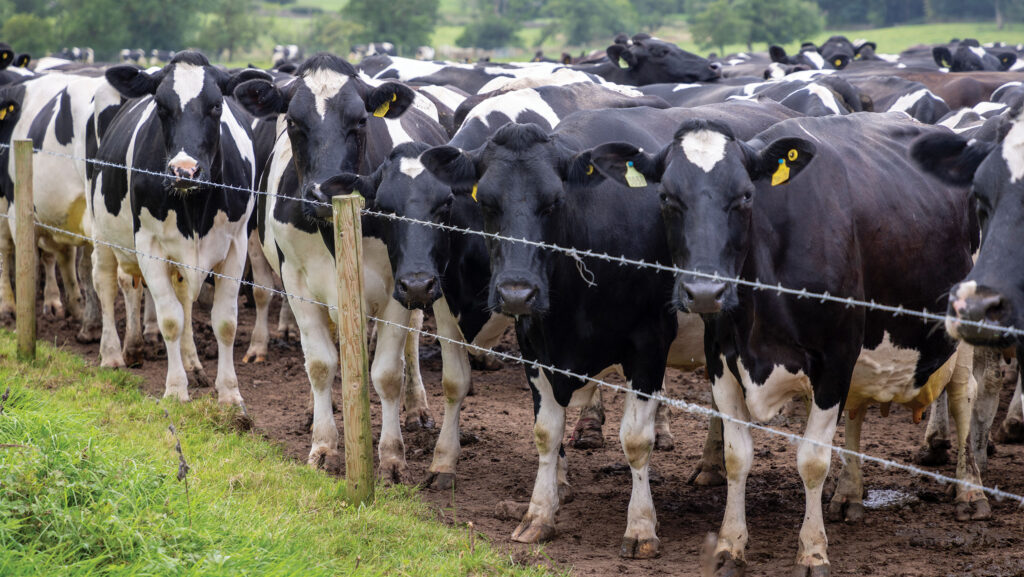
And then there is dairy, where milk producers have actually remained quite buoyant, despite the recent slide in their ex-farm prices.
According to our survey, 42% of dairy farmers reckoned to have had a “good” or “great” year in 2025, compared with just 23% who said it had been “bad” or “terrible”. (The other 34% said “so so”.)
Milk prices have been reasonable for much of the year – typically around the 45p/litre mark – and with output running 5% higher, returns have been strong and margins good.
The collapse in milk prices started in September in response to weaker commodity prices.
“With some farmgate prices falling below 40p/litre already and many more likely to fall towards 40p/litre by the year end, 2026 is looking very challenging unless the cost of production can be reduced,” says Nick Holt-Martyn of the Dairy Group.
Key challenges
While business performance has shown considerable variability over the past 12 months, there is near unanimity on what the greatest challenges have been.
Asked that question a year ago, 40% said “extreme weather” (not surprising given the storms and floods of 2024), with “government policy” ranked second with 20% of the vote.
Move the dial on 12 months and this year it’s level pegging, with 33% of respondents citing the weather and 33% more vexed by farm policy.
Clearly 2025 has been another year of extremes, with one of the warmest, driest springs on record, putting pressure on growing crops and affecting yields.
It had an even greater impact on grass growth, with a result that many livestock farmers had to cut into winter reserves before autumn had even started.
But “government policy” has become just as challenging.
This is not unexpected, as when we asked our readers 12 months ago what they thought would be the number one challenge in 2025, 52% of them predicted government policy.
(The chancellor’s decision to impose inheritance tax on farm businesses was very fresh in the mind at the time.)
The list of policy disappointments in 2025 for farmers in England is a long one and includes:
- Defra’s sudden closure of the Sustainable Farming Incentive scheme
- Almost complete removal of direct payments
- Continued citing of solar farms on productive farmland
- A US trade deal that decimated the UK bioethanol market
- Uncertainty over the future of Countryside Stewardship
- Appointment of new Defra ministers with even less experience than the last ones.
But there is little doubt that the lack of flexibility shown by the government on inheritance tax and its refusal to consult the industry overshadows all of these.
It is also notable that Welsh farmers were even more anxious about government policy than their counterparts in England and Scotland.
This is possibly a reflection of a new impact assessment that shows the Welsh government’s shift to the Sustainable Farming Scheme will be accompanied by a 5% drop in livestock numbers, a 4% cut to labour on farms, and a 16% fall in farm business income.
Of the other top concerns, cereal growers were more inclined to mention “market conditions for outputs” as a key challenge (17% saying this compared with 12% on average), while dairy farmers were more likely to identify “mental health”.
Inheritance tax – how are people preparing?
Given the anger sparked by chancellor Rachel Reeves’s decision to introduce inheritance tax on agricultural assets), we felt it opportune to find out more about how farmers have reacted.
The following is what you told us:
- I have started assessing my options, but have not yet made any concrete changes 33%
- I have changed my succession planning and will hand over assets to successors more quickly 17%
- I am unaffected as I don’t own land or business assets worth more than £1m 13%
- It is too late for me to take mitigating action due to my age and/or medical condition 12%
- It may be a problem, but I feel it is too soon to take any action 10%
- My succession planning is already sufficient to protect me 7%
- I have put in place other mitigation, such as life insurance, to reduce the impact 4%
- Tax bill will be quite small and spread out – my successors can pay it 3%
The survey found that those who are now actively assessing their options are more likely to include farmers who currently have no pension plan, suggesting the policy announcement has acted as a stimulus to get people thinking about succession.
Just over half of tenant farmers said they would be unaffected by IHT.
Investment on the wane as IHT fears loom
One of the oft reported impacts of the inheritance tax threat has been a reluctance from farmers to invest in their businesses – and this is borne out in our survey.
In aggregate terms, we found that the proportion who had invested, using either government funds, their own money, or borrowings, had slipped from 84% two years ago to just 66% in the past 12 months
The proportion not investing at all has more than doubled to 34%.
For those who have invested, machinery remains the main item – though industry figures suggest much of this is now second-hand kit.
Investment in buildings and livestock both dropped significantly in 2025, as did investment by cereal growers.
There was also a direct correlation between those who had chosen not to invest, and those who said it was too late for them to take mitigating action against IHT due to old age and/or a medical condition.
Sponsor’s comment

Virgin Money is delighted to back the FW Sentiment Survey which shines a light on the state of British farming.
Our agricultural managers provide advice for customers across the UK.
We have a heritage in supporting the sector and recognising the long-term nature of farming.